I’m not sure if I’ll ever have the same delighted confusion as I did in 2009 when my company, Six to Start, won SXSW’s Experimental award for We Tell Stories. The website for Penguin Books had launched the previous year, a showcase for its authors to tell stories in unusual, online-only ways, like Charles Cumming’s Google Maps-based The 21 Steps and Nicci French’s two-handed live-writing story Your Place and Mine.
We were ushered out of the main auditorium to do press interviews for just a few minutes when an official rushed over and practically pushed us back inside and onto the stage. I had no idea what was going on – we’d only entered the Experimental category. It was only after we asked what we’d won that we discovered we’d been awarded Best of Show.
This is the story of how We Tell Stories was made, reconstructed from emails and messages and working documents. A lot of it has been told in pieces elsewhere, but with the twentieth anniversary approaching, I wanted to memorialise it before the job gets too hard.
Even if you think little of those heady, Panglossian web 2.0 days, there are works like We Tell Stories that I’m still proud of, and that continue to be studied up to today. And if nothing else, it’s fascinating to think back on just how projects like this were built.
We Tell Stories is no longer online, but you can watch a regrettably low-res screencast and there’ll be screenshots and even some interactive bits later on…
2007 was when the iPhone launched. Twitter had only just spun out into its own company. I’d spent the last few years as Director of Play at Mind Candy. In practice, I was lead designer and producer of Perplex City, a multi-year ARG that, unusually, wasn’t just marketing for a movie or game, but featured hundreds of unique puzzles centred around an entirely original story written by Naomi Alderman.
It was thrilling to make. We designed dozens of sprawling websites, made puzzles that required thousands of people to work together to solve, ran live events in San Francisco and London with literal black helicopters, and sold millions of our puzzle cards – cards that were stupefyingly difficult to print due to us throwing every single possible special effect into a bag all at once: unique serial numbers, microdots, heat and light-sensitive ink, non-standard sizes and coatings. Everything that could go wrong did go wrong, but we found a way through each time.
It was also exhausting. I was 22 when we started making Perplex City and 25 when I left the company. Planning for a second season was well underway, with lots of puzzle cards already designed and printed, but there wasn’t enough money to develop my dream idea, Perplex City Stories, which would finally solve the problem of ARGs being too hard to play via what we’d now call a “fake OS” game, providing a web-based, mostly single-player ARGexperience that could help onboard players and keep track of their progress.
Six to Start was co-founded by Perplex City veterans – myself, my brother Dan Hon, and Lisa Long – who didn’t want to work on Mind Candy’s pivot to Moshi Monsters, an online game for kids. Perplex City had drawn outsized attention from broadcasters and marketers, and we felt confident we could make plenty of money making ARGs for hire: we even had a big contract from Channel 4 Education in the wings for what would eventually become Smokescreen (winner of SXSW’s Best Game in 2010).
But that project quickly became mired in development hell and we needed work – and money – fast. I also fancied the idea of making something more lightweight, that could be played far faster than a months-long ARG. And that’s where Penguin Books came in.
Penguin prided itself on its innovation, having revolutionised publishing in the 1930s with its cheap paperbacks sold at railway stations, recognisable by their clean design. This manifested in the 21st century with the “wiki-novel” A Million Penguins, and despite its mixed reception, the publisher was keen for more. Jeremy Ettinghausen, who ran digital initiatives at Penguin, had heard about Perplex City and was eager to make a Penguin ARG.
Initially named “Penguin in Wonderland”, the project quickly took shape during a paid concepting phase in late 2007, and the idea of a singular ARG was jettisoned. In order to unlock marketing funds, it would feature six short stories by six Penguin authors; the hope was that they could be convinced to write the stories for free to promote their upcoming books. Always with an eye on the main chance, the publisher also wanted us to promote its Penguin Classics line, so Mohsin Hamid’s The (Former) General in His Labyrinth was based on Tales from the 1001 Nights, Toby Litt’s Slice on M.R. James’ The Haunted Dolls’ House, and so on.
But I’m getting ahead of myself. By the end of our concepting phase in November, we had no idea who our authors would be. Instead, our formal proposal to Penguin had ideas for six “chapter formats”, each with their own unique digital storytelling style. Here’s one:
Adventure – Google Maps
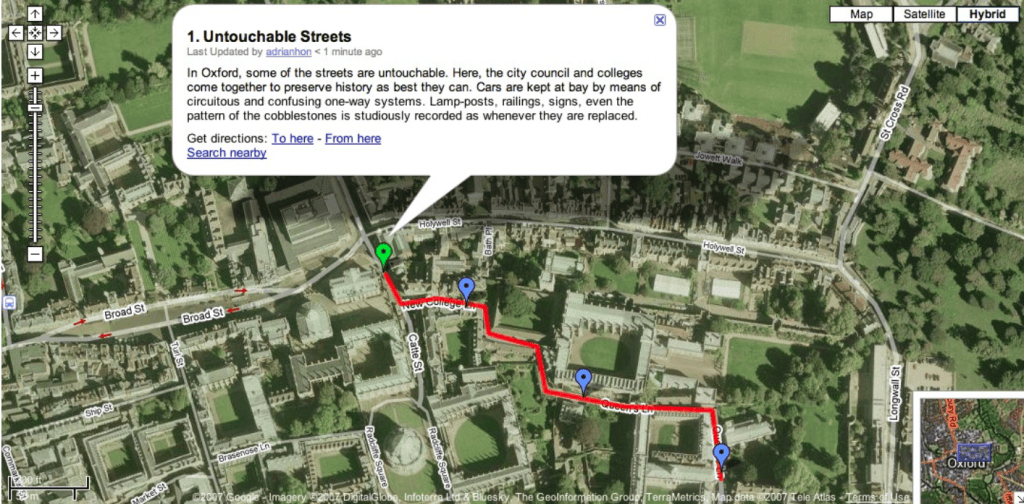
An adventure/travel story told over Google Maps — readers can view diary entries, sketches, photos and even phone numbers (that play a voice recorded voice message when called) by clicking on each stop along the journey. Zooming in and out lets readers see the very roads and houses mentioned in the story, and moving around the map allows them to literal side-excursions and anecdotes. The classic Indiana Jones metaphor of a journey being plotted onto a map is well-loved, and the popular and intuitive Google Maps interface allows for a traditional story to be told in an engaging and appropriate manner online.
Potential classics: Shackleton, Voyage of the Beagle, Treasure Island, Nelson and his Captains, Around the World in 80 Days.
There was also:
Thriller — Improv Storytelling
Watch the latest, most exciting thriller being written live! For five hours spread over five days, two authors will write a thriller together in real time. One author writes as the hero, the other as the villain; both can see each other’s writing (and will collaborate via a private chat channel). The story will be viewable as it’s being written, word by word, via the web and instant messenger, and daily installments will be released via email and RSS. By turning story telling into an online, real-time event, this chapter recreates the social excitement that surrounds ‘must-see TV’ and previously serial storytelling. It also provides a window into the actual process of writing, something that will interest thousands of aspiring writers.
Potential classics: The Thirty-Nine Steps, Wilkie Collins
Amusingly, The Thirty-Nine Steps would end up as a classic… for the Google Maps idea.
I am quite sad we didn’t get to do this next one precisely, as it turned into an “infographic story” between Matt Mason and Nicholas Felton instead:
Detective/Crime — Adventure Graphic Novel
A graphic novel, similar to the Heroes online comics, with interactive panels that allow readers to take part in the investigation. Readers can zoom in to read microdot text, look for fingerprints using a UV light, and help decode a puzzle. This chapter combines the strengths of traditional linear storytelling, with the rich visuals of graphic novels, and the engagement of videogames.
Potential classics: Sherlock Holmes, The Thirty-Nine Steps, Dracula
Within each story would be clues for an Alice in Wonderland-themed ARG taking place in external blogs, written by Naomi Alderman. This would conclude with a crazy croquet challenge and Mad Hatter’s Tea Party live event in Oxford, designed by Alex Fleetwood (Hide and Seek), Tassos Stevens and Annette Mees (Coney), and Felix Barrett (Punchdrunk). And if that wasn’t enough, there would be a weekly prize draw, and a grand prize of the Complete Penguin Classics, over 1,300 books.
Our proposal acknowledged that the technology required to deliver the stories wasn’t particularly complex. What was important was using “web 2.0 technologies” like Javascript and AJAX to provide a “fast, highly responsive, and attractive interface” with short loading times. This aligned with my north star, that we engage and excite visitors within six seconds (six stories, six authors, six seconds… are you getting it?!), a direct response to ARGs famously being very time-consuming to get into. No tutorials or instructions to be found here, only good storytelling vibes.
Our November 2007 proposal described the eventual form of We Tell Stories almost exactly, with the major exception of the live event, which was cut entirely to save money.
We weren’t getting paid much. We received £5,000 for the concepting phase (£9k/$12k today) and didn’t get a penny more until March 2008, the same month We Tell Stories went live. This wasn’t a question of late payment: we literally didn’t sign the contract to make We Tell Stories until a few days before launch.
Sadly, Penguin wasn’t exceptional in this regard. In the 2000s and 2010s, plenty of big companies saw nothing amiss with paying contractors months after they’d done the work. Thankfully this is changing, partly due to new laws, but it was brutal at the time. We knew Penguin was good for the £65,000 production contract (£115k/$150k today) but we had salaries and rent to pay for the four months. Bigger digital agencies could manage this because they had cashflow from lots of different projects. Some companies had investors’ money. We did, too, but not a lot.
So the only option for Six to Start was to get on the treadmill and spin up multiple projects at once, the concepting fees from one paying for a gap in another. During the development of We Tell Stories, I was:
Designing and prototyping Smokescreen for Channel 4 Education.
Designing Liberty News, an ARG for the BBC TV show Spooks: Code 9.
Designing an online game concept for the BBC about digital surveillance called The Plot.
Pitching to make an ARG for the new VW Tiguan car.
In my memory, these projects were completely separated in time, but in fact I was doing them all at once. Then again, I was 25 and apparently had unlimited energy, and had a fantastic team: Claire Bateman and James Wallis contributed to We Tell Stories’ design, Andrew Hayward and Ben Burry did the frontend and backend development respectively, and Richard Jones worked on the website design. They convinced me that if you had the right team, you could get things done impossibly fast.
But we were missing a few crucial members of our team: the writers.
Armed with our six “chapter formats”, we drew up a list of potential authors with Penguin. It wasn’t very long: we wanted authors with a following, who had books coming out soon, and would be excited by the idea.
Yet this makes the process sound one-sided when, in fact, we were asking for authors’ trust. They weren’t obliged to say yes, and we didn’t have any budget to pay them. Sure, this was a marketing opportunity, but speaking as an author myself, there are lots of opportunities out there, plus there’s always the next book to write. In other words, we had to sell them on it.
I remember the meetings vividly. They were in Penguin’s office on the Strand and I’d say, this is why we want you to write this kind of story with us. I’d sketch a design on a sheet of paper and suggest what narratives might fit, adding, this is a collaboration and it’s your story to tell, so if there’s something you’d like us to do or try, then we want to do it.
It was an odd dance, one I’m dwelling on because We Tell Stories wouldn’t be what it is without its authors. They took it seriously because they were convinced we took it seriously and we cared just as much about storytelling as they did – which is to say, we didn’t treat it as a gimmick or a tech demo or pure marketing exercise.
Along with the Google Maps story, which we were delighted to recruit spy writer Charles Cumming for, I was anxious to find someone right for our choose your own adventure (CYOA)-style story.
I had initially told Jeremy that I would design any format other than a CYOA. I regarded them as almost the worst form of interactive storytelling. CYOA books were bad enough – you spent half your time backtracking from dead-ends and usually had five fingers stuck in the pages as impromptu bookmarks – but hypertext CYOA stories were dreadful since you never knew where you’d been or where you were going.
But Jeremy wore me down, partly by letting me do whatever I wanted with the other five stories, and eventually I came up with an idea I liked, following a few hours of brainstorming with James Wallis:
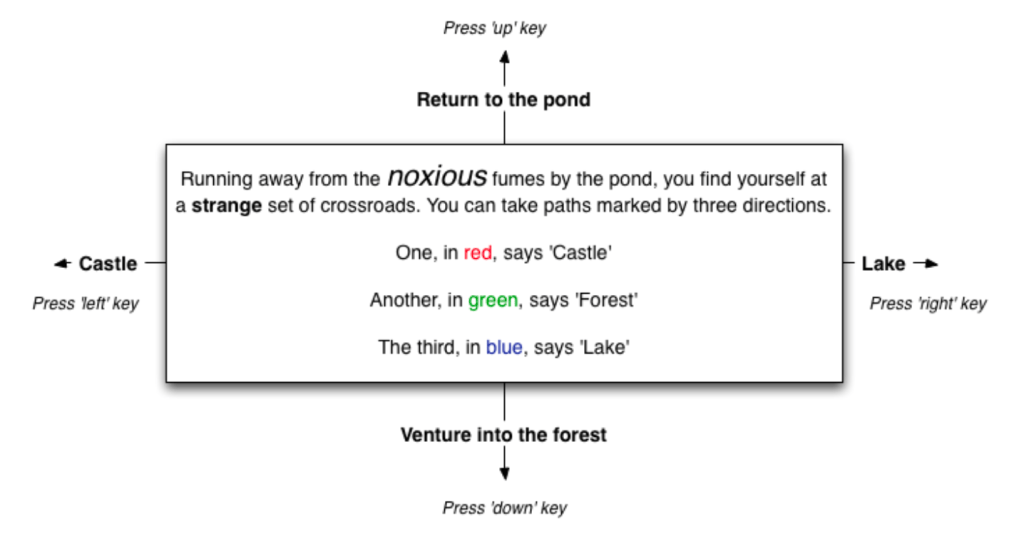
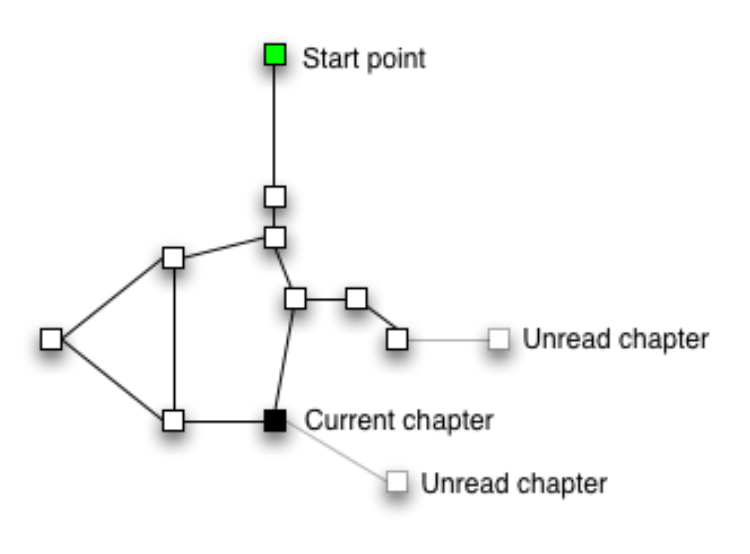
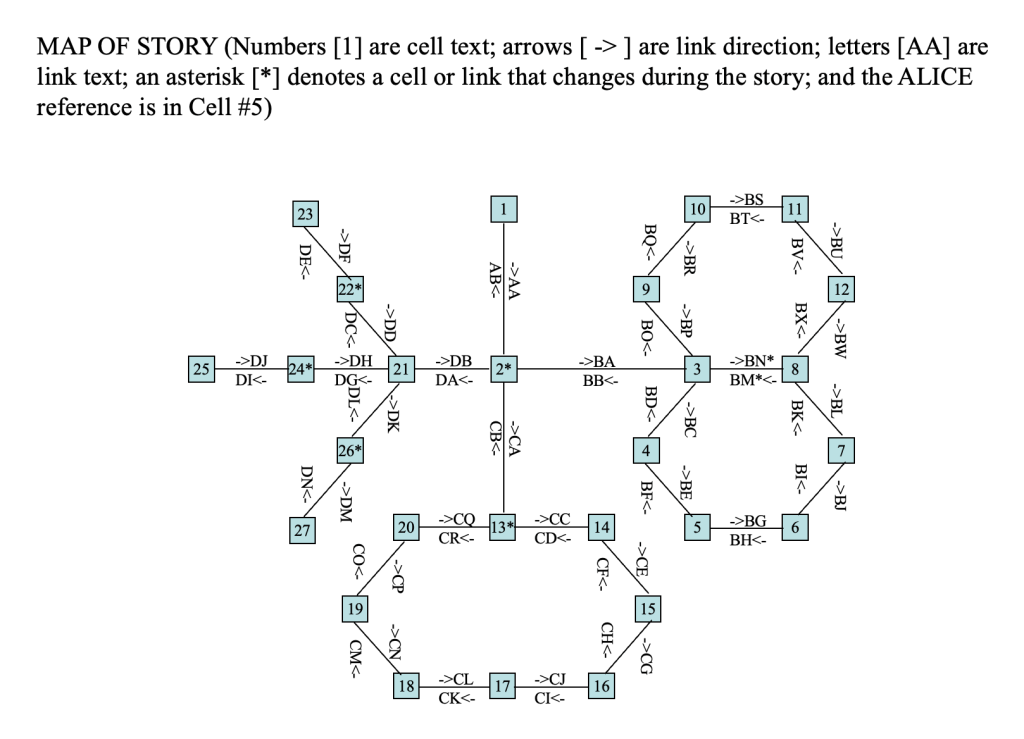
The design spatialised the branching paths of a CYOA story into a 2D map. Choices were represented by cardinal directions, so that readers didn’t even have to use a mouse to navigate – they could just use arrow keys. But this didn’t mean the author should be bound to a particular structure, as I wrote in the guide:
Unlike traditional CYOAs, the story need not necessarily have a branching narrative – that is, one which has multiple, exclusive branches and endings. Instead, the story could tell a single tale, where a full understanding of which comes from exploring the different side-plots and areas. This could be done Rashomon-style, for example. Separate branches may also converge onto the same chapter (but only such that a chapter has at most four links).
A minimap solved the problem of readers not knowing where they’d been in the story and what was remaining, though there was also a kind of “fog of war” preventing them from seeing the entire structure from the beginning.
While choices were spatialised, the author didn’t have to interpret them as literal physical movement:
There is no reason why the direction that readers ‘move’ between chapters should correspond to physical directions, or indeed any movement at all (e.g. traditional CYOA decision points usually do not involve any movement). However, this story structure blends both CYOAs and dungeon adventures, meaning that having reader movements correspond both to directions and to decisions could be mixing metaphors to the point of confusion and disorientation. Then again, that might just be part of the fun.
A bit of a cop-out there at the end, I see.
There were a few other “technical features” to my proposed format, some of them quite gimmicky and quickly abandoned (different fonts, text sizes, colours), the most important being the ability to change the content of “chapters” based on readers’ actions and exploration, such that text might change the second time they “visited” a chapter. While these offered a “tremendous amount of flexibility”, I warned that using them for significant changes in the story would require large amounts of alternate chapters, so they should be used sparingly and simply.
All of this was captured in our CYOA Writer’s Guide, a five-page document explaining exactly how the format worked:
We had similar writer’s guides for the other formats, concisely explaining their structure and affordances. They also suggested how we wanted authors’ manuscripts.
This all sounds very prescriptive, not really in the spirit of collaboration, but the point was to lay out everything we could do, then let the author write whatever they wanted within those broad parameters. Even manuscripts could come in different forms: for the CYOA, I suggested they could scan in a drawing of their chapter map, or use Omnigraffle or Visio or Illustrator. And of course, they were genuinely welcome to propose changes to our formats, though with the exception of Mohsin Hamid, I don’t think anyone took us up on this.
I am perhaps a little too proud of my ability, or at least my fondness, for writing technical documentation. I think it’s one of the most valuable things any organisation can do, almost like a superpower, because if done well, it structures thinking, and anticipates and answers questions before they’re asked, saving untold emails and messages. When I left Six to Start a few years ago, we had a vast internal wiki on Notion that was practically a manual on how to run everything the company did.
Our CYOA writer’s guide was especially helpful in convincing Mohsin Hamid. The author of the recent Booker-nominated The Reluctant Fundamentalist, Hamid would’ve been a sensational “get”, though a very long shot for the same reason. But after reading the writer’s guide, he quickly asked to meet, and suggested a number of new features and requested an online prototype to play with. And just a few weeks later, his 37-page manuscript arrived:
And it was perfect. A perfect story, one that you can still play today, and – if I’m putting my producer’s hat on – a perfect manuscript, because it required no editing whatsoever. In fact, it came as PowerPoint slides.
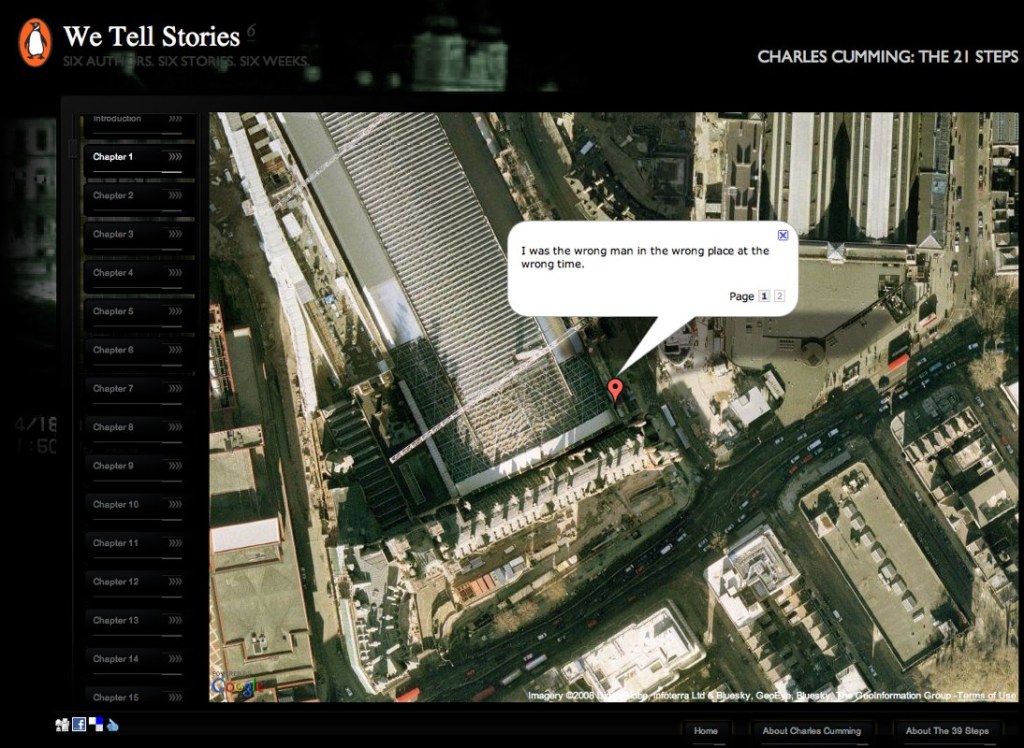
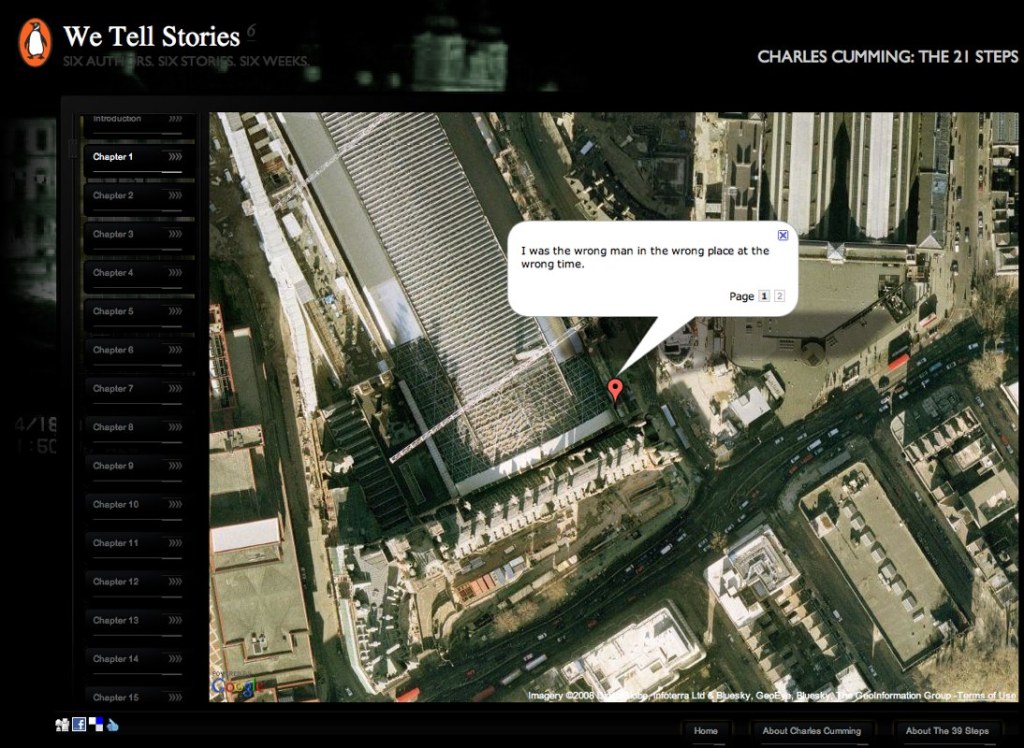
We Tell Stories launched on Tuesday 18th March with Charles Cumming’s The 21 Steps. We knew using Google Maps would be impressive, and the story was a fantastically pacy thriller, its clipped sentences perfect for comic book-like speech bubbles.
In just six weeks, The 21 Steps was read over 150,000 times – a small number for today’s YouTube and Instagram creators, but an enormous audience for a digital story in 2008 (a blast from the past: a third of all traffic came from StumbleUpon). A week later came Toby Litt’s Slice, told over four blogs and Twitter accounts, then Kevin Brooks’ Fairy Tales, a madlibs-style story generator.
Nicci French’s Your Place and Mine launched in week four. Husband-and-wife writing team Nicci Gerrard and Sean French wrote the thriller in real time, each person responsible for their own protagonist, and by real time I mean real time, as in you could watch their literal keystrokes appear – quite the high wire act. Our penultimate story was Matt Mason’s Hard Times, an “infographic novel” designed by Nicholas Felton, which you can download as a PDF; it didn’t quite come together as expected, but it do be like that sometimes.
And finally we had Mohsin Hamid’s The (Former) General in His Labyrinth to end things with a bang.
The (Former) General wasn’t read as much as Charles Cumming’s The 21 Steps – none of the stories came close – but most of the authors seemed very happy with the results. Cumming was delighted, of course, and I ended up demoing his story to Gordon Brown once.
We Tell Stories attracted lots of coverage from the very start. Early articles from outlets like Newsweek and Gamasutra focused on its innovation – this ain’t your father’s digital storytelling, no serialised email novel here – prompted, in part, by Penguin’s press team and Six to Start’s reputation as ARG designers. Journalists were charmed by the combination of old-school novelists and bright young technologists.
Slightly unexpectedly, the website’s visual design drew attention from AIGA, and in 2011 it was featured in MoMA’s Talk to Me exhibition, a feat I have dined out on ever since. In a 2008 review, academic librarian Anne-Marie Deitering homed in on the idea of how it was “designed for the web”.
I’m proud of how well We Tell Stories performed as a venue for authors to tell excellent, unusual stories that are worthy of study. A lot of people can share the credit for that, but something else I took forward was how much trust Penguin and Jeremy showed us. We were left alone to design the entire project as we saw fit. Maybe that’s because we had so little time, or because publishers were comparatively flush with cash in the late 2000s, but it’s astonishing how many clients will get in their own way through micromanagement and asking for changes that make things worse.
People can make incredible art at incredible speed, if they’re given freedom and believe they won’t be messed with.
Coverage slowed down considerably after 2017. That’s when Penguin asked us to decommission the website. We offered to keep it alive for free, but no dice. Some stories, like The (Former) General, are still visible and largely playable in their original form on the Internet Archive, but others, like The 21 Steps and Fairy Tales, no longer work, and parts of the ARG have disappeared. Server logic and APIs aren’t backed up easily.
Where video games are often delivered as a bundle of files that can be copied and decompiled and run in an emulator, the web is ephemeral. It stops working without constant care. Though they both use text, some kinds of online literature are less like a printed book and more like a theatrical performance, one that can be recorded but not wholly relived, like Nicci French’s live Your Place and Mine. Much like ARGs, it was improvised and responsive to audience feedback, a thrilling feeling for novelists. Perhaps it’s no coincidence this is integral to so much of the immersive art I study in my upcoming book, The Age of Immersion, art that is inherently ephemeral and fragile.
This distinction partly explains what happened after We Tell Stories launched. Everyone came out of it looking good: it was a marketing and public relations success, and the SXSW win a year later cemented its status. We pitched Penguin on the idea of a followup that would explore six new publishing business models, from microtransactions to donations to subscriptions. Instead, Penguin opted for a more durable product in We Make Stories, a suspiciously Moshi Monsters-styled subscription-based website for families to create their own interactive stories. Just like Moshi Monsters, we decided it wasn’t for us, and it folded after a few years anyway.
But as much as We Tell Stories was presented as a startling innovation in interactive storytelling, it was just another step in a very long tale. While our project proposal airily claimed “past attempts to transplant traditional novels or short stories to the internet have mostly failed” (I am sure I was thinking of serialised email novels again), this was a line written by a foolish young man with no formal education in the humanities, let alone digital humanities. Now that I am a foolish middle-aged man, I can appreciate the decades and centuries of interactive and ergodic and experimental stories that came before us and hopefully will come after.
One person who was not taken in by our razzle-dazzle was writer and game designer Holly Gramazio. Shortly after our launch, Holly wrote:
The press release [claims]: “These stories could not have been written 200, 20 or even 2 years ago.” This is not literally true; the first, Google-maps-based, story would have been trickier a couple of years ago, but the second, Toby Litt’s “Slice”, is basically a story told in parallel blogs of the type we’ve seen since 1995, with The Spot (parallel fictional blogs before the word “blog”; a daily audience of 100,000 in 1995, when the online audience was a couple percent of what it is today).
rekt.
The project is predicated not on perceived novelty but rather on how firmly it fits into what seems to me to be a long-running tradition of experimental text-based online fiction that verges on the gimmicky but doesn’t suffer because of it, a tradition that has Geoff Ryman’s 1996 253 as its first prominent “literary fiction” success (or, arguably, Douglas Cooper’s 1994 Delirium—but Cooper hasn’t kept the work online, so only the archaeologists care). By “gimmicky” I mean that the stories feel like they have been constructed medium-first; somebody’s seen a possible technological form for a work of fiction and then consciously created a fiction (or commissioned a writer to create a fiction) that fits that form. Regardless of their success as fiction, these works are most obviously about seeing what can be done; trying to find out what experiments will hold up in a relatively new medium (well, fifteen years old now, or you could start counting from academic darling Michael Joyce’s afternoon: a story and make it twenty-one; we’re not as new as we insist on thinking). Not “how best can I tell my story?”, but “what happens if I try to tell it like this?”
Holly goes on to dismantle the idea that online text-based stories must be “designed”, arguing that we already knew (in 2008) what successful internet-native online fiction looked like: webcomics and fanfiction, both forms that could be printed out and read on paper with little detriment. So why had it caused such a stir? She ventures four ideas:
The explicit division between “person who makes the form” and “person who makes the words”.
It came from Penguin rather than “someone doing it for fun” or “academia”.
It looks pretty, and provides multiple works in one location.
Here’s her final idea:
Game people doing fiction. The intersection between game design and story creation seems traditionally to be one where the game is the focus, and writers are brought in to do their writing as a relatively minor contribution (exception: interactive fiction, which I’m ignoring because (1) it’s a huge field, standing almost entirely apart from both literary/academic approaches to online fiction and to visual games; and (2) I find most of it kind-of annoying to play) … the area in which We Tell Stories is working is a fundamentally playful one, but it’s not one that’s usually approached by game designers per se.
If understood as a game, We Tell Stories fits into a continuity of interactive text-based storytelling, less in terms of parser-based fiction (“use key in lock”) and more in the world of visual novels.
One of the first such games I played was Christine Love’s 2010 Digital: A Love Story, which simulates logging into various BBSes on an Amiga computer desktop. Unlike We Tell Stories, the game can still be downloaded and played today for free, because it was developed in the popular open-source Ren’Py visual novel game engine. True, downloading a game to a computer poses a greater barrier than visiting a website, but then again, Digital is still here.
Engines like Ren’Py make it possible for solo writer/designers like Love to create work that would otherwise require a team of specialists. This isn’t to diminish the work and craft involved, but simply to recognise that game engines can act as a democratising force. Smaller teams mean lower costs, and the establishment of visual novels as a distinct game genre has meant that some designers can make a decent living from selling, say, ten thousand copies a year costing $10 each.
Meanwhile, Six to Start’s next big ARG, Smokescreen, was a technical marvel, a wholly web-based multimedia simulation of a computer desktop – and it, too, is no longer playable.
Our SXSW award was always about a specific moment in time. We won because we were good, but also because we represented the new, networked, real-time, “open”, web 2.0 way of making art for brands. Richard Powers’ 2004 digital story They Come in a Steady Stream Now was never going to be put forward for a SXSW award, no matter its quality.
We Tell Stories taught me how to make projects on time and on budget and, as Naomi and I would say, better than they need to be. It taught me that the way to make actual money was to sell a packaged experience, which is why we ended up making smartphone games like Zombies, Run! And it taught me how fulfilling it can be to help artists do good work.
Discover more from mssv
Subscribe to get the latest posts sent to your email.