This is an adapted and fully-annotated blog post version of my latest video essay. It’s just as good as the video – maybe better, because I had to mute and blur some clips for copyright reasons!
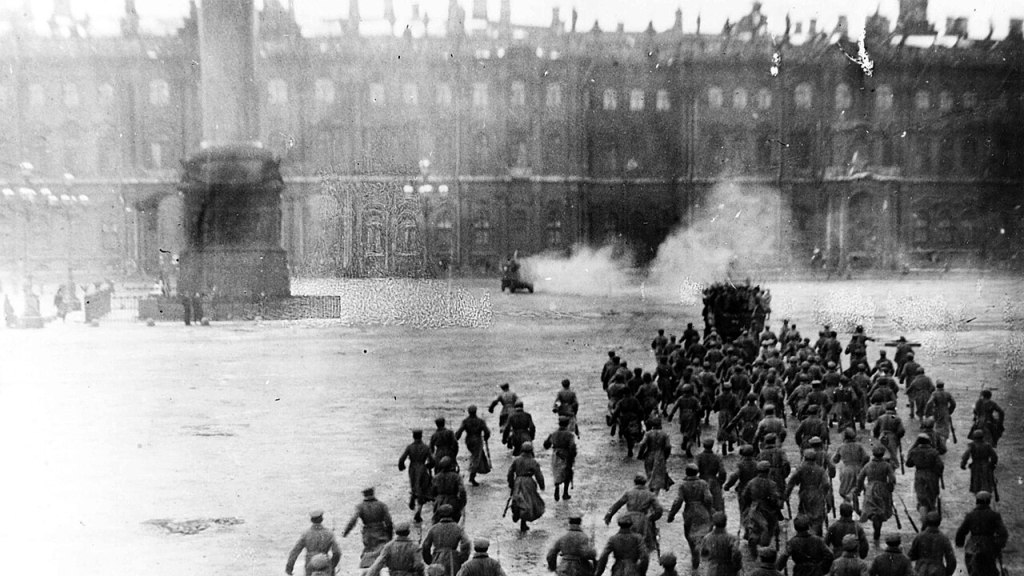
In 1920, just three years after the Russian revolution, the new government staged a re-enactment of The Storming of the Winter Palace. It was one of the biggest re-enactments in history, with almost ten thousand performers, many of whom had been involved in the actual storming, 320 military vehicles, and an honest-to-god warship. Watching all of this were 100,000 spectators, and actually, we probably shouldn’t call them spectators, because they got involved in the re-enactment too.
A lot of historians think the man behind it, Russian director Nikolai Evreinov, was just a Soviet propagandist, but the truth is much more interesting and complicated. In fact, I think the best person to compare Evreinov to is someone who became famous a century later: comedian Nathan Fielder.
I’m not saying this because they both created re-enactments so elaborate and spectacular, some people mistook them for reality. It’s because, in their heart of hearts, both men believe the way to be happy and to truly understand human behaviour is by turning life itself into theatre. And it’s that shared belief that I really want to drill into here.
Now, you might be wondering why you’ve never heard of Nikolai Evreinov before. A big reason is that, as with Nathan Fielder, people in the early 20th century couldn’t tell whether he was serious or not.
On the one hand, Evreinov was one of the three most important directors in Russia, alongside Konstantin Stanislavski, the father of realist theatre and method acting, and Vsevolod Meyerhold, the pioneer of symbolism in theatre. On the other hand, Evreinov was viewed as “just” a comedian. Some of his most popular works were his theatrical parodies, and his theory that all of life was just theatre was considered so bizarre, people assumed he was joking. As for Nathan Fielder, some people couldn’t tell whether his work on Holocaust awareness or aviation safety was just a joke, or something serious.
First, I want to tell you about Nikolai Evreinov. About what he believed, what he made, what he got wrong and what he got right, and why he was so far ahead of his time. Then I want to talk about Nathan Fielder and how his shows, Nathan for You and The Rehearsal, refract Evreinov’s ideas through the lens of neoliberalism and late stage capitalism.
That’s a lot – but stay with me, I promise it’ll be fun.
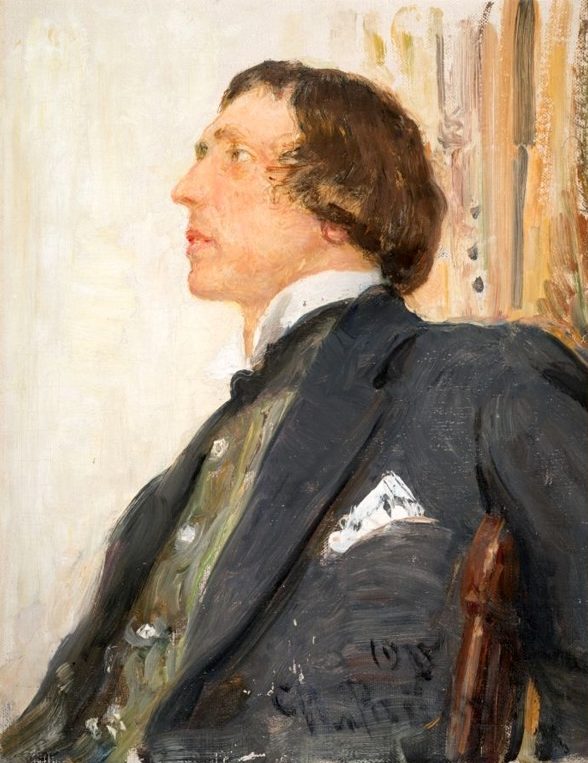
Nikolai Evreinov was born in Moscow in 1879 to an upper class family and almost instantly fell in love with the theatre. As a child, he staged puppet shows, and at the age of seven, he wrote his first parody.
This habit would get him into trouble at school, where he was almost expelled for writing a parody about his teachers. Another time, he played a prank by getting his class to pretend an absent student had actually died – he draped the entire room in mourning, covered the teacher’s desk in candles and crosses, and directed all the students to cry. Pretty elaborate work for a kid!
Evreinov studied law in St. Petersburg as a teenager and in his spare time, wrote and acted in plays. Everything in his life was about theatre – even his law school thesis was about the performative aspects of public executions. But when his parents separated, Evreinov had to get a real job in the civil service. In his spare time, he began writing his first full-length plays, which were starting to get noticed. Probably the best known of these is The Beautiful Despot, which debuted in 1906, when Evreinov was only in his 20s.
The play opens in the drawing room of a grand country estate where a master is chatting with his servants. Everything about it, from the props to the costumes to the furniture, looks like it’s from the early 1800s. It’s only when a journalist arrives wearing modern clothes from the 20th century that the audience realises this isn’t actually a period drama but actually a contemporary story.
It turns out that the master of the estate was once a famous liberal, progressive journalist. After he became disenchanted by modern life, he decides to live as his great-grandfather did, recreating his lifestyle in perfect detail, and gets a bunch of likeminded friends to role play as his servants and companions.
To be clear, this is pretty unusual kind of story for its time. The master isn’t portrayed as a madman, like Don Quixote, nor is he forced into this imaginary world because he’s been marooned on an island like Robinson Crusoe. It’s not some passing whim, either – he’s put a huge amount of effort into this immersive role play, sustained it for several months, and he’s not doing it solo – he’s convinced other people to take part. It’s more like Westworld than anything else – but of course, Westworld wouldn’t come out for another seventy years.
So at first, the 20th century journalist can barely believe what he’s seeing. He pulls books down from the shelves – they’re all from 1808, just like the newspapers. He talks to the servants he recognises, and they won’t break character:
Journalist: I can’t quite recall where—but still—I don’t know, perhaps I’m mistaken. (Picks up book and reads): “The Political, Statistical, and Geographical Journal; or, The Contemporary History of the World. 1808. Third part. Third book. September.”—(Picks up another.)—“The Genius of the Times,” 1808.—“St. Petersburg Review”—“Northern Mercury”—all September, 1808.—Tell me, that is, er, tell me, what are these papers, old ones?
Maid: I don’t know; we don’t know anything about those things. (Lights the last candles.)
Journalist: I don’t understand what sort of candles these are. They’re funny.
Maid: Funny? They’re the best sort of tallow.
Journalist: Tallow? Listen. What does this all mean? Come, I entreat you, tell me what it’s all about? My head’s going round.—Oh! Why, you’re Baroness Nordman, or I’ve gone mad, or I’ve got hallucinations, or I’m dreaming!
Maid: But, sir!
——Journalist: You’re Baroness Nordman, whom I met only a year ago at the Sociological Society!
Maid: But, sir!
——Journalist: I’ve no more doubts. You’re Helen, Baroness Nordman.
Maid (withdrawing): Lord preserve us! What are you talking about, sir? I’m a serf, a chambermaid, my name’s Grusha, I wash the floor.
Journalist: A serf? (Pause.) But serfdom was abolished in 1861!!!
Maid: Lord preserve us! Why it’s only 1808 now!
Eventually, he figures it out and starts to argue with the master about why on earth he’s doing this. The master responds by saying that the modern world has destroyed beauty, it’s turned gardens into factories, torn apart ceremonies and rituals, made everything about money, and is being overrun by extravagant Yankee millionaires – so, basically just like today, then.
But the master isn’t interested in changing society any more. Instead, by retreating to a more private world, he and his fellow travellers get to walk and ride in the fresh air, look at the stars in clear skies, build bonfires and read books. It’s a world full of physical sensation – the same world that people want to find today, away from their screens.
One of the most shocking moments in the story is when you discover that the master’s chambermaid used to be a leader of the feminist movement. A few years ago I might’ve said it was unbelievable, then we got tradwives.
It would be easy to dismiss Evreinov as a cultural conservative, just another guy infected with nostalgia for a lost golden age. But this play is more complicated than that. His protagonist wants beauty and sensation and excitement, and the only place he thinks he can get it is in the past, not the present or future. He knows he can’t literally turn the clock back and doesn’t want to force his ideas on anyone else, so he builds his own golden age and, rather than living in it on his own, invites other people in to make it feel more real.
Now, The Beautiful Despot is not a great play. It has a great hook and it’s entertaining in its own way, but it lacks any kind of plot and its characters are completely flat. Luigi Pirandello does the same thing far better in his play Henry IV, and it’s likely Pirandello was influenced by Evreinov.
No, what makes The Beautiful Despot fascinating is that unlike practically every story where someone builds a make-believe world, this one is not a cautionary tale. Evreinov is saying that people should construct their own worlds to make themselves happier. And I think that earnest belief is something he shares with Nathan Fielder.
It’s not that illusion and performance can be just as good as the real thing, but that there is no such thing as the real thing – that it’s illusion and performance all the way down. This idea became the centrepiece of Evreinov’s grand unified theory, that everyone should seek to turn their lives into theatre to their fulfil their deepest desires in a way that everyday life cannot.
Before we go into that further, I want to pull the camera back a little bit. At the start of the 20th century, not only was Russia going through rapid industrialisation that was destroying the nature that Evreinov loved so much, but it had just lost a war with Japan. This was an international humiliation, the first time a major European power had been defeated by an Asian nation.
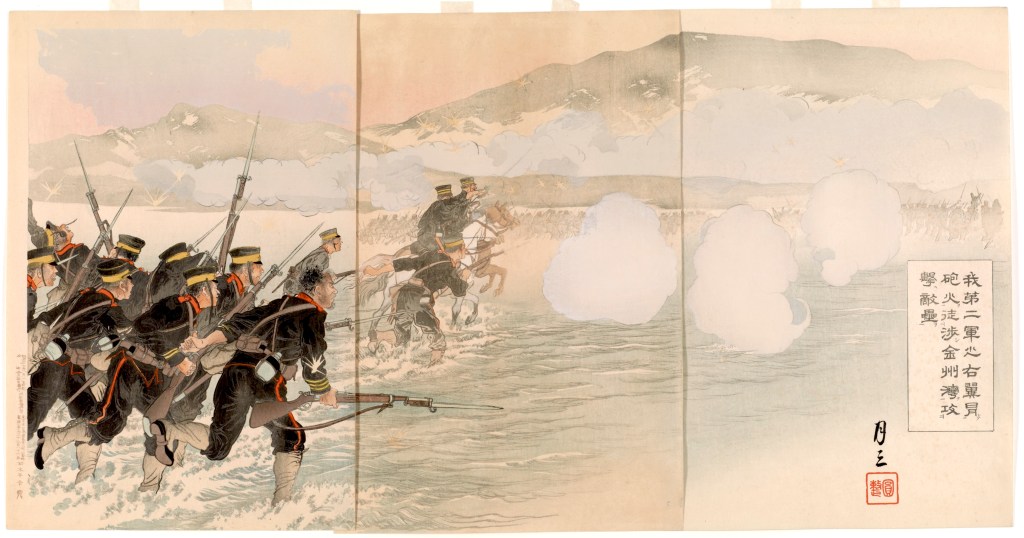
Traditional class structures and hierarchies were breaking apart, realism in art was being overtaken by new forms like impressionism and cubism and futurism. Nothing seemed stable. And most importantly, there was the failed Russian Revolution of 1905.
So it’s not surprising that Evreinov, a man who came from the aristocracy but was no longer tied to it, a man who had to work for a living but resented having to lower himself to the masses, would both challenge authority but refuse to march alongside the workers.
Evreinov’s next big project after The Beautiful Despot was setting up The Ancient Theatre. The idea here was to reconstruct past forms of theatre, from 11th century medieval plays onwards, to try and understand and illustrate how different they were from modern theatre. In particular, he wanted to show how medieval theatre wasn’t just a show you bought a ticket for to amuse yourself, but an interactive artistic experience that was so tightly woven into the fabric of life that it felt like life itself.
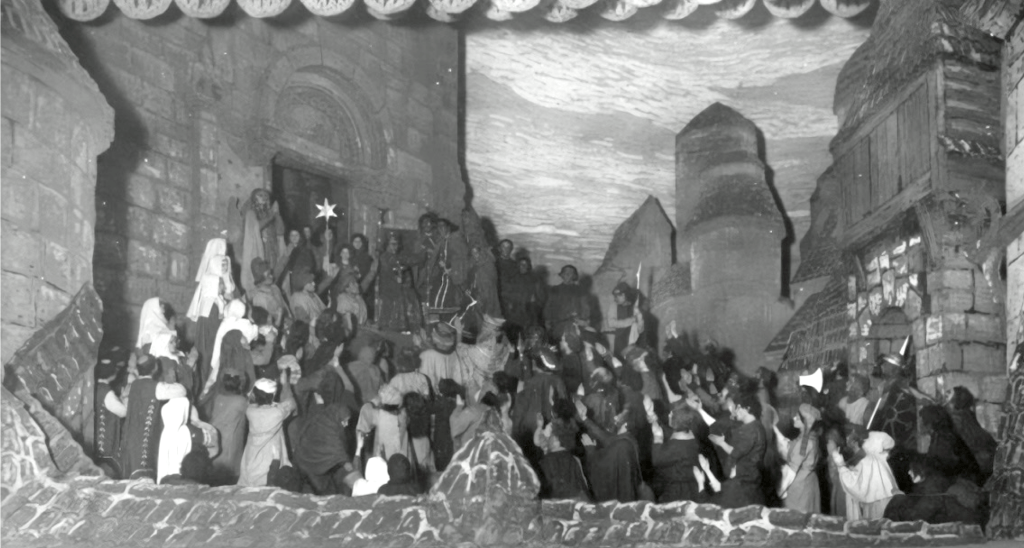
Probably the best example of this is his 11th century mystery play The Three Magi. You know the story – it’s about the birth of Christ in a manger, the arrival of the three wise men with gifts, and Herod ordering the killing of the firstborn. What’s unusual here is that after building a set that looked like an 11th century cathedral, Evreinov populated it with an 11th century audience played by actors. That on-stage audience gets so caught that when Herod appears at the end, they storm into the play itself.
While the company did a lot of research for these plays, designing period sets and costumes and playing medieval music on period instruments, it’s pretty clear that for Evreinov, the real goal was to inspire modern audiences to get more involved in theatre, just like medieval audiences once did. He wanted to show that if you got sufficiently involved, theatre could transform life.
The Ancient Theatre only lasted for a couple of years. It received a lot of praise, but you can probably imagine that audiences weren’t fighting to buy tickets. As critics at the time noted, it’s basically impossible to do a true historical reconstruction of a play from a thousand years ago – no-one really knows how it was performed or received. Some people thought it ended up feeling too broad, like a parody.
Evreinov decided to lean into parodies with his next role, as principal director for The Crooked Mirror cabaret in St. Petersburg. This wasn’t a cabaret like you’ve seen in musicals or movies, though – it was basically a high-brow sketch comedy night, similar to Saturday Night Live, with a massive 750-seat auditorium.
Some of Evreinov’s best known plays are when he parodied the style of well-known directors, a bit like when SNL does a horror movie in the style of Wes Anderson, or Mario Kart in the style of The Last of Us, except way more personal. He loved mocking Stanislavski’s Moscow Art Theatre, which he thought was incredibly pretentious and overly fixated on recreating reality as accurately as possible, with its authentic 3D rooms and costumes and props.
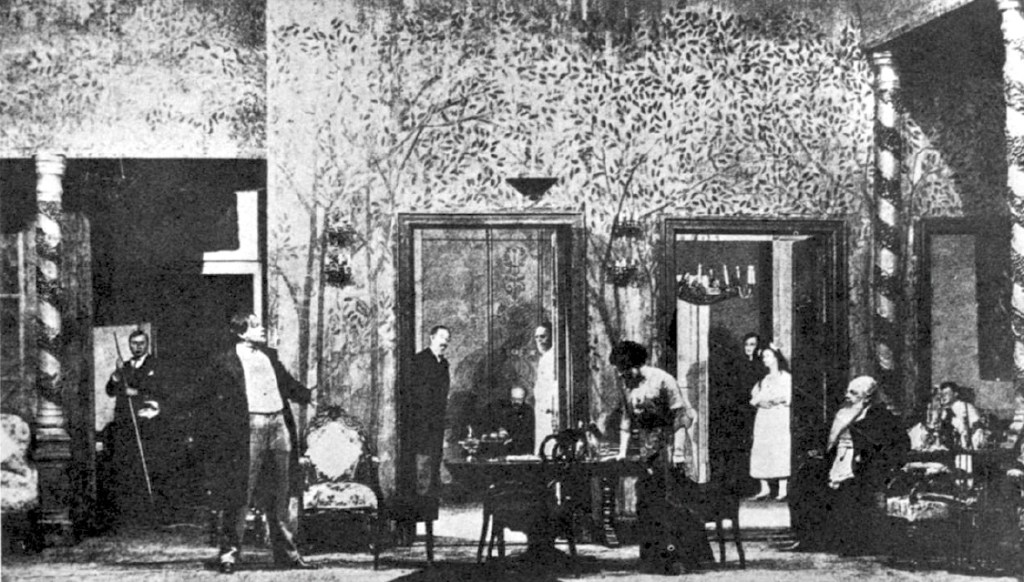
His ultra-realistic parody of Stanislavski’s production of The Inspector General starts with a sofa with its back turned to the audience – because why would the people in the play even know there was an audience to face? – and it takes forever to get going, because real life is slow, too. When there’s dramatic dialogue, it gets interrupted by church bells, because sometimes that happens in real life.
Evreinov also parodied symbolist theatre and silent movies, but it was the one of Stanislavski that was the real hit. Tsar Nicholas II loved it so much he requested a command performance and gave everyone gifts. Of course, Stanislavski was pissed.
This might all seem pretty silly, but he had a serious point, which he was arguing in essays at the time. He thought that modernity had eliminated theatricality from people’s lives, by which he meant that adults were no longer able to role play as they once did as children. The styles and traditions and costumes of the past had also been banished by modernity, but nothing new had arrived. Worse, directors like Stanislavski were even driving theatricality from theatre itself, by insisting that everything on stage look and behave exactly like it did in real life, making everything boring and miserable.
One of his parodies addressed this attitude head-on – it was literally called The Fourth Wall. In it, a director obsessed with Stanislavski decides to improve the opera Faust by making it as realistic as possible. First, he removes the singing, because in real life, people don’t sing. Then, when an actor has to drink poison, he fills a cup with real poison. Finally, he builds a literal fourth wall on the stage, blocking the audience’s view of the actors, because in real life, rooms have four walls.
Of course, Evreinov thought that a certain amount of realism was necessary to get people to buy into a fiction, but if you went too far beyond that, you ended up limiting people’s imagination. Someone on a beach in bathing suit isn’t a believable king, but with a well-cut paper crown, silent courtiers, cardboard throne, and a bath towel as a mantle, then it’s convincing.
But his dislike of realism was just a prologue to his more fundamental theory. Evreinov thought that everyone is born with an innate drive, an instinct, for “theatricality”, which we might call role play. Everyone wants to transform themselves, which is why people wear makeup and buy clothes and pose in photos. Sometimes we do it knowingly, like politicians dressing up in military uniforms or in casual clothes, and sometimes we do it unconsciously, like when we go out to an important dinner and have to behave well. If you know about performance studies or you’ve read Erving Goffman’s The Presentation of Self in Everyday Life, you know all of this.
But this is the point where Evreinov takes it a step too far for people in the early 20th century, and even for a lot of people today. He didn’t just want people to watch plays on a stage, no matter how theatrical they were. He didn’t even want people to wander around an immersive set, like in a Punchdrunk show. He wanted them to become stars of their own personalised dramas, where the story revolved around them, where they got to act.
Evreinov called this idea “The Theatre for Oneself”, and he wrote a book about it during WW1 while in Finland. Here are some experiences he recommended creating for yourself:
- Pretend to be a cab driver
- Be a chambermaid for research
- Steal things from your friends’ houses and then return them
- Be a detective
It’s like a list of larps.
One of his favourite examples of the Theatre for Oneself was actually designed by someone else, a famous Russian historian, Mykola Kostomarov. One day, Kostomarov’s beloved canary was eaten by his family’s pet cat after it broke into its cage. Kostomarov was devastated and decided to put the cat on trial. He got his friends to be the defence lawyer and the judge, and made his family into the jury (his mom, however, refused, saying “my son has gone mad”).
Kostomarov, of course, was the prosecutor. He started by talking about the role of cats in ancient Egypt and Rome, examined the moral aspects of the case, and gave what witnesses said was the best speech of his life. But then the defence said that the cat was the victim of a bad influence set by Kostomarov himself, who had written a book arguing that the weak must unavoidably become the prey of the strong, and so the cat was of course only acting according to his master’s ideas.
The jury filed out to discuss the case, and after just fifteen minutes, proclaimed the cat innocent.
Evreinov loved this example not because he wanted to do it himself, or he thought it’d make for a great play. He loved it because Kostomarov had created his own theatre for himself. No-one else was going to design an experience for him where his cat gets put on trial, he certainly couldn’t just walk into a theatre or cabaret in St. Petersburg and get a ticket to see it, let alone do it.
No, Kostomarov had designed this experience, gotten other people to be part of it, improvised his own role, and taken it deadly seriously even as the whole thing was obviously meant as fun. And if you’ve seen The Rehearsal, you know that’s pretty close to what Nathan Fielder did in Season One when got kids to role play as his son so he could feel what it was like to be a father.
There’s one more example that I really like. Evreinov says that one of the best feelings in life is being taken care of and fussed over when you’re recovering from an illness. But what if you’re so healthy you never get ill? The answer is to stage a recovery. You get two friends to act as a doctor and a nurse, then for a couple of days everyone role plays as if you’re ill.
You lie in bed, the nurse takes your temperature and makes you soup, she reads to you from the newspaper, then the doctor arrives and you chat about the news while he checks your pulse. He says you’re on the mend but you should really spend another day in bed. If you insist, you can sit in an arm chair for an hour or two, but only because he likes you. After all this action, you go to bed, close your eyes, and fall asleep.
“Now tell me,” writes Evreinov, “isn’t it charming when people nurse you and take care of you with a truly touching attention, when they talk of your health as if it were a treasure to them, when everybody’s thoughts seem to centre around your dear self?”
Isn’t this all what we’re looking for? Why should we embarrassed for wanting to stage it if we can’t get it?
One of the problems Evreinov faced with The Theatre for Oneself is that people really didn’t know whether he was being serious or not. I think part of the problem is that his list of examples seemed silly and frivolous at the time – like, why is it so important that people pretend to be ill or put their cat on trial?
He’d struggle with this for over a decade until his most popular play, The Main Thing, which I’ll come to later, but from Evreinov’s perspective, what looks silly and frivolous to one person can be deeply meaningful to another. So to give you a more modern example, let’s take Dungeons & Dragons. For some people, role playing around a table in a fantasy world full of orcs and trolls and elves is just as pointless as putting your cat on trial, but – hopefully – we now know that tabletop role playing games can be just as valuable as any other kind of experience.
Here’s what Evreinov had to say about entering the transfigured reality of role play. “We remain the same as we were, and yet we become different, we see ourselves in a better, nobler, brighter light. You will admit that that is a considerable gain. A new sense of life — is that not more valuable than a new dress, a new bracelet, a new car?”
Today, we call this the experience economy. We know people find it valuable because they cut back spending on everything else in order to prioritise experiences, like Disney fans going deep into debt for their theme park pilgrimages.
So for Evreinov, the Theatre for Oneself isn’t just some optional frivolity. It’s the most important thing in life. And to loop back, this is why he hated realist theatre so much. He thought it was an obstacle, a distraction from people being able to create and inhabit their own fantasies. In fact, he disliked most of theatre, full stop. He thought that because it had to make money, it always ended up appealing to the lowest common denominator.
But this is where things get a little contradictory. From one angle, he presents The Theatre for Oneself as a kind of populist, egalitarian idea, saying that we should do away with “impertinent actors feeding on our money play and enjoy themselves as they wish, while we are kept confined to the gloomy and motionless [audience]?”
But from another angle, the Theatre for Oneself isn’t actually achievable for most people. Who’s got the money and time and space to take a couple of days off to pretend to be ill? Not the workers, that’s for sure. You can’t help but think that by atomising theatres into private experiences, he wants to make it so that that aristocrats and elitists like himself never need to mix or see or even think about commoners.
And when you look at some of the examples that were left out of the English translation of his writing, then you start to wonder exactly what it is that he wants to transform into. He suggests pretending to live in Persia with a harem, or on a plantation surrounded by enslaved people played by your friends, costumed in gold bracelets.
Now I’m sure Evreinov would’ve said that he didn’t want to enslave people in real life, he just wanted to know what that felt like. And there are definitely cases of larps where people role play as evil characters – I literally just did a video where teenagers larped as fascists – but usually there’s a point to that kind of role play, whether it’s for education or for other participants to play against. In Evreinov’s case, however, I’m really not clear what the point was, other than simply to have the experience in and of itself. And so – he might not have apologised for these ideas at all – after all, whose business is it what he does in the privacy of his own time with consenting adults?
But on that: I really do wonder whether Evreinov managed to get any of his friends to play as a nurse or as enslaved people for him. It’s one thing to write about it in a book and quite another to get someone else to role play for hours or days. And maybe that’s a big reason why his ideas were talked about but never really adopted, because the problem with the Theatre for Oneself is that it is literally a theatre for one person, not for everyone.
You might be lucky enough to find someone who’s happy to role play as a doctor for a day, but it’s less fun when everyone knows the patient is the star. It’s very telling that the one example where multiple people get to have fun – Kostomarov’s trial of his cat – wasn’t even invented by Evreinov!
That’s the tragic thing. Everyone who knows about Evreinov and has studied role play and psychodrama and Erving Goffman and performance studies agrees that he was decades ahead of his time in realising the power of performance in life. He practically invented his own form of highbrow larp. But he just couldn’t see that larp needs multiple people to feel like the star, otherwise no-one will do it.
Anyway – not long after Evreinov published his theory of The Theatre in Life, a little thing called the second Russian Revolution happened in 1917, which this time, was successful.
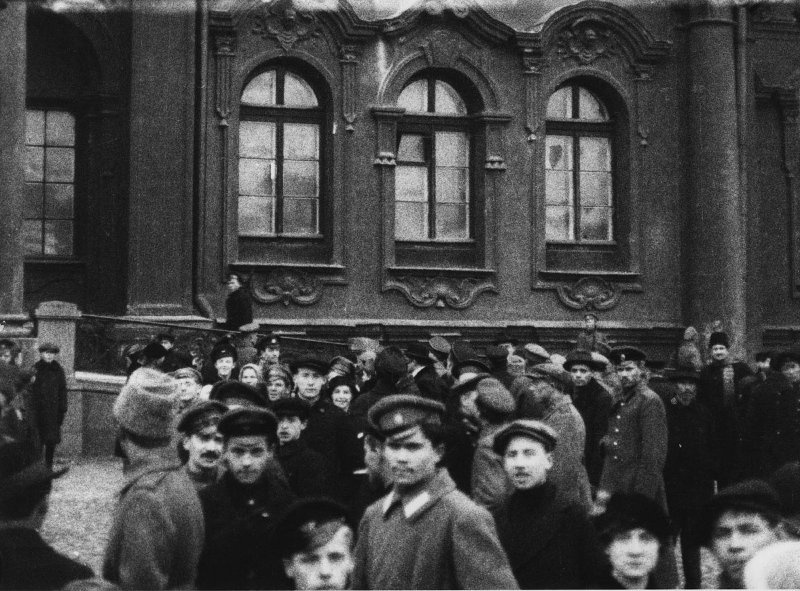
After the revolution, Evreinov was invited by Meyerhold to become director of the second most important theatre in the Soviet Republic, but he turned it down, probably realising that his vision of the theatre was far too individualistic and elitist to work in a new socialist world. For the most part, he stayed out of politics.
There were two big exceptions. The first was in 1920, when he was invited to direct the re-enactment of The Storming of the Winter Palace, partly on the strength of his work at The Ancient Theatre. Even though he wasn’t in love with the new regime, he couldn’t resist the opportunity to stage what would be the biggest theatrical spectacle of all time, to turn life into theatre and theatre into life.
The re-enactment wasn’t all Evreinov’s idea, though. The most direct inspiration comes from a man called Louis Napoleon Parker. In 1905, Parker staged a pageant – what we might today call an outdoor play or environmental theatre – in the English town of Sherborne to celebrate 1200 years of its history. It wasn’t a professional production, but more of a community endeavour: about one-fifth of the town’s entire population was involved – meaning 900 actors, musicians, and costume designers.
No-one had seen anything like it before – 30,000 people turned up to watch. That fact that it was filmed at all shows how excited everyone in the country was:
The Sherborne pageant sparked a craze that swept across the UK and to the United States, with bigger and bigger productions featuring thousands of performers. One of their spectators was Platon Kerzhentsev, who was in exile from Russia before the second revolution. He saw a pageant in Hampstead, in north London, put on by 300 villagers about the legend of St. George and the dragon. Kerzhentsev thought that the villager’s collective production of their own story reinforced their collective ownership of the land, so you can see why he was interested. What’s more, the story wasn’t just about kings and queens, but about commoners. He called it the most intense theatre experience he’d ever seen.
By 1918, Kerzentsev was back in Russia and wrote a book called The Creative Theatre, where he talked about these pageants. It became highly influential in the Proletkult movement, which was essentially about fulfilling the cultural needs of the working class through things like amateur theatre. “Why confine theatre to the proscenium arch,” he wrote, “when it can have the freedom of the public square?”
That’s why there were several massive re-enactments in Russian after the revolution, with The Storming of the Winter Palace being the biggest, and it’s why, despite his politics – or lack of politics – Evreinov ended up involved.
But even though it was a fantastic example of his ideas from The Ancient Theatre, that audiences should become more involved in theatre and that life was theatre and theatre was life, it wasn’t exactly the Theatre for Oneself. Everything was tightly choreographed, there was no room for improvisation, and definitely no room for individuals to feel like the story was about them specifically.
It was Evreinov’s last play staged in Russia, The Main Thing, that was the second exception to him staying out of politics. When he wrote it in 1919, he was clearly trying to reconcile his love of the Theatre for Oneself with the new socialist reality. It was by far his most successful play, and it was adapted into a 1940 movie, The Comedy of Happiness (La Comédie du bonheur):
In the play, an eccentric director decides improve the lives of unhappy people in a boarding house through role play, or what he calls “theatrotherapy”. He hires one actor to play a maid and cheer up a suicidal student; another actor plays a handsome lover to bring a shy secretary out of her shell, and a comedian makes friends with a lonely old man and romances a prim teacher. The scheme is so successful that by the end of the play, the people living in the boarding house do their own role play in order to help the other people in their lives.
The moral, if it wasn’t obvious, is that the Theatre for Oneself doesn’t just deliver cheap thrills, it literally makes life worth living. These people’s lives aren’t improved by a book or play or movie or their jobs or even their friends and family, they’re improved by a personalised live action role play that feels like it’s real. Of course, it’s not real – the scheme gets revealed soon enough – but Evreinov’s point is that when it comes to happiness, there is no difference between reality and illusion.
In fact, he thinks that happiness itself is a state of illusion. Because illusion is created by make-believe and role play, that means role play is most direct and effective way of attaining happiness. That was “the main thing” in life.
Surprisingly, the play was a hit in Russia, probably because it felt like a high concept, warm-hearted comedy on the lines of Jury Duty more than anything else. Critics were not best pleased, though. They thought that the idea of theatrotherapy as an actual practice was completely unbelievable, that there was no good way of introducing theatre and role play into life – and to be fair to them, even a century on, a lot of people would agree with them, despite the fact that we have psychodrama and larps and table top role playing.
Mixed reviews were one thing, but the political reaction was harder to deal with. In the play, the eccentric director who does the theatrotherapy gives a speech saying that while socialism is wonderful because it can deliver the material needs of life:
…there are millions of people on this earth deprived not only of material needs but also of personal joys, owing to impoverishment of the body or spirit, millions of our fellow men for whom the equality of Socialism isn’t enough.
You can just imagine what the Soviet regime thought of that.
During the 1920s, The Main Thing expanded across Europe and to the United States, with a production on Broadway starring Edward G. Robinson; Robinson said it wasn’t a work of art, but it was highly theatrical and stirring. Interestingly, the play described itself as “a comedy for some, a drama for others”, which once again, made it hard for people to know whether to take Evreinov seriously or not.
Thanks to the play’s decent success and because Evreinov was in town, he got a decent amount of press coverage and his writing was translated into English as a book. It’s interesting to see the reactions – some reviewers took his ideas seriously. Many thought that his idea of role play was obnoxious and annoying. Others found it “exceedingly interesting” but actually quite dangerous and liable to lead people into madness – a bit like the moral panic around Dungeons & Dragons during the 1980s.
Still, Evreinov never achieved that level of popularity again. In 1925, he left Russia and moved to Paris with his new wife. He directed opera, wrote history books, but as far as the theatrical world was concerned, he basically disappeared until his death in 1953. His theories about how role play was central to all of human social life were forgotten, which meant that they could rediscovered, in much more rigorous ways, by people like Jacob Moreno and Erving Goffman and Eric Berne and Victor Turner and Richard Schechner. It do be like that sometimes.
Now let’s fast-forward to the present day, over a hundred years after Evreinov was working. There are plenty of people examining performance and role play in life, but for me, Nathan Fielder stands out because he’s doing it in such a sustained and funny and popular way, just like Evreinov did.
Of course, they’re not the same person. Evreinov saw the Theatre for Oneself as an escape from modernity and rationality, while Fielder, at least on the surface, uses role play as a way to optimise individuals for a neoliberal, late-stage capitalist world. Also, Fielder isn’t trying to advance an explicit theory of theatricality as Evreinov did.
But there are obvious parallels in their practices and their journey. Both started out doing pranks and parodies:
They’re saying: look at what I can make you do, what I can make you believe, with just a little nudge. And quickly, they realise that this is a way in to deeper and more interesting ideas:
There’s an episode in Season Three of Nathan For You called Smokers Allowed that I know Evreinov would’ve loved.
Fielder suggests to a bar owner that allowing smoking indoors would help attract more customers. Of course, that’s against the law – unless the smoking is part of a theatrical production and integral to the plot. So to get around the law, he turns the bar into a theatrical space where the patrons are actors in a freeform play where smoking is allowed, and to make it even more legitimate, he invites an audience in. And they find it surprisingly interesting.
Clearly this is Fielder doing a bit, but it also exists within a tradition of experimental theatre and seeing the real world as a theatrical space, as Evreinov did.
After the first showing, Fielder decides to turn the play into a scripted performance, essentially re-enacting the original “improvised” reality to the most minute detail, this time with professional actors. The result is an unholy mix of Evreinov’s Ancient Theatre and Stanislavski’s realism.
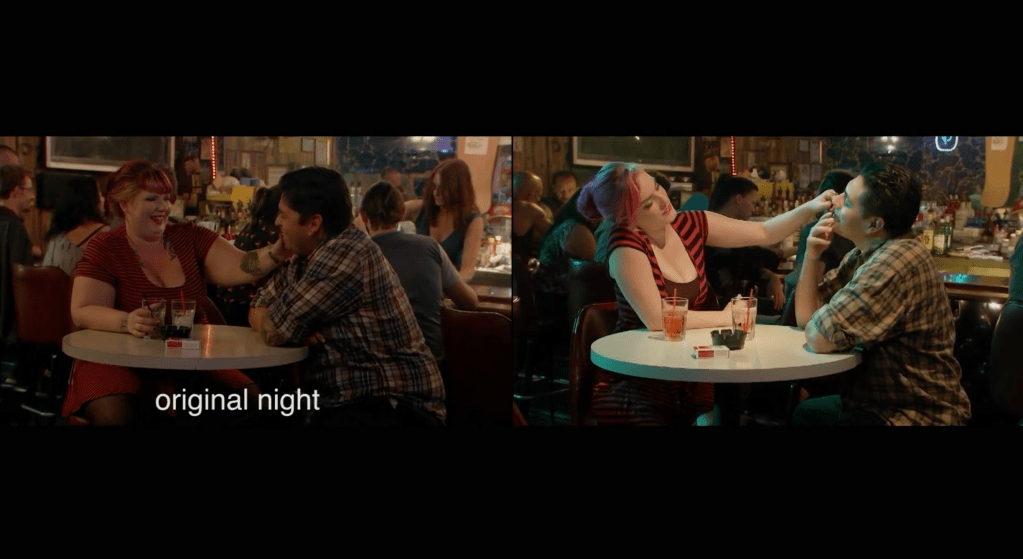
There are two moments where I think Evreinov would have been falling out of his seat if he were watching. The first is when Fielder steps in to help two actors practice their parts:
The second happens after the bar’s owner says she didn’t care for his scripted play, which is obviously disappointing!
This is Evreinov’s Theatre for Oneself and theatrotherapy all rolled into one. It isn’t a deception or a prank played on someone unwitting, it’s someone saying, “I want this particular feeling of happiness and satisfaction and being loved, and I will accept the illusion of it because it feels real,” – and if it feels real, that proves there is no distinction between illusion and reality.
Smokers Allowed is a perfect encapsulation of Fielder’s shtick, and it also highlights the big differences between him and Evreinov. Fielder almost always starts out by using role play to help people with very specific, everyday, mundane concerns, like making more money, or helping someone apologise for a lie. The role play is there only as a means to an end, rather than being a good in and of itself.
And honestly, it’s probably the smartest way to get modern TV audiences to buy in. In our hypercompetitive neoliberal world, it feels wasteful and self-indulgent to do things just because they’re enjoyable. Instead, we’re only allowed to go for a walk or listen to music because it improves our health and makes us more productive. He treats immersive role play in the same ways – sure, it looks weird, but it’s a useful tool that can be perfected.
This always comes across as a bit ridiculous in the moment, but only a bit, because we understand that this is just a part of life now – that we’re all expected to be as efficient and adaptable as possible. That’s what Fielder is doing when he attempts to eliminate the role of chance and contingency in life through endless rehearsals – it’s why he has these decision trees that map out every possible outcome in a kind of calculated and predictive process.

Sociologist Anthony Giddens wrote that late modernity is characterised by our need to constantly evaluate all possibilities of action, calculating risks and selecting between different counterfactuals and possible worlds at every moment. The idea isn’t just that we can shape the future, but that it’s our individual responsibility to do so. That’s what Fielder is doing with these decision trees, always thinking about what could have been in order to control the future:
With five exact replicas of Colin’s studio apartment and five fake versions of him and Emma inside of it, I could use this as a predictive tool that would hopefully reveal every possible challenge a new couple might face, allowing Colin to have a sneak peek at his own life.
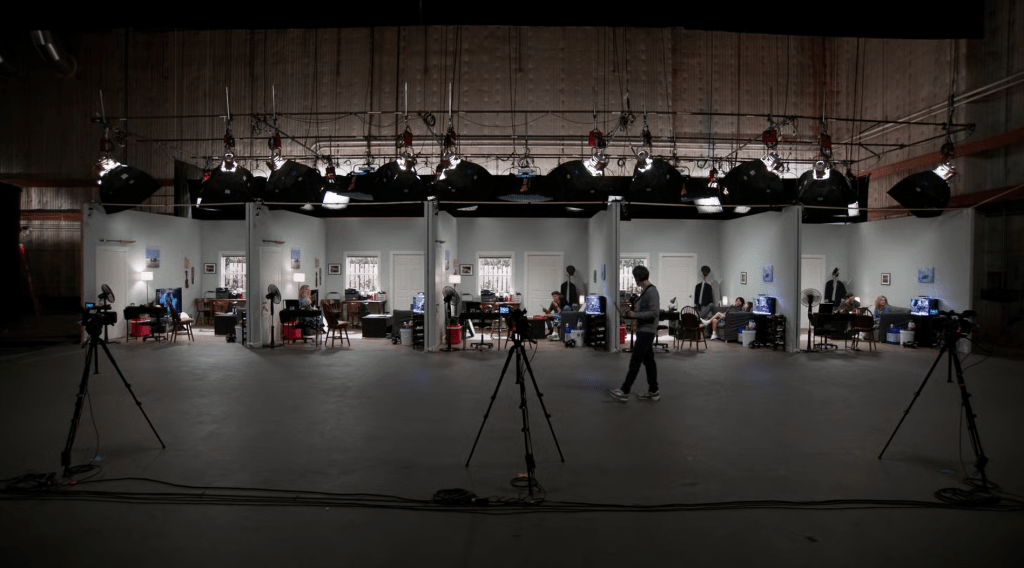
It’s hard to express just how alien this would have seemed to Evreinov a hundred years ago. The point of his theatrotherapy was to deliver spiritual needs, not to make increase sales at someone’s bar. That was what socialism was meant to fix. But given that the United States is not a socialist republic, you could argue that Fielder might actually be more on the side of the workers’ immediate needs than Evreinov.
Then again, Fielder follows Stanislavski in his belief that realism is essential in achieving the kinds of results he’s looking for. He’s obsessed with precisely mimicking the physical details of reality.
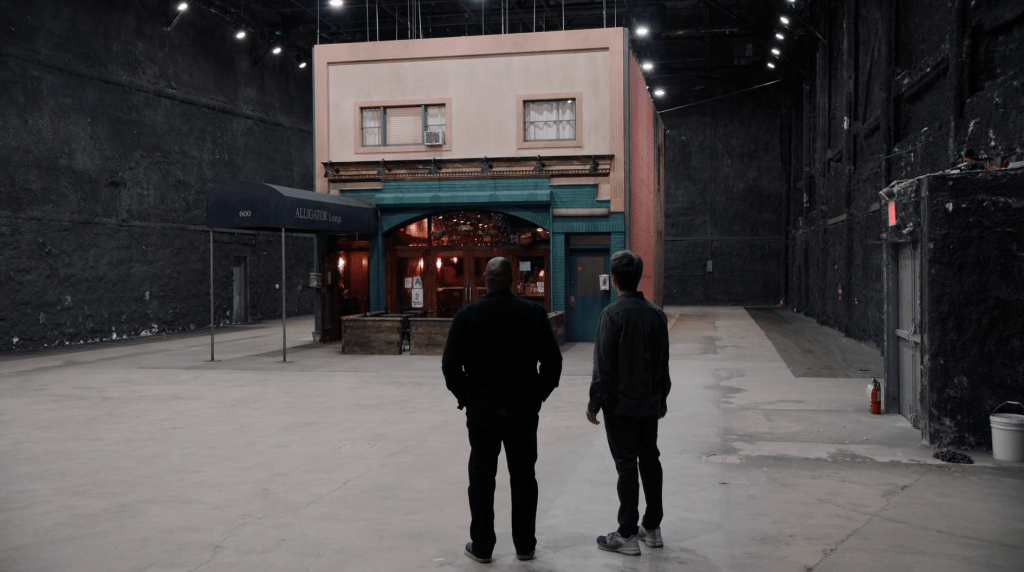
Fielder argues that this is because he can’t stay in the moment otherwise:
When your three-year-old son goes into his room and emerges as a six-year-old a minute later, it can be hard to stay in the moment.
So, you need to have custom digital mirrors installed that allow you to see yourself age at the same pace as your child. But that means the world around you has to move faster too. Seeds that are planted one week have to be plump vegetables the next. Nature’s time line has to be accelerated… and your brain desperately tries to adapt to your new reality.
And then every now and then, there are these glimmers, these moments where you forget, and you just feel like a family. That’s when you know the rehearsal is working.
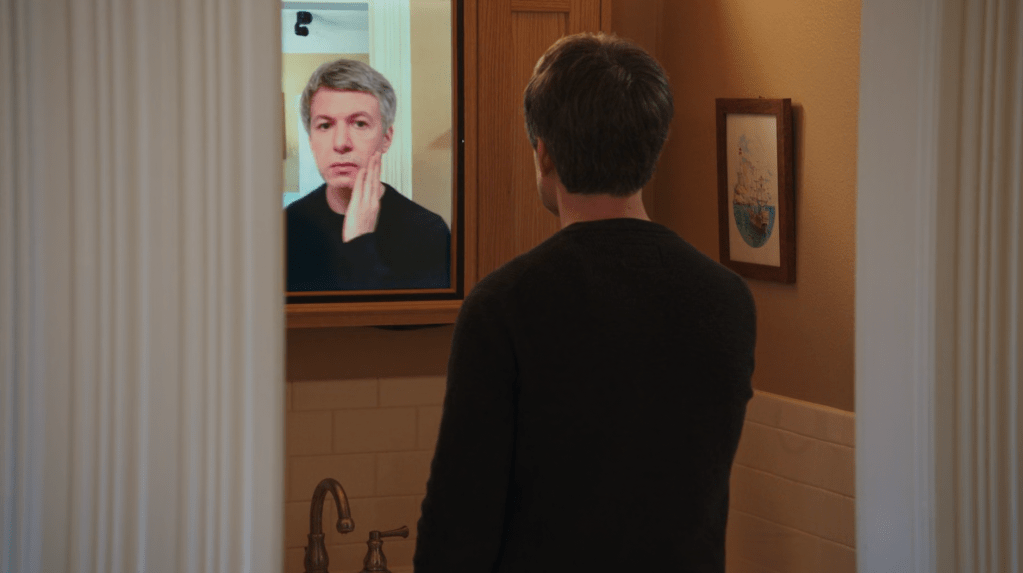
Clearly, a big part of the reason for this is that it looks good on TV. It’s just exciting and impressive and absurd to see someone build these epic sets.
At the same time, Fielder understands there are parts of experience that cannot be precisely mimicked, and that results in some of the most interesting and funny moments, like when he tries to re-live Captain Sully’s childhood to figure out how he became such a good pilot:
Like, there is just no good way to do this “for real”, so the only option is to do it as best you can given the circumstances and use your imagination to fill in the rest. Evreinov would have approved, just as he would have by Fielder being forced to compress Sullenberger’s life into just a few scenes.
In fact, there are plenty of times where Fielder doesn’t actually need detailed sets or real time simulations to get into the moment, like when he practices “chair flying” by using his imagination rather than an elaborate motion simulator:
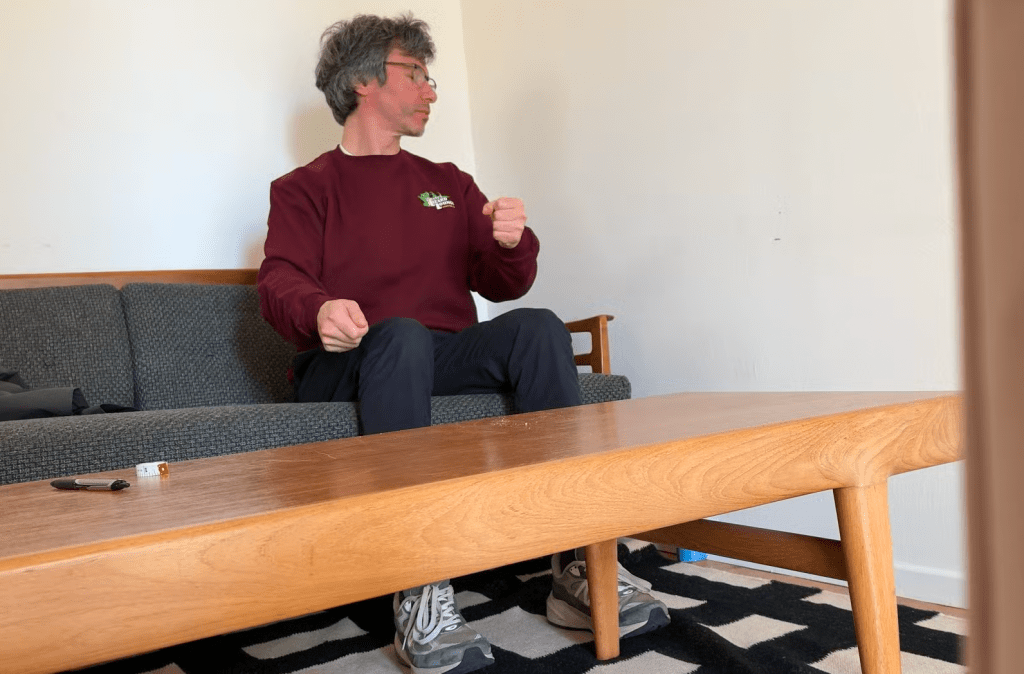
You could argue that these are exceptions for this or that reason but I think it points to the fact verisimilitude can be helpful to ease people into a new world but it’s not strictly necessary, especially when you have practice.
I don’t really have a problem with Fielder contradicting himself here, though. It’s not surprising that he doesn’t have a coherent theory of performance given that he isn’t presenting himself as a theorist. At the end of the day, he’s got to pay the bills.
That’s why he’s less interested than Evreinov in arguing that everyone should create their own Theatre for Oneself, even as he discovers what they can give to people. A constant theme in Fielder’s work is that he starts out with some silly prank or rehearsal for a mundane situation, then in the process of creating a ridiculously elaborate theatrical experience, he realises it can provide a deeply meaningful personal experience, usually when he becomes the protagonist because other people have given up or not been up to the task. It’s like he’s backing into the Theatre for Oneself.
In Season One of The Rehearsal, we see this when Fielder enters a simulation of being a father. This is transparently not “for” any functional purpose other than pleasing himself – you can tell because unlike his other work, it’s not rigidly scripted, there are no repeats, and it’s incredibly solipsistic.
And because this is a TV show, Fielder gets to use HBO’s money to hire a fake family for his Theatre for Oneself rather than asking his friends to do it, like Evreinov did.
For me, what makes Fielder and Evreinov distinctive amongst artists doing similar work is how passionately they believe that all emotions and relationships are the product of illusion and performance, and how far they’ll go to prove their point.
It’s one thing to say, like Fielder does, that, “I believe that any human quality can be learned or at least emulated. Sometimes it just takes time,” and another to carry through on that premise. It’s almost inevitable that the result looks bizarre and comical, so when you look at Evreinov and Fielder, you’re always left wondering whether these guys are actually serious.
For Evreinov, the answer is in the description of The Main Thing, which he called a comedy for some, a drama for others. And for Fielder:
Angela [Fielder’s fictional wife]: So, is this silly? Or is it something that I should take seriously?
Fielder: It’s silly and serious. I mean, it’s complicated! Life can be more than one thing, right? Life’s complicated.
Some people find this confusing, but the world is silly and serious at the same time.
Ultimately, what I appreciate most about Evreinov and Fielder is that they aren’t mean-spirited. They both seem to have realised that you can only get so far by deceiving participants. Not only can it harm them, but it’s incredibly hard to keep up a con for that long.
So while they both started out making pranks, they ended up creating transparently fake simulations and re-enactments. Everyone knows they aren’t real but it still triggers a genuine emotional response, like the woman role playing as a mother in The Rehearsal, or the actors in Smokers Allowed.
I think there’s a refreshing honesty in that. And after all, that’s really the basis of modern role play, both on tabletops and in larp.
There’s one, final, strange parallel between these two men. While Fielder’s work has been highly documented, Evrienov’s life is mostly lost to history.
So much of his early work has vanished completely. In fact, of the very first full-length play he ever wrote, the script is gone. We don’t know what it was about. We only know two things. Evreinov wrote it when he was 14 or 15. And he named it The Rehearsal.
References
Inke Arns et al., Nikolai Evreinov & Others: The Storming of the Winter Palace (Diaphanes, 2017)
Stefan Aquilina, Platon Kerzhentsev and His Theories on Collective Creation, Journal of Dramatic Theory and Criticism 28, no. 2 (2014), 29-48, https://doi.org/10.1353/dtc.2014.0008
J. Brooks Atkinson, Bitters of the Month of May, The New York Times, 5 June 1927
J. Brooks Atkinson, The Play, The New York Times, 23 March 1926
H. I. Brock, Play-Acting Viewed as a Fundamental Human Instinct, The New York Times, 15 May 1927
Sharon Marie Carnicke, The Theatrical Instinct: Nikolai Evreinov and the Russian Theatre of the Early Twentieth Century (Peter Lang, 1989)
Nicolas Evreinoff, The Theatre in Life, ed. and trans. Alexander I. Nazaroff (Benjamin Blom, 1970)
Spencer Golub, Evreinov: The Theatre of Paradox and Transformation (UMI Research Press, 1984)
Edward G. Robinson, All My Yesterdays: An Autobiography (Hawthorn Books, 1973)
Inga Romantsova, ‘Evreinov and Questions of Theatricality’ (University of Newcastle Australia, 2017), https://hdl.handle.net/1959.13/1389595
Sylvia Sasse, ‘Theatricality’, in Central and Eastern European Literary Theory and the West, ed. Michał Mrugalski et al. (De Gruyter, 2022)
Laurence Senelick, Nikolay Evreinov’s “Inspector General”, Performing Arts Journal 8, no. 1 (1984), 113-118, https://doi.org/10.2307/3245415
RUSSIAN AUTHOR CROWNS BUFFOON, The New York Times, 21 March 1927
The Redress of the Past: Historical Pageants in Britain, King’s College London, 10 September 2024, https://www.kcl.ac.uk/news/spotlight/the-redress-of-the-past-historical-pageants-in-britain


