
Jubensha has become a sensation in China since its origins in the late 2010s. A “scripted murder” game format involving a small group of players working together and against each other to solve a mystery, Jubensha has been compared to parlour games, murder mystery games, live action role playing (larp), and escape rooms.
But the scale of Jubensha – tens of thousands of physical locations, tens of millions of players – makes it impossible to pigeonhole as derivative of existing games. Many Jubensha no longer involve murders or mysteries, and digital Jubensha is incredibly popular. That’s why I was so happy to read a new open access paper by S. Liang et al., The Collaborative Sensemaking Play of Jubensha Games, deconstructing and analysing the core components of Jubensha and digging into what makes it distinctive.
The authors are stone-cold experts. The two lead authors, Shano Liang and Max Chen, were born and raised in China. They’re Jubensha enthusiasts, and one has four years experience founding and managing a tabletop games company in China. The team built a corpus of 83 games, spending over 400 hours playing and documenting them.
The paper is readable but dense, so I’m writing up notes here. Unless indicated otherwise, everything below is their thoughts in my words.
Jubensha is a script-centred group game about collaboratively understanding an unfolding series of fictional events. Games typically involve 4-8 players in a board game cafe, or, if they’re paying digitally, via app with voice communication.
Gameplay involves “distributed cognition and sensemaking” – that is, individuals analysing raw information (e.g. clues, diaries, evidence) both privately and collectively via discussion, and transforming it into intelligence with the aid of automated systems, instruments, and rules, like pilots in a cockpit flying a plane with the aid of instrument panels and manuals.
Scholars and journalists frequently oversimplify Jubensha by focusing on its detective themes (it’s a murder mystery game!) or its live-action elements (it’s a larp!). But this overlooks the scripted nature of the game, and how information is distributed amongst players.
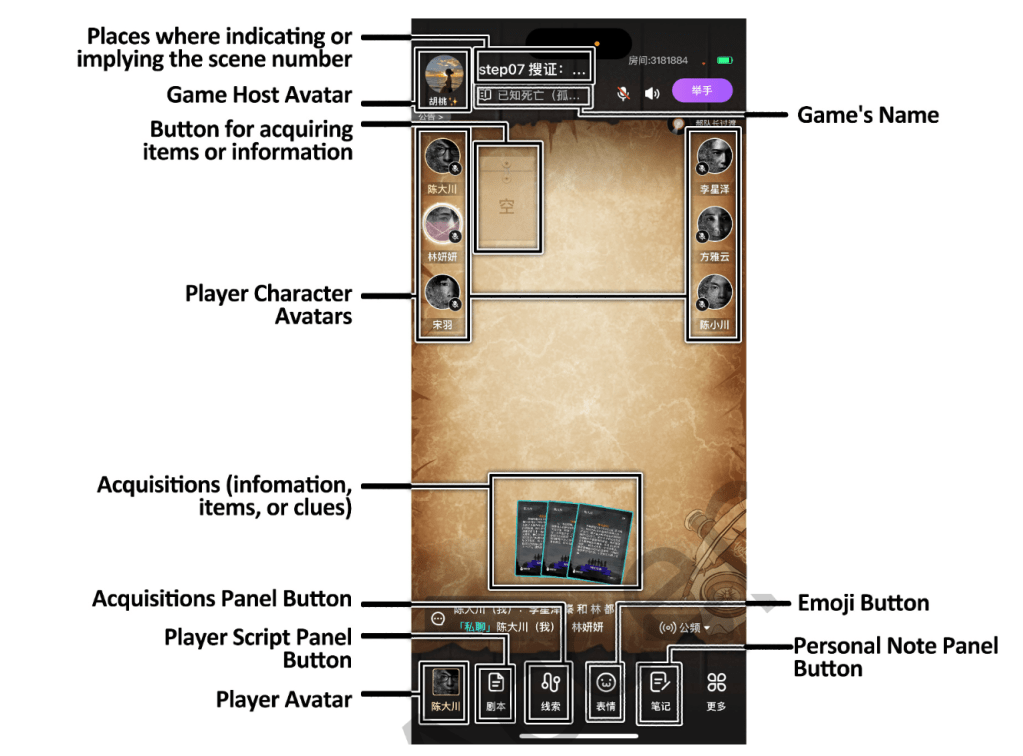
Jubensha was originally played in-person, but digital versions have become immensely popular. They are the focus of this study, though the authors also played several physical games.
Jubensha is similar but different to…
Role Playing Games: Jubensha involves joint discussion and paper inscriptions, and like larp, it can feature costumes, props, tokens, and elaborate environments to aid immersion.
But it’s different to larp because its script-centred, not character/immersion-centred: players might switch characters during a game; characters might not have detailed backstories; or there may be no named characters at all. Jubensha is not primarily about physical presence, immersion, or materiality.
[This section is puzzling. Clearly digital Jubensha isn’t about materiality or physical presence, but a lot of physical Jubensha does seemingly foreground immersion. In addition, there are larps in which players switch characters or have no backstory, usually of the Nordic/blackbox style.]
Murder Mystery Games: A lot of Jubensha games see players acting as detectives solving a murder, but not all of them. Many Jubensha have no murder themes or mysteries. Additionally, there is no randomisation in events, unlike some mystery dinner games.
Detective and Murder in Video Games and Fiction: Like games and novels, Jubensha can involve studying clues, maps, and puzzles in a predetermined sequence. But Jubensha is a social activity including performance, and each player will have different, incomplete sets of information.
Game Design
Jubensha is about distributed cognition and group sensemaking – acquiring information, discussing it to develop intelligence, and making decisions. Sensemaking is a part of many forms of gameplay, but in Jubensha, it is gameplay.
The Jubensha player community has created a number of overlapping categories of game. These are difficult to translate but include:
- Detective: Solving a mystery (with different categories for Japanese-style detective fiction)
- Immersive: Involves strong emotions and the sensation of being physically present.
- Fantasy: Involves dragons, castles, knights, etc.
- Empathy: Engaging deeply with characters and their feelings.
- Story-Restoring: Centre character relationships and secrets.
- Competition: Player-versus-player mechanics like resource acquisition or team-based mystery solving.
- Game mechanics: Incorporates board game mechanics, e.g. Werewolf, deck-building games.
- Modern: Involves cars, aircraft, computers.
- Historical: Based on real historical events.
- Time-travel
- Magic
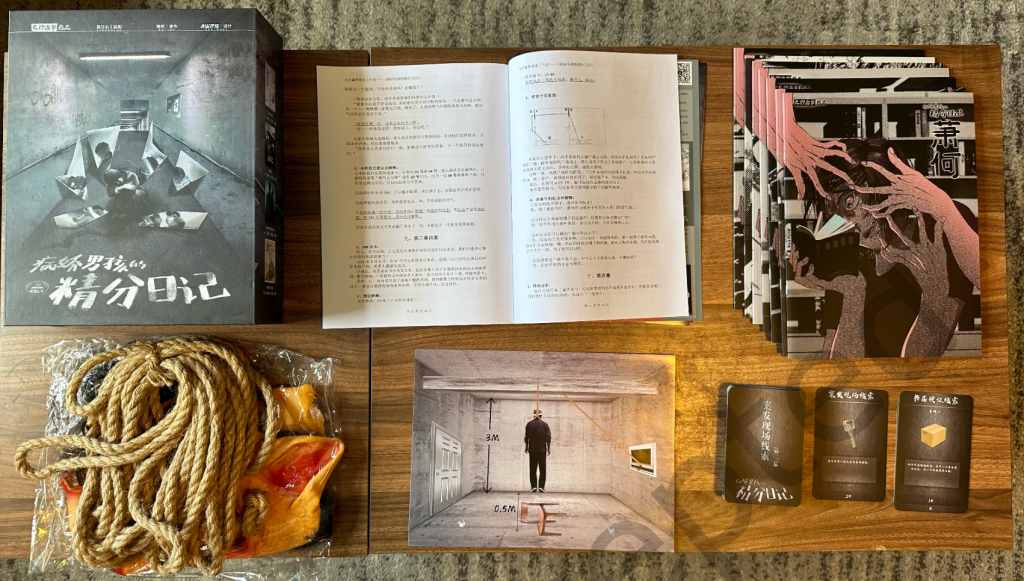
Jubensha gameplay revolves around a fixed story. This story is divided into distinct player scripts, each with its unique perspective of the story. It’s also divided into multiple scenes, which may be timed. Scenes do not necessarily unfold in order – they can occur in reverse chronology or jump around between times and perspectives. Good design means a good balance of information and involvement between players.
Design Mechanics
During each scene, players may…
- Scriptreading: Read their scripts individually, in private.
- Tablereading: Read aloud pre-written lines. This can involve stage directions for tone, emotions, and facial expressions, enabling players to bring themselves into their characters and immerse into the fictional setting.
- Investigation: Acquire items, information, clues from each other and from the physical or digital environment. Environments can be very elaborate, spanning multiple rooms and featuring actors as NPCs. This phase can be public, private, or collaborative, and there is a time limit.
- Player discussion: Negotiate, defend themselves against accusations, ask questions, deceive, etc.
- Poll: Vote to identify the perpetrator or answer specific questions. This doesn’t happen every scene, and can be in public or private.
The game host (confusingly, inaccurately called a “DM”) enforces rules, promotes player discussion, supplies hints, plays NPCs, and helps with puzzle/story comprehension in case of confusion.
Players are given mandatory and optional goals in the scripts. Goals are designed to help players uncover the story, solve the mystery, or reinforce player characters and relationships. Games with competitive elements may require players to hide or withhold secrets or mislead other players’ discussion and sensemaking.
Goals can span multiple scenes (a murderer hiding key evidence) or single scenes (withhold information within a set timeframe). They can also be optional; lovers choosing to keep each other’s secrets. These optional goals help enhance immersion.

Experience Themes
Depending on their balance of game and story elements, Jubensha can fall into three broad buckets:
- Detective: Investigation and discussion are key. Each player is typically a detective and a suspect, in that they are trying to figure out what happened in the story while also defending themselves against accusations. Collaborative sense-making is crucial.
- Affective: All about the emotional journey. Lots of interpersonal relationships, with an emphasis on dramatic tablereading performances. Stories might be romantic, patriotic, or foreground themes of compassion, friendliness, empathy.
- Social: Balanced. Rarely about solving a mystery, more about player competition, forming factions, debating, negotiation. Stories are often satirical or funny.
Physical Jubensha, with its props and costumes and use of body language and performances, is seen as more dramatic and intense. Sensemaking is more effective, probably because you can more easily tell when someone is lying.
Design Implications
Jubensha demonstrates the potential of multiplayer narratives, where each player receives a different part and the group pieces it together. It’s also very good for rapid prototyping group experiences because you just need pen and paper to write a script.
Example Games
The appendix summarises five games demonstrating different themes. These are really fun and you should read them in entirety in the paper!
The Snare of Qizhou City: Detective-focused game with realistic story. Seven players are summoned in response to a child kidnapping. The story unfolds linearly: players discover each other’s secrets, learn about child bullying in a winter camp recently, and figure out the connection between it and the kidnapping. Each scene, players get new information from scriptreading and clue cards acquired during investigation.
Taoyao, the Woman on Altar: Detective-focused fantasy game. The game unfolds in reverse chronology as six players investigate and remember their involvement in a mysterious cult across three scenes. In the fourth scene, they solve a present-day murder and solve the mystery using spells they’ve just remembered, which can involve spatial transformation and character resurrection(!!).
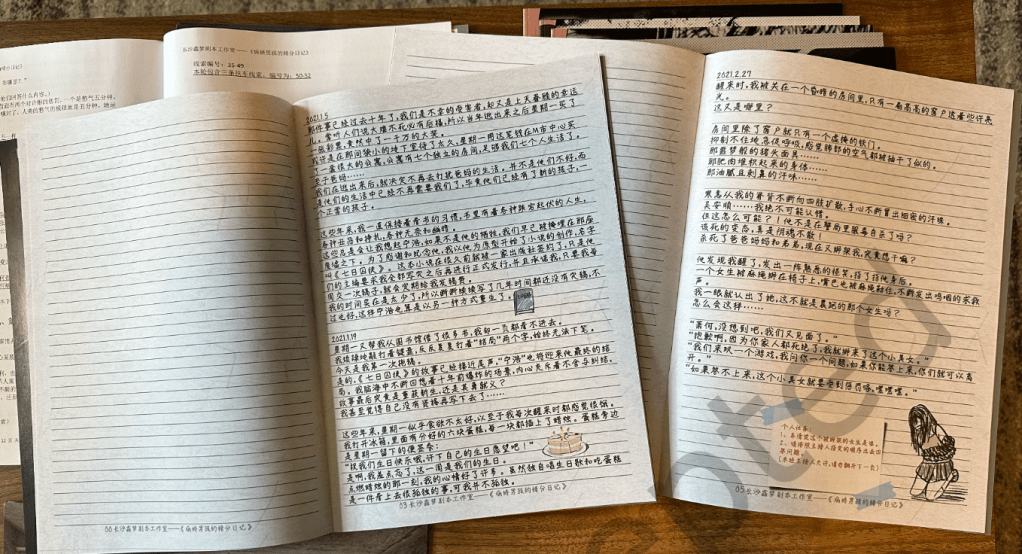
The Plural Diary of the Yandere Boy: Detective-focused game. The main character has seven personalities, each activating on a different day of the week. Players figure out which personality corresponds to which day, then there’s an escape room, and finally a big twist where it turns out one of the personalities was previously erased and their diaries faked by a serial killer, requiring a reassessment of everything that already occurred.
Little Bunny Little Kids: Affective-focused game. At first, players are animals in a fairytale solving riddles to overcome a wolf, then they realise they’re all kids with leukaemia. They embody their characters with spontaneous improvisation, confronting sickness and mortality. There is no mystery or murder to solve.
[This seems very larp/RPG-like!]
A Mouthful of Chicken Leg: Social-focused competitive, resource management, puzzle-solving game. Players are pets competing for rewards during a party at their owner’s house. They vote to identify scapegoats for trouble caused during the party, gaining random items and in-game currency through sidequests. Finally, they form groups to compete in a turn-based card game for victory, using the resources collected beforehand.
[These kinds of games seem very amenable to satire and politics, which might explain the Chinese government’s crackdown and censorship.]
Further Reading
This is me now, not the paper!
I first read about Jubensha in 2022, in the dearly departed Chaoyang Trap House newsletter. It’s a smart, funny discussion on the evolution of Jubensha, with discussion of specific games, and why it became so popular in China:
Maybe Jubensha (and its attendant apps) provide a frame for these exploratory “semi-anonymous” spaces today, allowing what Tricia [Wang] calls the “trying on of heterodox identities” without shame or anxiety.
Maybe this also explains what I always think of as the unthinkable: people playing Jubensha with strangers. I’ve seen on Dianping where Jubensha studios sell individual tickets, and I always wonder if someone would just drop in and spontaneously start playing with whoever happens to be available. Maybe not knowing the people you play with makes it easier for you to immerse yourself in your role and in the story. It’s another layer of anonymity on top of the “semi-anonymous” space provided by Jubensha’s worldbuilding.
… It seems like Jubensha are filling a Dungeons & Dragons-sized hole in Chinese social life. Working in video games in China, it was interesting for me how few of my Chinese coworkers played D&D, even as they were often on top of the latest American or European video games and TV shows. But Jubensha provide a platform for a lot of the same aspects that have helped D&D keep rising in popularity in the US, allowing people to try on new identities and play collaboratively without needing any mediating devices.
Also in 2022, an article in Distance of Touch (p86, PDF), the annual Nordic Larp book, directly compares Jubensha to larp. One Jubensha is inspired by the zombie video game Dying Light, taking place over an elaborate two-storey miniature town with day and night cycles, NPC actors assigning quests in return for food and resources (tracked via an app).
Finally, Laura Hall will be doing a deep dive into Jubensha at the Center for Immersive Arts soon, including lots of interviews. I’m looking forward to it!
Thanks to Mátyás Harpgándi for pointing me towards this paper. Check out his recent article in Anatomy of Larp Thoughts (p164, PDF) about the origins of the term “role playing” before Jacob Moreno…


 mssv
mssv 