2-3 August 2024
Tehdas Teatteri, Turku, Finland
€60 (£51 / $66)
Earlier this month, I travelled to Turku, Finland to take part in Immersion, an international chamber live-action role playing (larp) festival. I’ve been reading a lot about the tradition of Nordic larp for a book I’m researching on the rise of immersive art, and I wanted to see if the reality lived up to the hype. Immersion was the perfect opportunity: attendees could play three larps from a programme of 21, and it had a lot of creators whose names I recognised from books on Nordic larp theory.
Most people understand larps as games where people in costume hit each other with plastic swords. These are “boffer larps” and are quite popular worldwide; the Marvel TV show Hawkeye has a reasonably respectful larp scene. Many boffer larps have been running for decades, and while they often involve a lot of political and relationship drama, physical combat and individual advancement remain a central focus.
Nordic larps can also involve combat but they place a greater emphasis on collaborative gameplay rather than direct competition; players will pass up the chance to win a confrontation in favour of a more interesting and dramatic outcome for all. They also tend to be one-offs rather than long running series, allowing for situations where everyone dies or the world ends. This has earned them a reputation for being intense and dour, which isn’t entirely wrong, but is a bit like saying all prestige TV is about misery and trauma. To put it another way, if The White Lotus or Mad Men or Euphoria or Succession were larps, with all their drama and humour and sex and action, they’d look like Nordic larps.
All of Immersion’s larps were on the shorter side at around three to five hours long, and were “black box”, with little set dressing and no costumes. These constraints made them more abstract than most day or weekend-long larps, which usually have more physically immersive environments and more time to develop and inhabit characters. Still, they were designed with Nordic larp’s collaborative spirit and its aim to explore the full sweep of human experience.
A couple of weeks before the festival, attendees registered their preferences for each larp. People weren’t guaranteed to get their first choice, especially since some larps could only accommodate a few players, but as far as I could tell, everyone got a decent selection. On Friday evening, I’d start with Seaside Prison, a Palestinian-Finnish-Norwegian larp about the siege of Gaza. The next day, I’d play Cherry, Dust, Chair!, a larp set in a world where you have to buy every word you say, and finish with Monet and the Moment, an (even more) abstract sensory journey through Claude Monet’s memories.
When I arrived at Tehdas Teatteri, I spotted a few larp designers I knew from Bluesky. Everyone was I spoke to was very friendly, and most conversations were in English (all the larps were conducted in English).
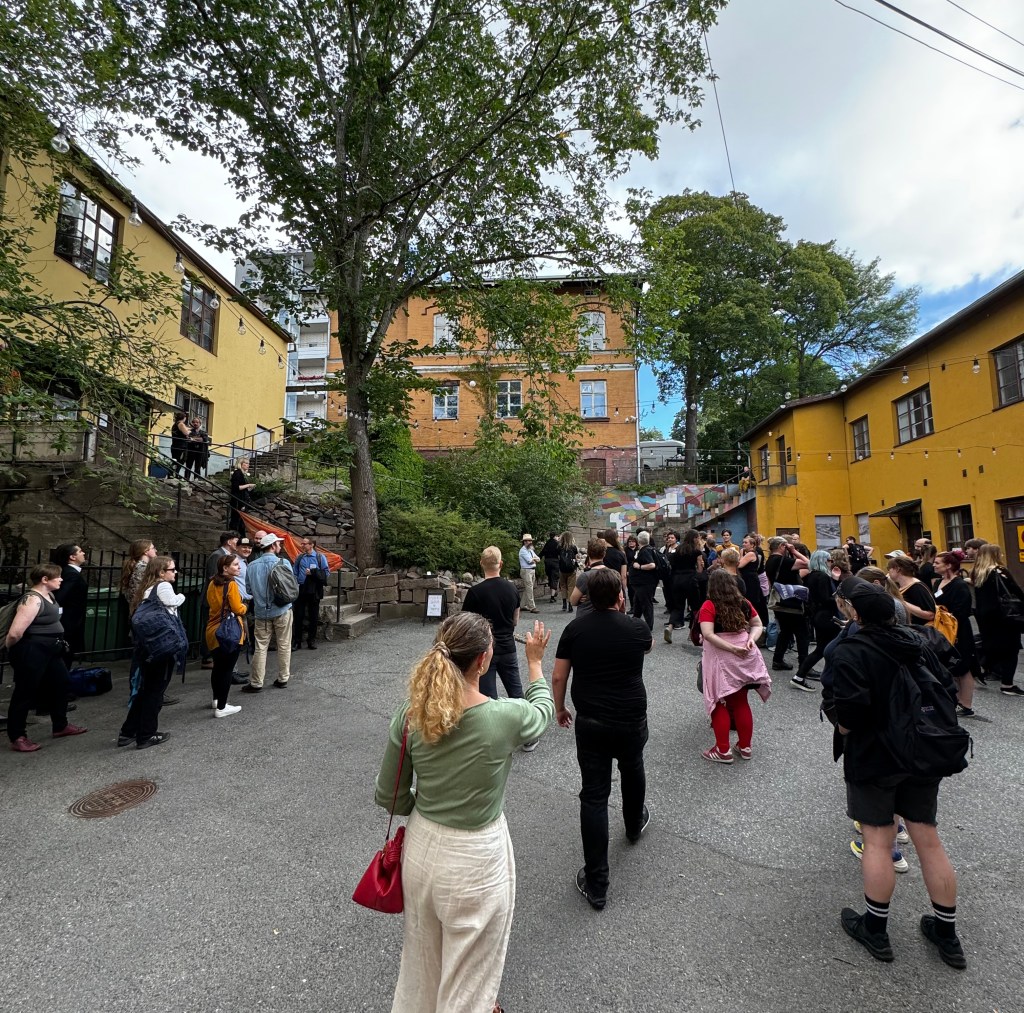
30 minutes before the first larp, everyone gathered in the theatre’s courtyard for a introductory talk followed by the important business of ensuring each of the seven larps running during that session had the right number of players. Players were directed to gather in different areas of the courtyard; if there was an undercount for a larp, they’d ask for volunteers to switch over. This was a very manual process, one that wouldn’t work if there were a lot more than the ~100 players present, but it had the virtue of guaranteeing against inevitable no-shows.
Thus organised, people grabbed free coffee and water, dashed to the toilet, and assembled for their first larp.
Seaside Prison
Kaisa Kangas, Martin Nielsen, Mohamad Rabah, Essi Santala, Hannu Sinervä and Joona Pettersson
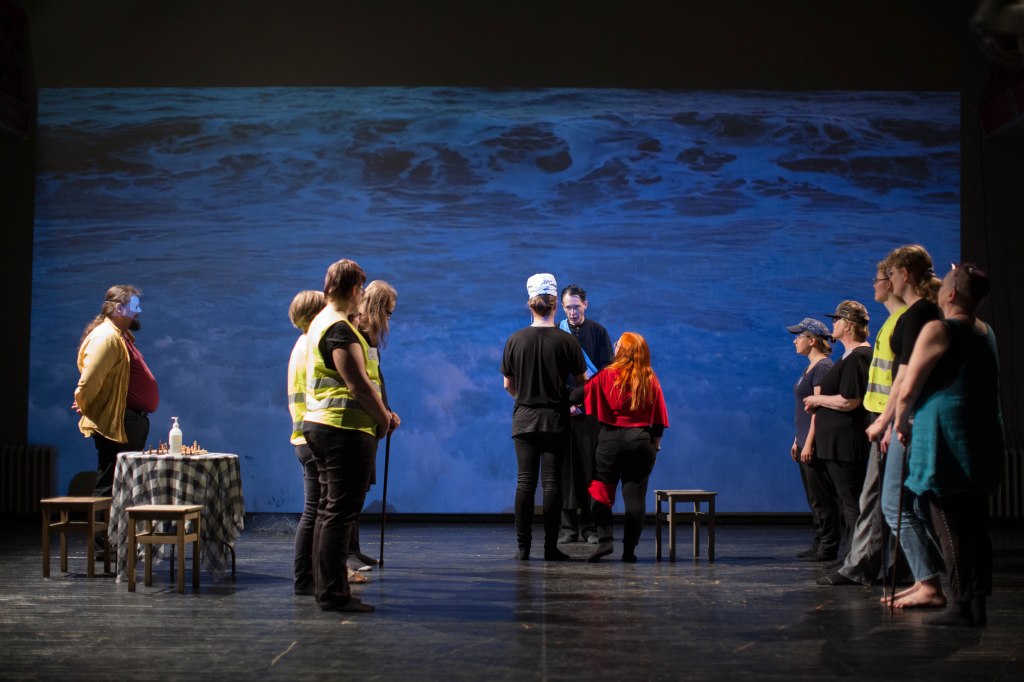
When people say Nordic larps are dour and intense, Seaside Prison may be what they’re thinking of: a political, emotionally-charged experience set in an alternate reality where Finland is under occupation and Åland Islands have become an open-air prison undergoing occasional bombardment. Designed in 2019, it was intended as an allegory of life under siege in Gaza, and was precisely the kind of highest-difficulty level larp I wanted to play, though perhaps not as my very first. As it happened, of the fifteen players in our session, three were first-time larpers.
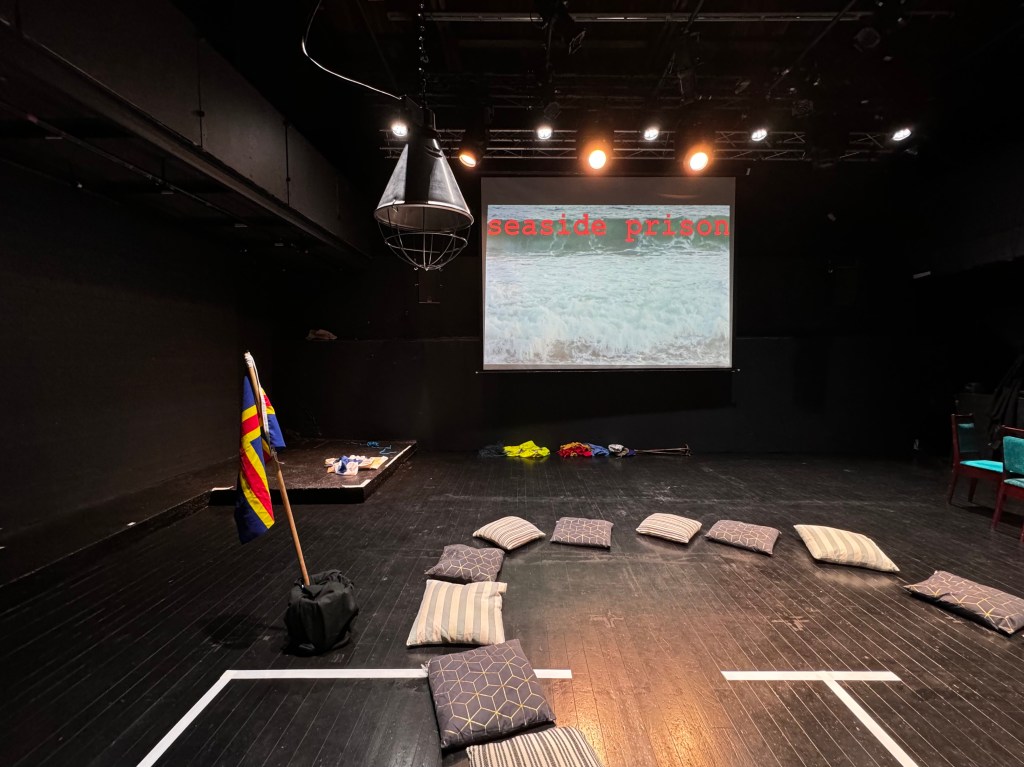
The larp was set in a large black box theatre and was preceded by a two-hour workshop – longer than the entire duration of many immersive theatre productions.
We began by watching a short video where Palestinians talked about their daily lives in Gaza and their hopes and dreams, a reminder to avoid reducing anyone to stereotypes. Next, a series of warm-up exercises that’d be familiar to any actor: walking around as different characters, practising how we’d greet friends and family in town and at home, etc. “Larping is not acting,” says the Seaside Prison website, but it’s not not acting either. Even though there’s no audience except for the other players, you’re still learning to embody a character different from yourself, and one of the workshop’s goals was helping you practice and get into the right frame of mind.
Similar to devised theatre, we co-created our characters based on loose archetypes: students, elders, fishers, and protesters. We chose which of the four we were willing to play, then divided ourselves into the Christian or atheist family. Finally, we received one-page character sheets and encouraged to change any details we liked.
Successive exercises saw us explore whether our characters wanted to stay in Finland or leave; whether we would object to a family member marrying someone of a different religion; which member of the other family we’d have a relationship with; how we’d relate to players of the same archetype, and so on. Each exercise added texture to our characters and relationships and alliances.

Not all of the exercises worked for me. I found it hard to relate to the other students with only a few minutes of chat, but overall they were well-paced. I particularly liked figuring out how my character had become friends with the other family’s patriarch, through a shared love of novels. The last time I’d had such intimate discussions with total strangers was when I did jury duty, and hadn’t even started the larp itself.
The last part of the workshop focused on structure and rules, exemplifying Nordic larp’s unusual “transparency of expectations” . The larp would take place over five days. In the mornings, students would go to school to write letters and apply to universities, fishers to the shore to gather food, elders would play chess, and protesters would organise protests. We could do anything we liked in the afternoon, and in the evening we’d return to our homes – marked out by tape – for dinner and then to sleep.
On the fourth day, there would be a wedding between the families. We agreed on the two characters in advance, so they could organise their storylines and relationship appropriately, and even practiced the cèilidh-like dance. And every night, there was a chance a bomb would fall and kill someone.
Unlike the many pointless workshops I’ve endured in my professional life, Seaside Prison’s two-hour version felt both engaging and necessary. Most of the time we were practising gameplay rather than listening to lectures; and if we’d skipped it, players would be constantly confused and breaking character during the larp. It resembled the character creation process and tutorial from a video game RPG more than anything else.

After the workshop concluded, we had a quick bathroom break, then began the game. The ensuing two hours and fifteen minutes were a total immersion into the larp, with zero interruptions or distractions from phones or anything else.
The best way I’d describe Seaside Prison is that it felt like normal life punctuated by moments of random tragedy. There was a constant undercurrent of worry – whether the fishers would gather enough food, how to tell your family you wanted to leave Finland – but it was always balanced by the routines and rituals of everyday life, like dinner and weddings and gossip and graduation.
Then a bomb would fall one night, and a person would die – first, my grandfather, with a masked angel of death leading him away. Two nights later, we would receive a phone call telling us to evacuate immediately. My whole family rushed out, but I looked back for a split second to see whether I could fetch my grandfather’s book. Right at the moment, lights flashed around the entire house and everyone left inside – my mother and father – was killed. I still wonder if that glance made the difference. I would spend the final day of the larp lost, wondering whether I could possibly abandon my grandmother to study abroad.
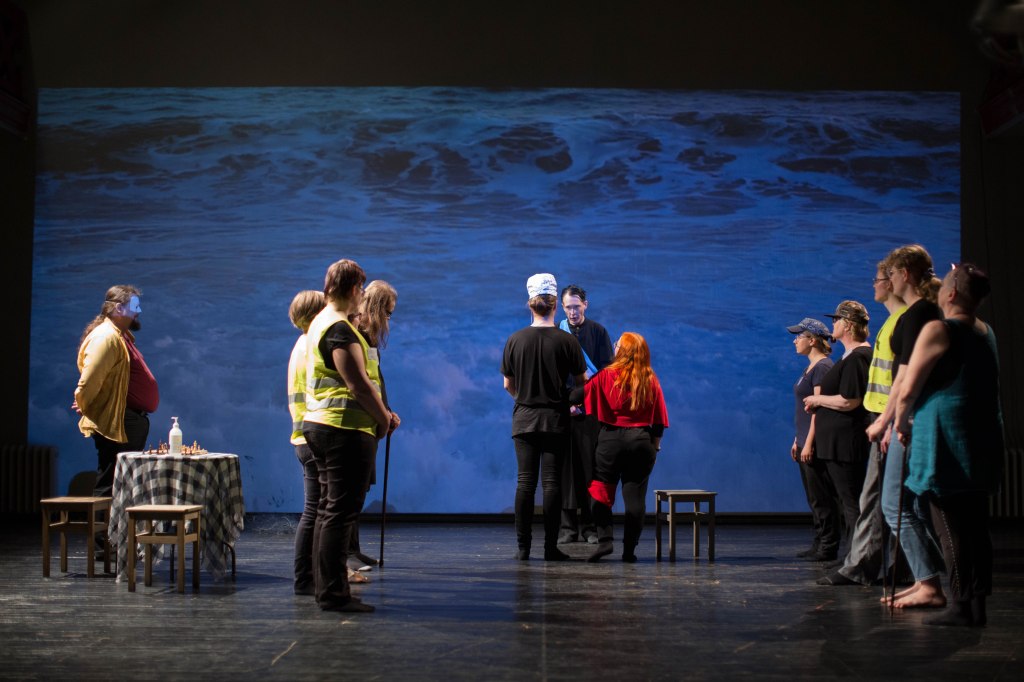
The wedding was something to look forward to, a genuinely joyous and funny occasion with feasting and dancing. Deaths would overwhelm daily life, too; but then the routine would assert itself once more, as it always does.
I remember it as this story, but it was never quite that simple. I’m not an experienced actor or role player, so I kept worrying about how my expressions were being perceived or whether I was saying the right thing. Was I being a good enough player? Maybe it didn’t matter; no-one seemed bothered, preoccupied as we all were by gossip and protests and work as the mornings and afternoons and evenings sped by, perhaps a little too quickly.
On the final day, a protester was shot. We carried them back to the single remaining house, where the angel of death hovered over them. The protester refused the invitation, but also didn’t get better. The other players fretted, wondering whether we could find medicine or water or something to ease their pain.
In this vacuum of indecision, the afternoon extended far longer than any previous one. I wondered what the larp runners would do. Would they step in and force events to move events along? Would the angel of death pull the protester away? In the end, the players – all still in character – began sitting down. Even while death was hovering, we still had to eat, and sleep.
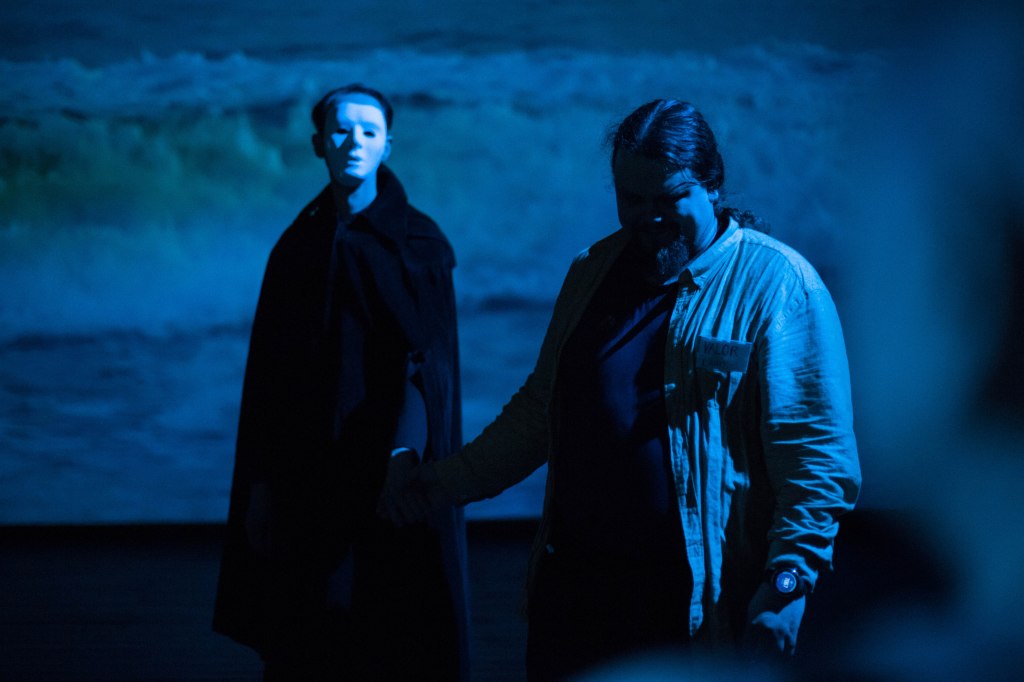
The larp concluded, and a half-hour decompression began. We talked about what had happened and what our characters might have done next, then sat for a live Zoom call with Fatima AbdulKarim, a Palestinian larper living in the West Bank. Fatima saw larp as a way for players to imagine what it’d be like to live in a similar situation as Gazans and to understand their feeling of injustice.
It is worth noting at this point that Seaside Prison was co-created by Mohamad Rabah, a Palestinian. That doesn’t insulate it from criticism, but it should inform any questions about cultural appropriation. Nothing about the larp felt trivial. The larp might give players the false impression they know what it’s like to be in Gaza, but its alternate universe setting and the contextualising videos and Zoom call are all attempts to correct any such misapprehensions.
I’m still unsure how I feel about Seaside Prison. I’ve literally only ever played three larps, so I don’t have much to compare it to. One experienced larper told me that she liked it, though she found it much harder to get into character than her preferred multi-day larps.
What I do remember are the pride and guilt of receiving a ticket out of Åland, my mother’s hand on my arm as she gave me her blessing to leave, a fatal last glance back as a bomb exploded, and spinning through the joyfully chaotic wedding dance.
Seaside Prison is a followup to Halat hisar, a two-day Palestinian-Finnish larp. There’s a free book on Halat hisar’s design and inspirations, with reflections from Palestinian players.
By the time we finished, it was almost 10pm, so I went straight to the bar and assembled several sandwiches out of soft boiled eggs, cheese, flatbread, etc – open-faced, of course. The free and unlimited vegan food helped keep players on site rather than fracturing into cliques, so I had a good chance to talk to my fellow players over beers.
I kept thinking back to the two-hour workshop. They’ve become a well-known component of Nordic larps, spoken of in hushed tones by immersive theatre-makers in the UK and North America. How could we possibly do such long workshops and make money, one director has asked me. How can we not do workshops knowing how well they work, asked another.
People have speculated to me that workshops are only possible in the communal Nordic societies, that audiences and players in other countries would never tolerate them. Not true, says Juhana Petterson, a Finnish larp designer I interviewed:
In the Finnish larp community here, there was a lot of resistance to this idea of workshops. For us in Finland, workshops as a concept were like a foreign idea. The original Finnish style was just, everybody’s standing around, “Okay, larp starts now, go in-game.” And that was fucking awful, and I hope we never do that again
… I didn’t understand workshops until I got into it and experienced them in other larps. But as recently as 2013, we still had to kind of justify it and explain, when running a larp in Finland, like, “Okay, this is what we have to do. This is an exotic, amazing, modern, foreign style,” because it was not the Finnish style.
I wouldn’t go so far as to say that the workshops I did were fun, but they were interesting and worthwhile. In fact, I wonder whether the problem of their acceptance outside of Nordic larp is simply one of framing. If you told punters they’ll get a highly interactive, expert-led training session teaching them valuable acting and collaboration skills, they might have a very different reaciton.
That’s the capitalist in me. The socialist sees workshops – and larps – as a gift, one that can never be truly profitable without fatally compromising their radical inclusivity and collaborative nature. A ticket to the Immersion festival only cost €60 – you’d be lucky to get a couple of hours in any other immersive experience at that price, let alone twelve hours’ worth, and certainly not one with such a high ratio of staff to players.
That low cost is thanks to subsidies and donations-in-kind by various institutions and government bodies, not to mention practically everyone volunteering their time, but hey: that’s the point. It’s probably why the larp runners looked very different to the video game designers I usually meet at conferences – more women and more older people – and why the players were so diverse.
Cherry, Dust, Chair!
Cherry, Dust, Chair! is set in a land where people hardly speak, where every word needs to be bought. Players are on a train, stopping at stations where stray balloons from the word factory float by, containing precious words.
The obligatory hour-long workshop began with “walk like this” warm-ups, meditation, and exercises where we communicated messages and feelings using only gestures. During one exercise where we had to declare our love to another player, I foolishly tried to do a Hugh Grant and only realised too late that his stuttering romcom shtick required speech. Most players were very good, however.
Character creation involved picking two positive emotions and one negative emotion from a pile of suggestions, then “remembering” moments where they combined in our past. Relationships were made randomly: we gathered in groups of five and picked our best friend, former lover, current love, and someone whom we owed our life to. This was done in total silence, so of course everyone picked different people, laying the seeds for a half a dozen love triangles during the larp.
Cherry, Dust, Chair! was much less structured than Seaside Prison. During the hour-long larp, players either sat or stood in the train (its outline taped on the floor) or walked around on stations, where there were sometimes balloons to catch and music to listen or dance to. If you had a bunch of balloons and a tank of helium, you could run this larp pretty much anywhere with minimal preparation.
The lack of structure meant the drama was generated entirely by players. In my group, one player kept giving me the remnants of popped balloons; she was my former lover but I didn’t have the heart to completely reject her. Another player was fortunate enough to pop a balloon containing the word “you”, which he declared to his love. Sadly, he was tragically misheard, resulting in wordless arguments and tantrums for the rest of the train ride. By coincidence, I had a reciprocal love to whom I said the word “journey”, so I had a pretty easy time of it, only occasionally resorting to The Sims-style emoting.
The balloons were deeply fun objects to play with. The first balloon was lost when the player who caught it detached the string by mistake, leading to lots of anguished gestures. Players flung themselves on balloons to pop them, passed them to one another in acts of devotion, jealously hugged them, and carefully untied them.
At one station, the larp designer appeared as a character on a phone call. Everyone was shocked at how she carelessly spoke word after word after word, but as the call went on, its importance became clear and the words seemed more judiciously chosen than I imagined.
Even though this was a very short larp at one hour, players had endless stories to share during the debrief and over lunch. I don’t think I’ve ever seen people bond so quickly outside of exceptional circumstances like an accident. Larp’s ability to bring people together in a kind of accelerated hypersociality is incredible to see, the effect of having such a high density of powerful, charged moments.
As for Cherry, Dust, Chair!, it was a lovely fable about how we can and can’t know what we mean to others.
One of the unexpected joys of smaller festivals is getting to have long post-larp chats with designers and runners and players. When you finish an online multiplayer game, it’s rare to have any continued contact with other players, let alone the creators. This is not to elevate chamber larps above other forms of art or entertainment – I’ve made good friends through MMOs and ARGs – but to highlight a strength of larps’ small scale. Over lunch, I learned this was Cherry, Dust, Chair!’s twelfth or thirteenth run, and first since Covid lockdowns. Apparently there were 30 balloons in total for around 15 players, and our group was unusual in popping them as soon as we caught them; most players in other runs hoarded their balloons.
Immersion’s generous three-hour breaks between larps made up for what this Scot found to be oddly-timed sessions starting at 11am and 5pm. That’s lunch and dinner time! For Saturday’s lunch/dinner, we had vegan sweet potato soup, with various protein-heavy toppings. Again, it wasn’t the most extravagant meal, but it was perfectly decent and filling.
Most people at the festival were Finnish, and curious why I’d flown over. When I mentioned I was writing a book, they invariably brought up two topics, the first being their irritation with immersive theatre. It wasn’t that everyone hated it as much as they felt immersive theatre boasted a degree of participant agency that paled in comparison to larps. There’s definitely truth to this – many theatre academics seem to have been totally ignorant of larps until very recently – but a lot of the immersive theatre makers I’ve spoken to are respectful and admiring of Nordic larps, if not in awe.
The other topic that kept coming up was Disney’s Star Wars: Galactic Starcruiser, in part because a lot of designers had read my review. I kept being asked whether it was true that Starcruiser guests didn’t talk to each other. I explained that while it wasn’t technically necessary for guests to speak to one another outside of scheduled activities, I spent hours talking to strangers in the bar. These were some of the most fun moments of the experience for me, and I agreed it was a shame that some guests didn’t feel inclined or comfortable doing so.
This wasn’t a very satisfying answer, and people remained mystified why guests wouldn’t spend all their time talking to each other (no workshops!). Still, they were impressed by Disney’s ambition and felt its cost was reasonable compared to other highly-immersive multi-day “blockbuster” larps. Given Nordic larp’s broadly non-profit nature, this might seem surprising, yet one person expressed his frustration with what he felt were ill-founded critiques of the Starcruiser, “not that Disney needs me to defend them,” he added. Nordic larpers are nothing if not evangelists for their art. Perhaps that’s why they’re willing to defend Disney, though they might have been just as apprehensive had it been a phenomenal success.
Monet and the Moment
Ann Kristine Eriksen and Danny Wilson
Monet and the Moment is an abstract larp about journeying through Claude Monet’s memories and reliving his obsessive chase to capture the fleeting “Moment” – the perfect combination of light and colour and atmosphere in a scene.
Players adopt the role of an elderly Monet reminiscing about his paintings, periodically becoming the younger Monet at work. Players also can become an anthropomorphised version of the Moment itself, along with onlookers and characters related to the painting.
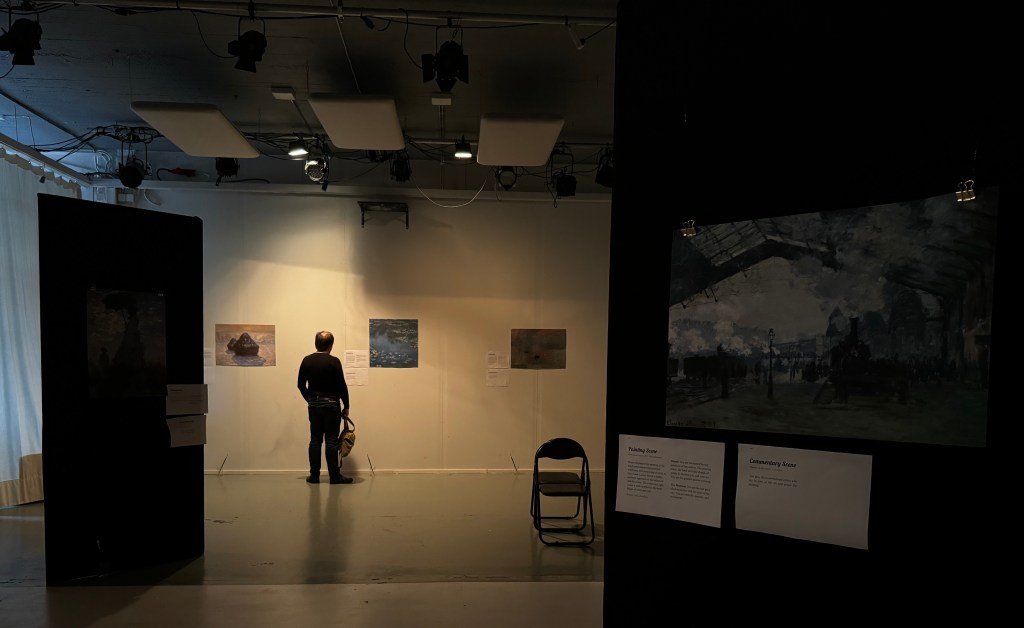
Monet and the Moment was easy to learn. The workshop was only an hour long and began with a brief history lesson about Monet and Impressionism. The creators were at pains to note that despite its historical nature, their larp wasn’t about Monet’s literal life, but rather about using history to understand the life of an Impressionist artist.
Next, we practiced playing the larp. The space was decorated like a traditional gallery, hung with reproductions of Monet’s paintings. As we walked around the space, we were all playing “old Monet” inhabiting memories of his youth, meaning there could be a dozen old Monets at the same time.
Below each painting was a label with its “Painting Scene”. This explained what Monet was thinking as he worked on the painting, and what the “Moment” was thinking, too. When a player picked up a brush next to a painting, they adopted the role of young Monet as the painter, waiting for another player to arrive as the Moment. Young Monet would then wield their brush as if painting the Moment, all the while verbalising his thoughts, with the Moment responding in turn.
For example, below a painting of Gare Saint-Lazare was a brief description of its aesthetic portrayal of the industrial and the urban, plus a “Painting Scene” with prompts for Monet and the Moment.
Monet: You are enchanted by the spectacle of the station. The moving trains, the hard steel and clouds of steam. It elevates you and your art. You are the greatest painter yet seen.
The Moment: You are the fast pace of the locomotive and the noise of the city. You are intensity, passion, and excitement.
People played this “Young Monet” as an energetic, arrogant man at the height of his powers, arms waving and eyes darting. “The Moment” was more varied; some players talked back to Monet, passionately encouraging him to paint their strength and scale, while others would be more animalistic or even wordless. This was one of the more fun prompts, but others were demanded confrontation: young Monet heatedly arguing with the Moment, the two disagreeing about what and how he should paint.
There was no time limit to each scene, but it was pretty obvious when either player wanted to end it, storming off in a huff or declaring the Moment perfected. The players would then walk away, both becoming old Monet once again, lost in his memories.
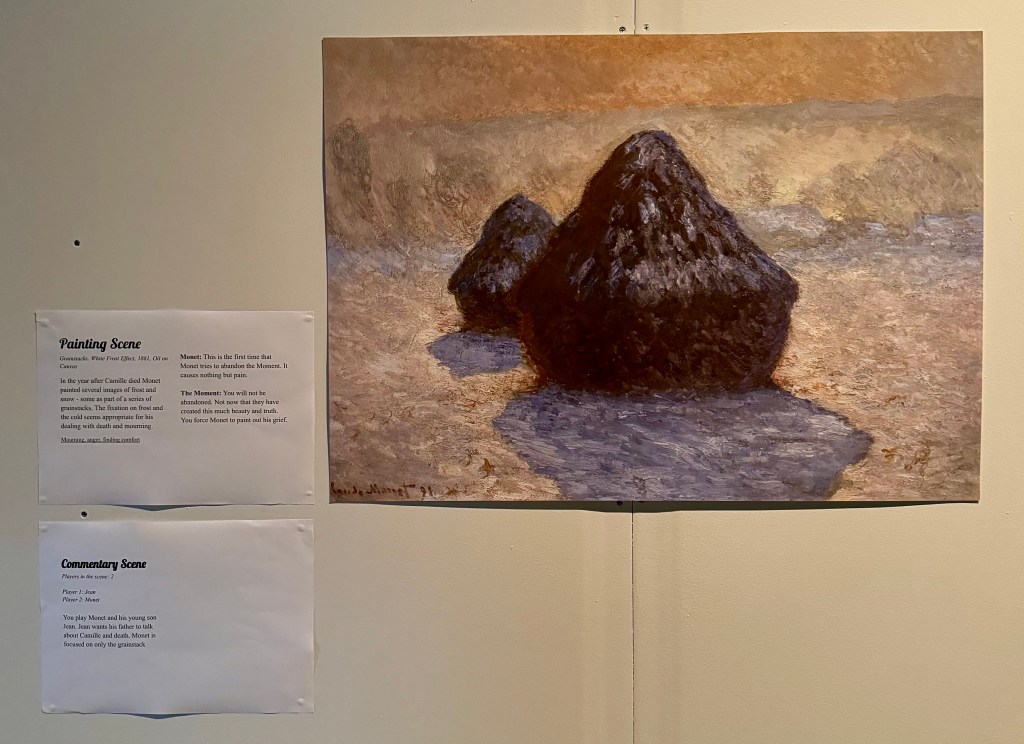
Players could also become commentators on a painting by following the prompts on its “Commentary Scene” label. Sometimes these were easy; for Gare Saint-Lazare, players would become overwhelmed critics praising the painting. For Haystacks, the prompt was more painful, with players becoming Monet and his young son Jean. Jean wants his father to talk about his mother Camille’s death, while Monet is only focused on the haystack.
The creators described their larp as a buffet, and as a game with lots of toys to have fun with. Players were free to drift in and out of scenes in any order, though people would usually respond to the invitation of a young Monet holding a brush or someone looking to commentate with. Some people replayed the same scene many times.
During the two-hour larp, only a few of the nine paintings were “active” at any time, denoted by spotlights. I assume this was partly to ensure players weren’t too spread out, but also to shape the experience, since prompts were periodically changed for paintings to give them new meanings and relationships. As new paintings cycled in, a story of Monet’s increasing obsession and fame and his deteriorating family life emerged, one that players literally inhabited but could also watch being played out in a dozen different ways.
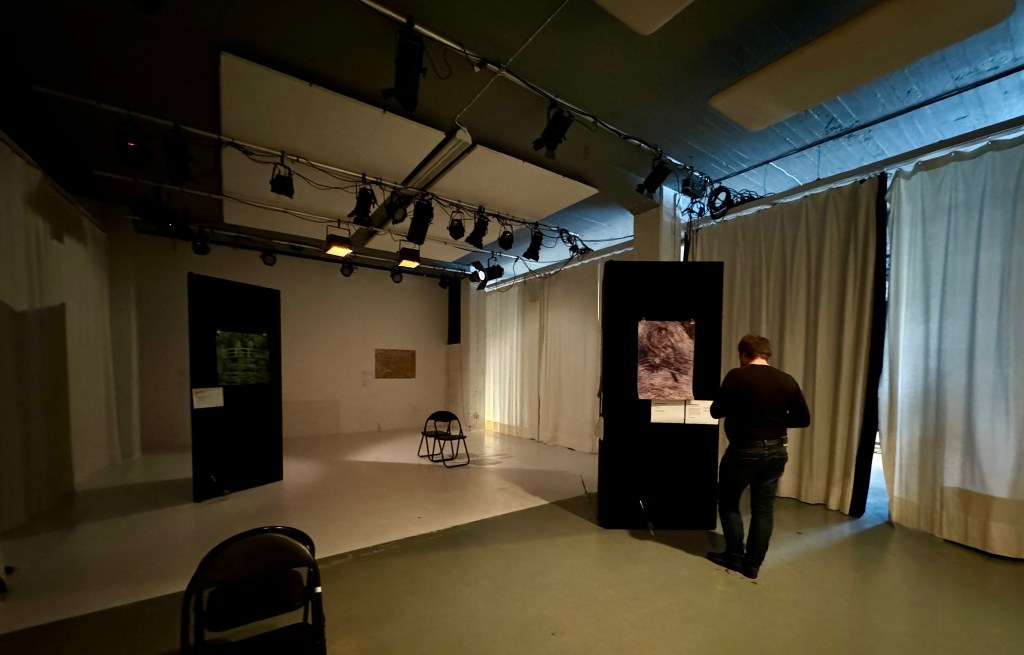
Monet and the Moment was surprisingly challenging for me. I tried to be a good partner, but I felt distinctly inadequate as an actor and improviser. I can see myself getting better by playing more larps, but not very quickly. It was emotionally draining to inhabit characters in the depths of mania and grief, and physically tiring to be walking and “painting” for two hours (though there were plenty of chairs to sit on). There was no obligation to do anything at all – I stayed away from some scenes that I didn’t feel capable of acting well – but pretty much everyone gave most scenes and roles a good shot.
As time went on, the themes became darker, with Monet desperately trying to recapture his former glories. The number of active paintings gradually dwindled until only the Water Lilies was left. The prompt was simple: Old Monet has found the perfect Moment once more, painting it as powerfully as he ever has; and the Moment urges him on. Commentators were to copy Monet and the Moment, but at an even more ecstatic level.
I took turns in every role, then I stepped back, watching a collage of a dozen Monets and Moments circling each other in mutual rapture. I knew it was madness but I exulted in the memory. Some were better at emoting than others, but the overall effect was like hearing an orchestra attain a sublime harmony. It was the perfect moment to end the weekend on.
Until this festival, I’d never really understood why Nordic larp designers found alternate reality games (ARGs) so appealing. What did games played mostly online have in common with fully-embodied Larps? Immersion helped me realise that ARGs and larps both encourage players to try anything they like, with good designers working to support those goals in real time. Players are expected to spend most of their time entertaining and talking to each other, so the success of a game very much depends on the community.
Where ARGs and Nordic larps differ is in their transparency. Many ARGs still refuse to acknowledge they are games, believing their power lies in the unalloyed suspension of disbelief. Nordic larps rejected this binary thinking some time ago, employing workshops and safety mechanics to support greater in-game immersion. Designers believe it’s easier to lose yourself in a larp when you’ve already been trained on what to expect and how to act and play.
This level of transparency may seem anachronistic in our era of spoiler culture, but it’s better to understand it as a transparency of form and expectations rather than of content. When people watch a movie, they know its duration, genre, director, actors, and age rating. They expect twists from M. Night Shymalan, a happy ending from a romantic comedy, and end-credit teasers from Marvel blockbusters. We’ve developed the same understanding of video games, whether they’re Soulslikes, city builders, or match-3 puzzlers. Knowing the form doesn’t detract from the experience, it enhances it.
That’s not to say surprises are never welcome. One of my favourite moviegoing experiences was, appropriately enough, Yorgos Lanthimos’ The Favourite. I saw it at an industry screening and I had no idea who was in it or what it was about, which only sharpened the pleasure. But most people aren’t looking for that when they watch a movie, and even then, I still knew it wasn’t a horror or superhero movie. Shock and awe isn’t everything.
The other thing to note about Immersion is that it had very good organisation. Everything began on time, all the tech worked, every room was signposted, and every larp had the players it needed – no small feat. Player safety was always highlighted, but not to the point of distraction.
While chatting to a larper, I remarked on this by way of a bad experience I had during the Watch the Skies megagame. I was playing a journalist, interviewing politicians and writing newsletters, when one player accused me of deliberately misquoting her. She was so angry and abusive I seriously considered walking out entirely. The game’s staff didn’t help, leaving the conflict to fester. The larper noted that too many game designers “won’t take ownership” of player conflict, leaving it for players to resolve. Anyone who has a bad experience may never return, resulting in a diminished player base.
Nordic larp, in contrast, takes great pride in its diversity. Kaisa Kangas, artistic producer of Immersion, told me that there are now more women in the Finnish larp scene than men – a big change from the 90s and 2000s. I saw that reflected in Immersion’s demographics, which also had a wide range of ages and genders.
For some creators, all this talk of safety and workshops and inclusivity can sound like a chore. Why go to so much effort for a handful of players when you could make a video game played – and paid for – by thousands or millions? But there’s a refreshing lightness to making smaller games. When you can literally see every player, you can fix things if they go wrong. With trained players are responsible for so much of their experience, with successes and failures equally reported on wikis and blogs and annual books, Nordic larp as a whole becomes antifragile – it gets stronger and better when exposed to shocks and disasters.
Fully a quarter of the festival’s participants were larp designers and runners. I imagine running a Nordic larp is scary, but it’s also exciting and rewarding, especially when you get to talk to all the players afterwards. Some black box larps at Immersion also seemed to require a lot less preparation than many D&D and TTRPG sessions. I’m already designing my own larp on the side, called “Yes Chef” – no prizes for guessing what it’s inspired by.
Coming from two decades of designing ARGs and smartphone and video games, I frequently succumb to the belief that technology always deepens immersion: my game Zombies, Run! was only possible thanks to handheld computers with accurate GPS tracking, touchscreens, and internet connections. We think the Apple Vision Pro and 70mm IMAX screens and 4DX cinemas will give us more immersive experiences than anything we’ve had before.
We aren’t wholly wrong to think that. Technology is a crucial component for Nordic larps too – even black box larps. Seaside Prison’s house was marked out in tape, but it had a huge projection screen and complex lighting and sound system. Even Cherry, Dust, Chair! needed a laptop.
That’s not the main source of Nordic larp’s immersive capabilities, though. More important is the decades-long focus on culture and player skills. Larpers call this “herd competence” but if I were describing it in Silicon Valley, I’d call it a social technology – a body of social practices and agreements that enable high-trust, high-risk gameplay.
Nordic larp’s social technology creates a space where players can have fully embodied immersive experiences that aren’t even close to being realised in virtual reality. The brush of a hand on your neck; the mad scramble for an escaping balloon; the feeling of weariness at the end of your life; and a gleeful wedding dance in the midst of a war.
You can find upcoming events on the Nordic Larp wiki.
If you’re interested in learning more about Nordic larp, check out the free Knutepunkt conference books – the 2019 book on Larp Design is a highlight.
For Evan Torner’s concept of transparency in larps, see p14 in the 2013 WyrdCon Companion book PDF or p98 in the Larp Design book above.
For Teresa Axner’s term “herd competence”, see p21 in Larp Design.


 mssv
mssv 