London, UK
£40-60 per person
Parabolic Theatre
1 hour 45 minutes
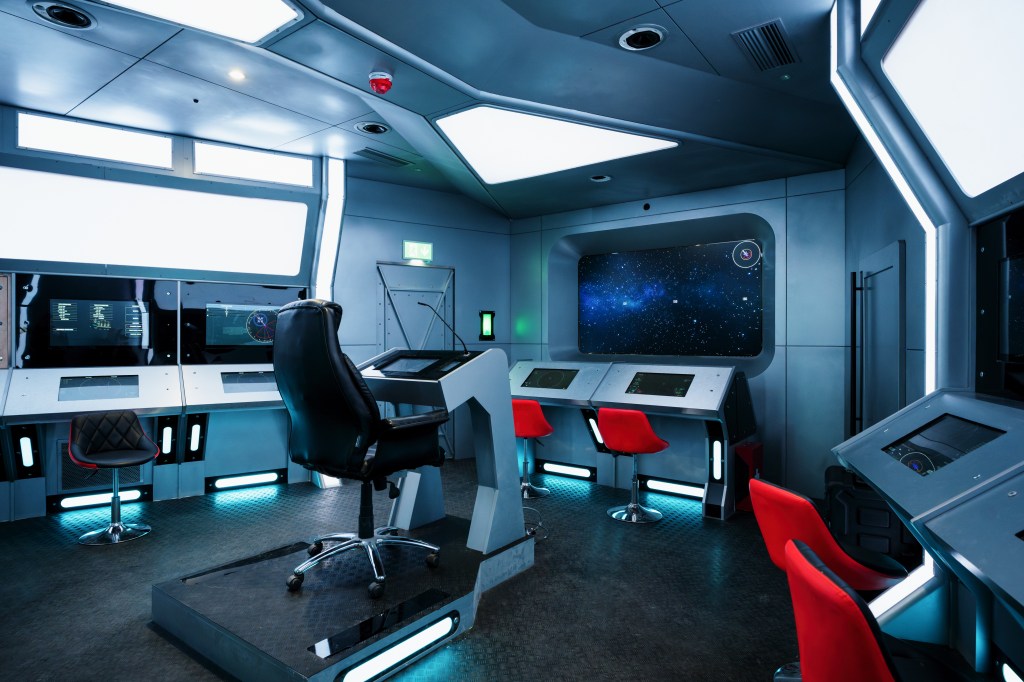
Bridge Command is a starship bridge simulator where crews embark on diplomatic, military, and exploration missions. The action centres on the bridge, where players run navigation, engineering, weapons, and comms stations, but the ship also houses a sickbay, hangar, engineering areas, and even a six-person shuttle that can take on separate missions.
Much of Bridge Command resembles a multiplayer video game, being powered by a customised version of the open source EmptyEpsilon simulator, which itself was inspired by the 2010 Artemis Spaceship Bridge Simulator. Artemis has many key features of the 2002 Star Trek: Bridge Commander video game (still admired by fans) like combat, power management, and diplomacy, but it introduced two key features.
Firstly, each station was represented by a separate computer, with players usually arranged around a big screen or projector serving as the bridge’s viewscreen. Secondly, Artemis included a role for gamesmasters (GMs) to control scenarios and stand in as non-player characters (NPCs). These innovations shifted the game into the realm of live-action role play (LARP), especially if players wore uniforms, constructed sets, and acted in character.

The 2017 game Star Trek: Bridge Crew incorporated some of these innovations while adding its own: it was developed specifically for VR. Despite being widely seen as a rip-off of Artemis, the game received favourable reviews. Most recently, the free (but not open source) Unreal 5-powered Starship Simulator raised £400k on Kickstarter this April.
My favourite bridge simulator experiences have been at both ends of the realism scale. There was the Spaceteam co-op smartphone game (now also a card game), where players would shout commands like to each other “engage eigenthrottle” and “everybody shake!” Then there was the fully immersive LHS Bikeshed: a caravan converted into a spaceship, its interior festooned with switches, knobs, screens, and flashing lights. You can see the inside thanks to a video by a young Tom Scott! And I’m sure there are many more bridge simulators I’m not aware of.
But Bridge Command is different. It hosts up to 14 players, more than any other game I’ve mentioned. Unlike the LHS Bikeshed, which is sadly no more, it has a permanent location in central London with a multi-room set that cost £3 million to build. Stories can continue over multiple visits, with players earning promotions. But most of all, it has live actors and is controlled by a live GM. As such, it fully overlaps with D&D and role playing games and LARPs, which is probably why it was made by a theatre company.
Bridge Command is the most thrilling two hours I’ve spent with a small group, and it augurs the breakthrough of deeper, more interactive, and more accessible immersive experiences.

My recruiting efforts began weeks in advance: ships can be crewed with as few as four players, but I wanted maximum chaos on my voyage. That meant convincing thirteen friends and acquaintances to travel into London for the best part of a Saturday – and contribute to the cost. This wasn’t as hard as I expected (more on that later), but it still involved a lot of organisation.
Everyone arrived more or less on time at the venue, just a start walk from Vauxhall tube station. We picked out jumpsuits and sweaters out of a pleasingly broad array of sizes and options, and velcroed on various rank patches. This was a good opportunity to get into character as a team, since most people hadn’t met before. Sadly, I forgot to take a “The Right Stuff” photo before heading up the ramp into the teleporter:
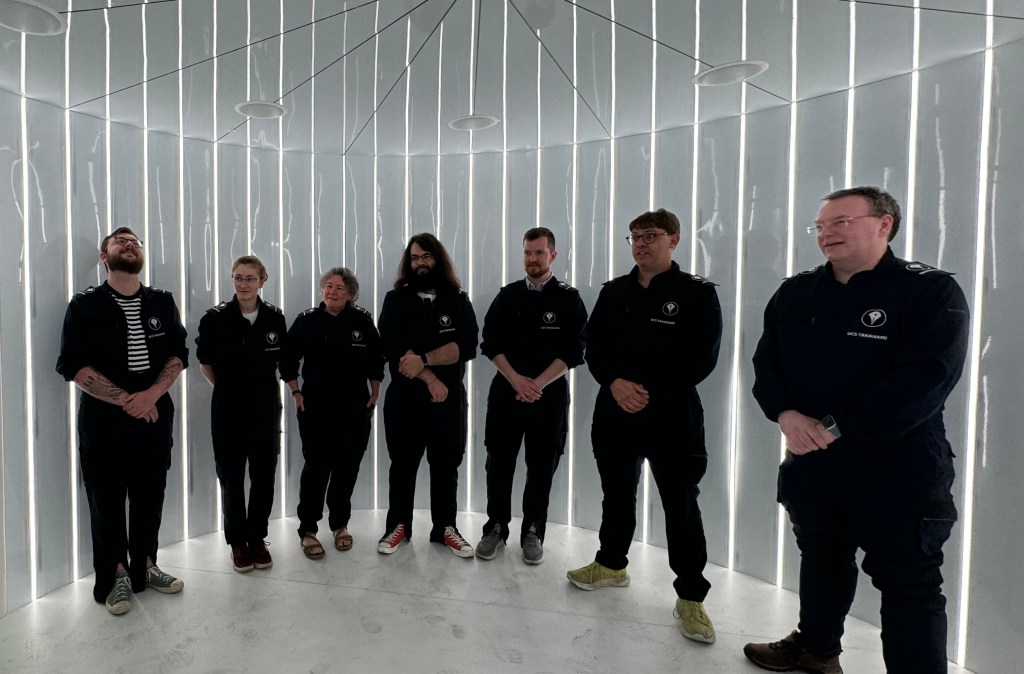
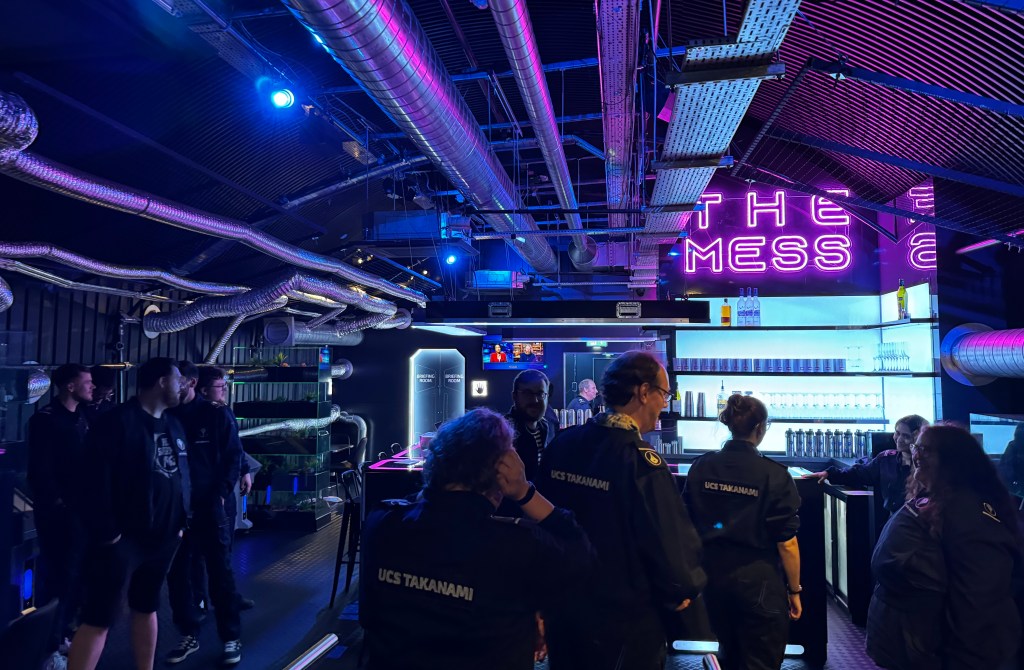
We were instructed to take a deep breath as lights raced around the room and a computer read out technobabble. The disorienting effects conveniently disguised the fact the entire room was rotating so its single exit now led to the venue’s bar, which was already hosting another crew (hence our velcroed starship name). We’d travelled over twenty light years, onto the UCS Warspite and into a whole new star sector.
Bridge Command’s thread of kayfabe began in earnest here. Some bar staff were role playing while proffering iPads to register our player details; drinks could be ordered from a menu with plain old terrestrial names, but they were poured into sci-fi metal canteens. I have a sneaking suspicion that half my crew were downing beer and cocktails during our first space voyage, thankfully with no ill effects on their performance.
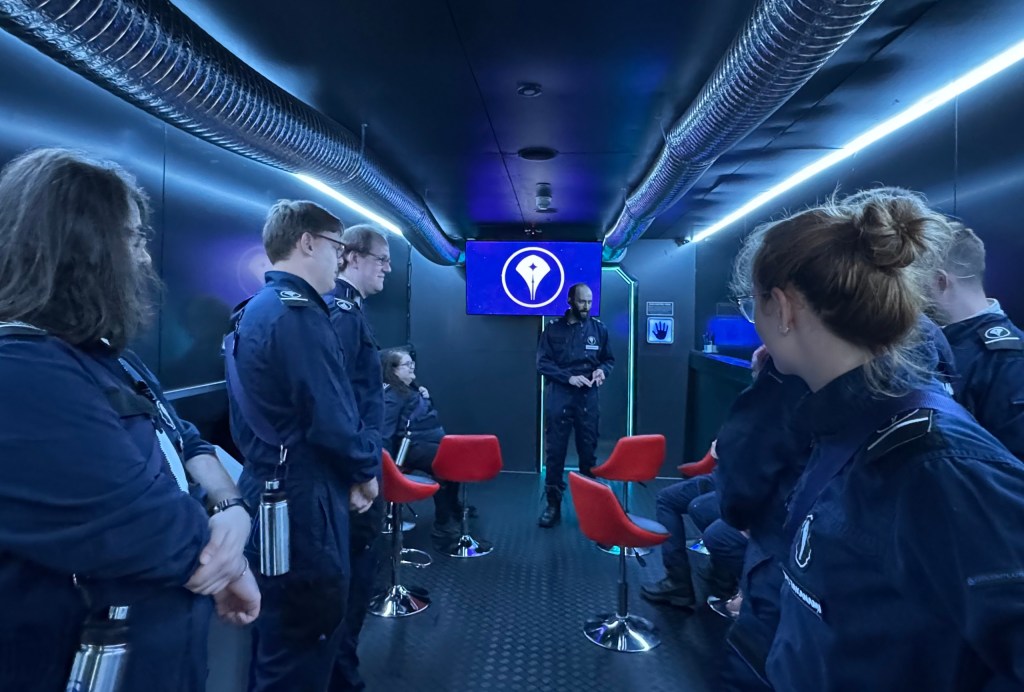
Our crew – the UCS Takanami – were called into the briefing room, where we watched a video. Bridge Command’s videos had inconsistent production values: some looked decent, others were more obviously made from contemporary stock footage. This one had noticeably poor sound, though the gist was clear: various human colonies inhabited this region, and the United Confederation Navy (UCN) hoped to establish peaceful contact.
An officer serving as our acting captain explained the specifics of the “Intrigue” mission we’d chosen when booking our visit (other options were Military, Exploration, and Diplomacy). We were to infiltrate a Terra Novan star base captured by pirates, drop off a marine, and retrieve a datapad containing secrets about an Ark Ship. In effect, the UCS Takanami was doing a big favour for the Terra Novans – or so it seemed.
I was left a little cold by this introduction. This was literally the first time I’d heard of pirates or the Terra Novans, let alone an Ark Ship. Did the Terra Novans deserve to be helped? Were the pirates all that bad? The stakes were unclear. A panicky, staticky Terra Novan distress call wouldn’t have gone amiss here; then again, Bridge Command is still in previews so perhaps they’ll roll something out for their hard launch in October.
Any misgivings were extinguished as we entered a docking bay and crammed into the Takanami’s airlock (we had to keep at least one door closed to stop “the vacuum from getting in,” the officer joked). The Takanami was suitably futuristic, with steel panelling and sci-fi decals and touchscreens covering every surface, second only in polish to Disney’s Star Wars: Galactic Starcruiser hotel. This ship was both compact and sprawling. As captain, I spent all my time on the bridge, but there were plenty of other rooms. The only real issue I noticed was that the doors’ touch panels weren’t very reliable.
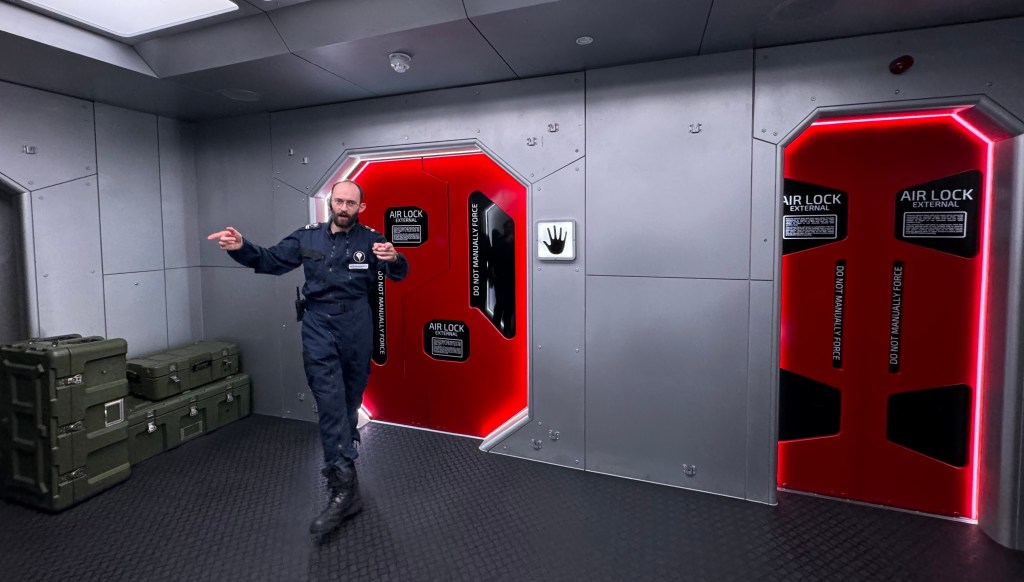
Our officer delivered a tutorial on practically every system as we toured the ship. Despite being delivered at what felt like 2x speed, this still took over twenty minutes and was easily the least engaging part of the experience, something its creators readily admit. I don’t think there are any straightforward fixes here; videos wouldn’t be much more engaging, and interactive tutorials would probably take longer.
Things picked up when we reached the bridge and players peeled off to learn more about their respective stations from our officer and Major King, the marine joining us for our mission. We’d picked our officer roles earlier: some were absolutely sure they wanted to be at the Helm or Comms or Weapons in advance, while the more equivocal doubled up on the Engineering and Science stations. This sounds worse than it actually was since those doubles spent most of their time on the six-person shuttle, which had its own stations to look after.
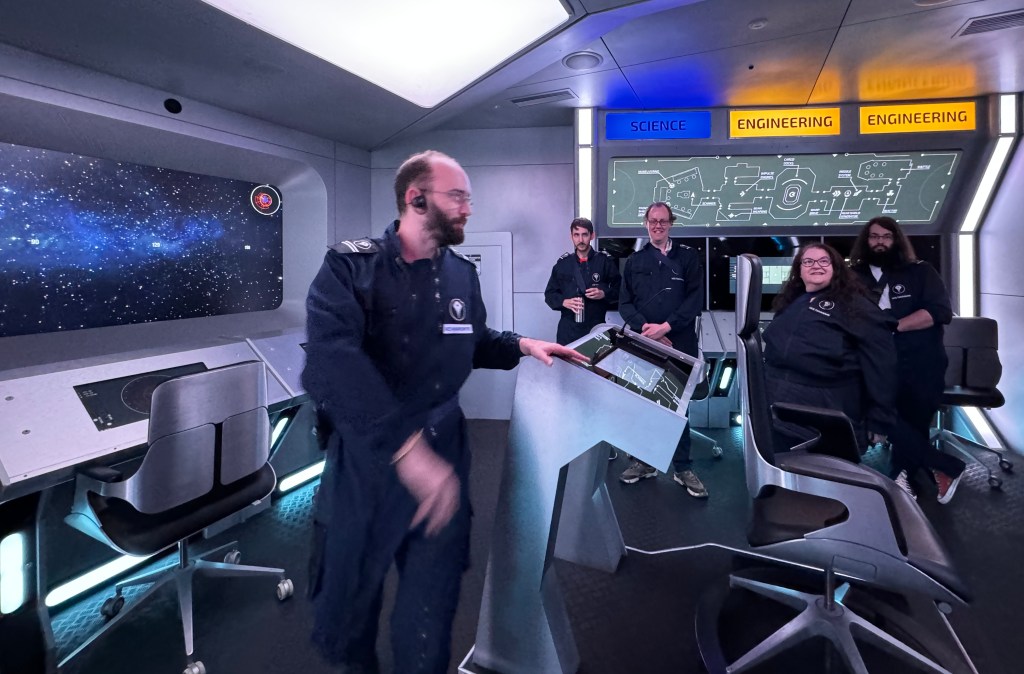
Each station had one or two touchscreens powered by EmptyEpsilon. The Helm, Navigation, and Radar stations planned our route, scanned for enemies, and operated our engines; Weapons handled shields, torpedoes, and beam weapons; various Engineering stations kept the our energy levels steady and stopped the Takanami from falling apart; and the Comms station did comms. The LCARS-adjacent interfaces were fairly easy to use, with cooldown and timer mechanics believably elevating drama – why wouldn’t it take a few seconds to calibrate your shield harmonics?
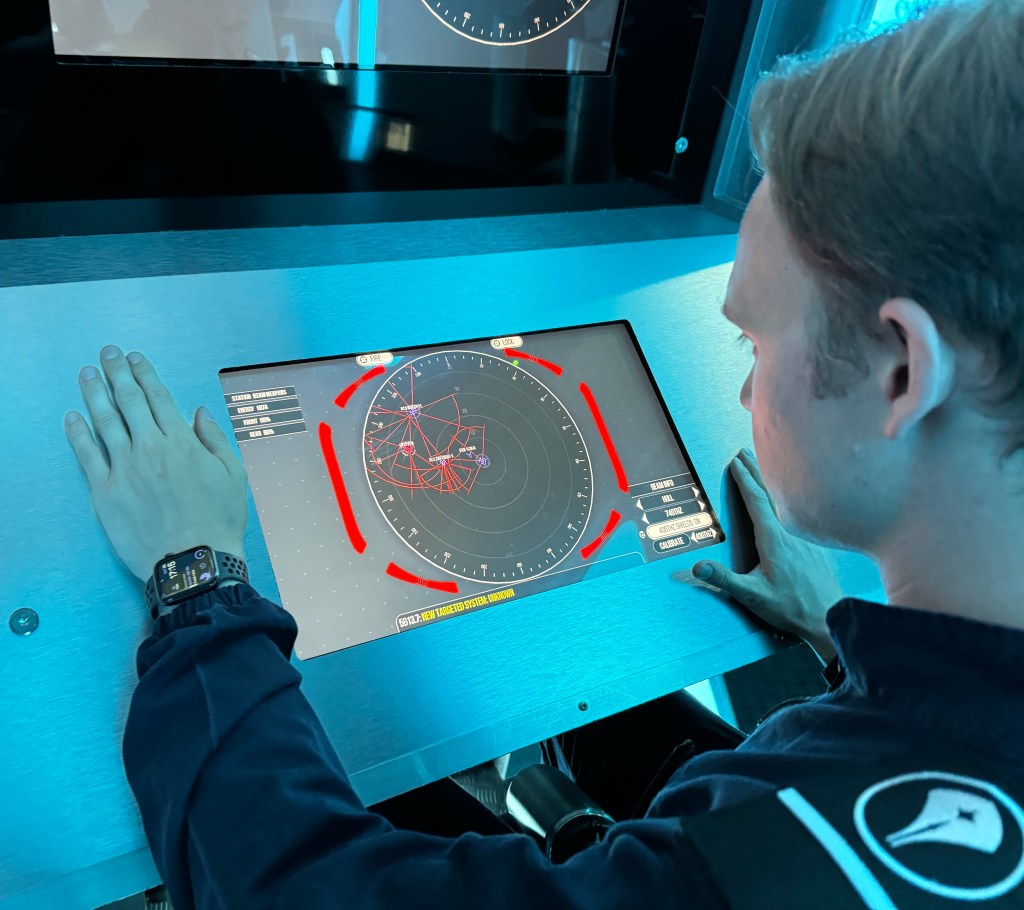
A live fire exercise highlighted how the stations were linked together: one person launched a probe, another used its sensors to scan a target drone’s shield, so a third could calibrate our weapons for maximum damage.
The drone having been destroyed, a commander on the UCS Warspite authorised us to begin our mission via a video call which, to some people’s surprise, was live. Finally, our officer formally handed over command of the Takanami to me (“The bridge is yours, Captain”) and left the ship. Our game had begun.
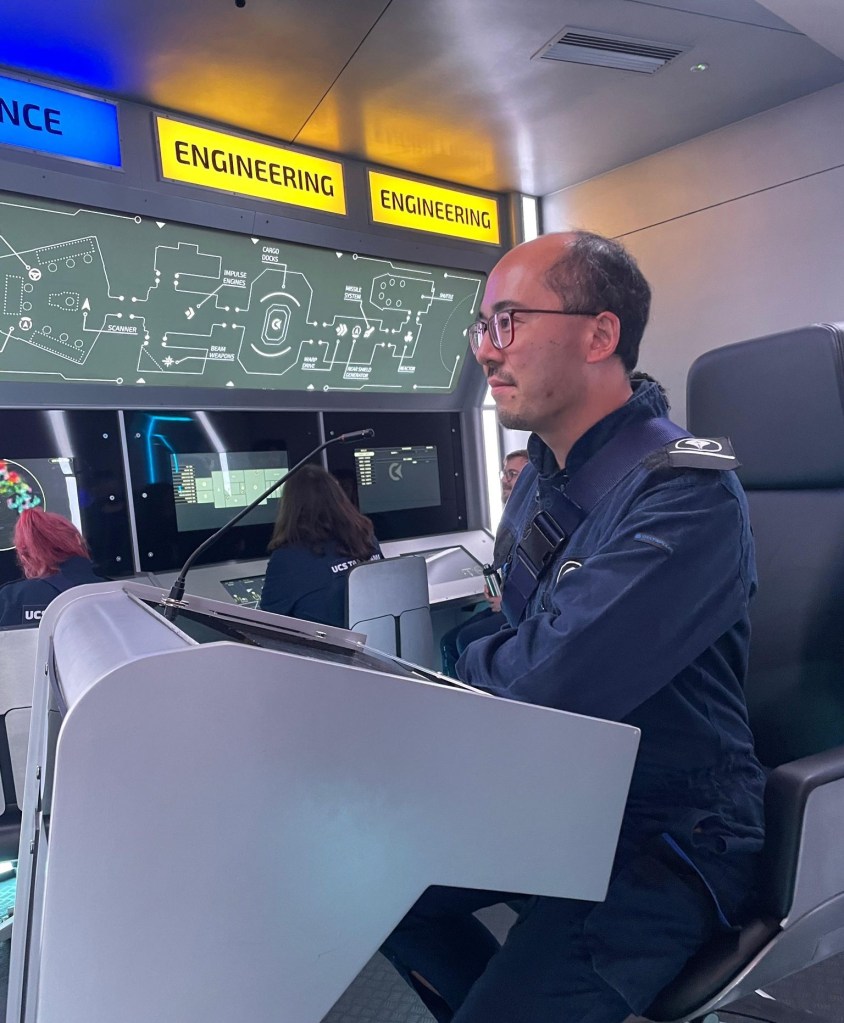
Since the Takanami was a warship, Major King explained, we had two options for infiltrating the Terra Novan starbase. Either we go in all guns blazing to distract pirates as our shuttle dropped her off, or we threaded a path through a series of nebulas that would hide us from the pirates’ sensors.
If I were role playing as a Shelby-esque hard-ass, I would’ve made the decision myself. This wouldn’t have been much fun for everyone else, so I threw the decision to the crew while adding I trusted our helm could get the job done, being a highly qualified pilot in real life. I didn’t mention that I suspected we’d see plenty of combat in the rest of the mission, so there was no need to get any extra.
Thankfully, everyone agreed on the stealth approach. While the Navigation team plotted a course, Major King gave the Science team a partial transcript of a message from Terra Novan base, from which they were to draw a map to help her locate the datapad. This was done with low-tech pen and paper, which looked a bit underwhelming but had the advantage of not requiring another tutorial.
As we crossed into pirate-controlled space and snuck into the first nebula, I pressed the “yellow alert” button on my Captain’s console. This didn’t do anything in particular but made me feel cool, which is really 90% of its purpose. A couple of pirate ships near the next nebula drew me over to Navigation, where we carefully watched their patrol patterns and sensor ranges. We timed our next run perfectly, though the strain we were putting on the engines set off alarms and forced Engineering to divert power sources.
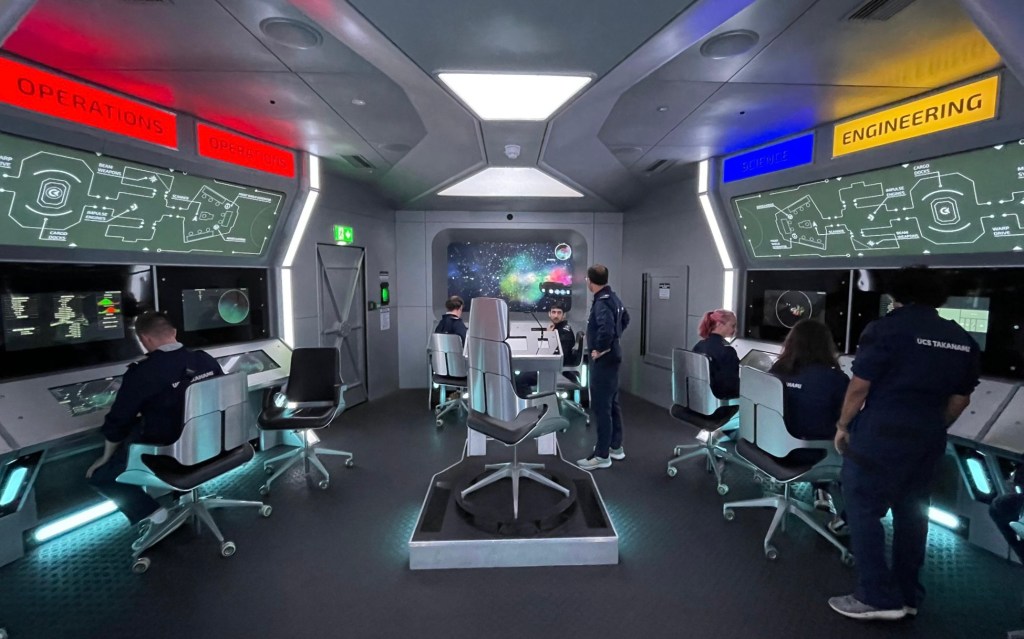
With no pirates in sight, we despatched our shuttle crew; they’d drop Major King off at the base, then rendezvous back with the Takanami in a nearby nebula.
I also agreed with Weapons that they could raise shields and fire at will once we’d engaged in combat. An unfortunate consequence of this was that I couldn’t do the classic Riker “shields up, red alert!” but the role of captain, as I saw it, was mostly relaying information between stations and making minor snap decisions. The overwhelming amount of visual information on each station – overlapping fields of fire, sensor ranges for every ship within sensor range, the status and location of multiple repair bots – made it impossible for any single person to drive decision-making in the same way one might in a slower or turn-based game.
This lean towards delegation was crucial given that the shuttle and the Takanami both ran into pirate ships almost immediately and everyone scrambled to battle stations. One ship demanded we identify ourselves, leading Comms and I to briefly entertain the idea of bluffing our way through with Star Trek-style japery, but the fact we were in an unmistakably huge warship nixed that idea:
Meanwhile, Science and Weapons worked to scan the pirate vessel so as to calibrate our shields and beam weapons to most effective frequencies. In practice, this meant tapping targets on maps, solving very simple puzzles like aligning waveforms, and waiting for cooldowns to complete. People called out their findings across the bridge, relaying frequencies, and running off to charge fuel rods.
The combat itself felt a little too straightforward, at least from my Captain’s chair; the Takanami was far more powerful than the pirate ships and dispatched them with ease. Though I’m sure the talents of our crew helped, from a storytelling perspective, it wouldn’t have made much sense for our ship to have been incapacitated so quickly.
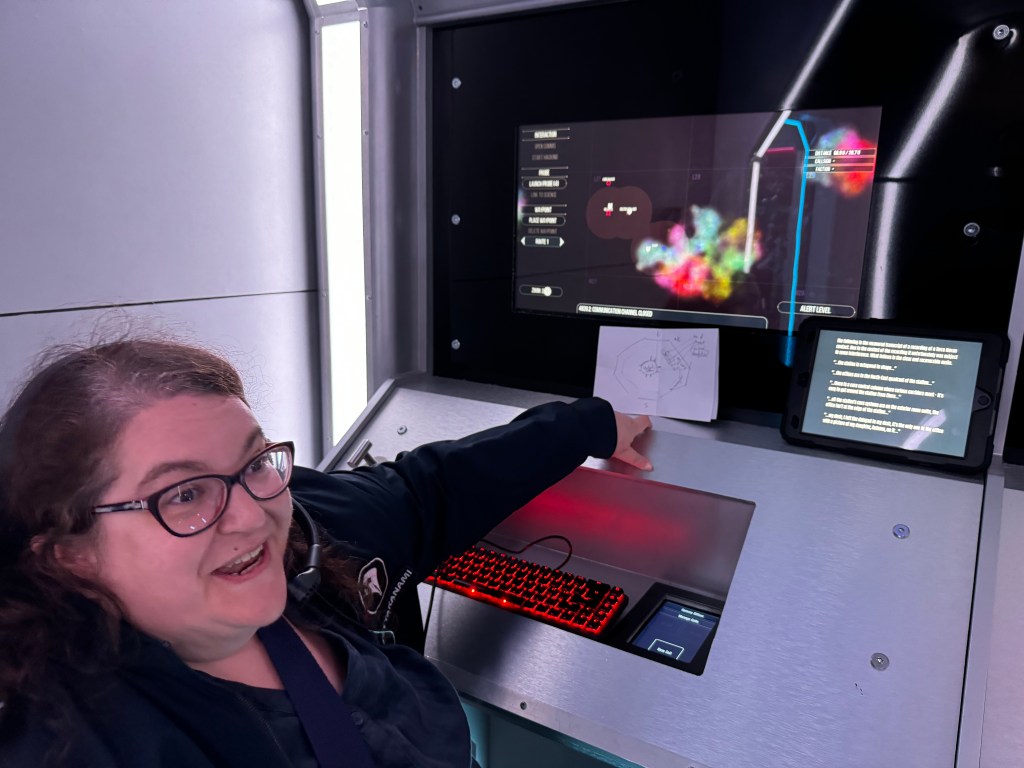
With Major King safely on the base, our viewscreen switched to a basic live map of her surroundings. The marine was represented by a moving dot, with red dots signifying pirates. Over a voice call, we guided her toward the datapad using the map we’d sketched earlier. The whole thing reminded me of running online live events for the Perplex City ARG: it looked very ad-hoc but its real time nature upped the stakes and helped expand our sense of the fictional world.
No-one else wanted to give her directions so it mostly fell to me. Since our own map was so tentative, I was operating more on guesses than anything else, and wasn’t at all confident in my instructions. This led to a kind of “eh, it doesn’t really matter what we do, it’ll all wash out in the end” shrug, which was confirmed when Major King tracked down the datapad and made it out in one piece.
Around this time, we received a message from the Warspite: a pirate fleet was inbound, with a big ship among them! We warped to the starbase, released our shuttle, picked up Major King, and warped out as soon as they were back on board. Hilariously, we collided with the starbase in the process, sending literal sparks flying across the bridge.
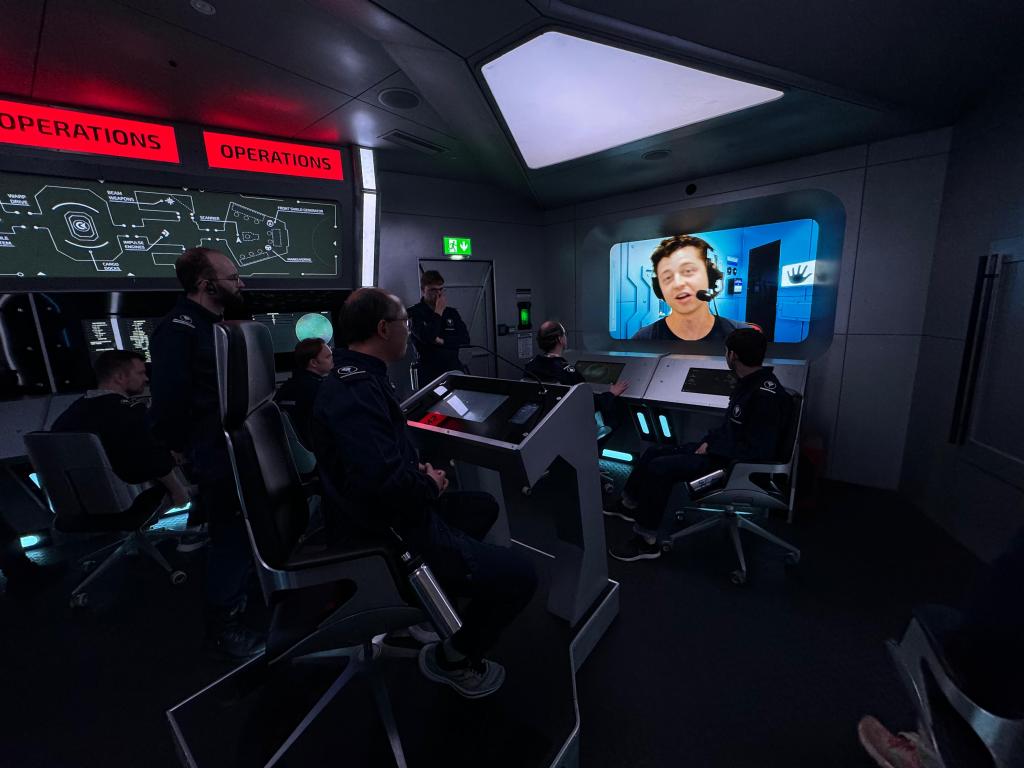
Once we rendezvoused with the Warspite, we were instructed to engage the entire pirate fleet. I took the opportunity to get permission to use our nuclear missiles, which had been teased during our tutorial, which made combat a little more interesting since we had to get everyone to back off before we nuked the pirate’s big ship. Competence porn, the game!
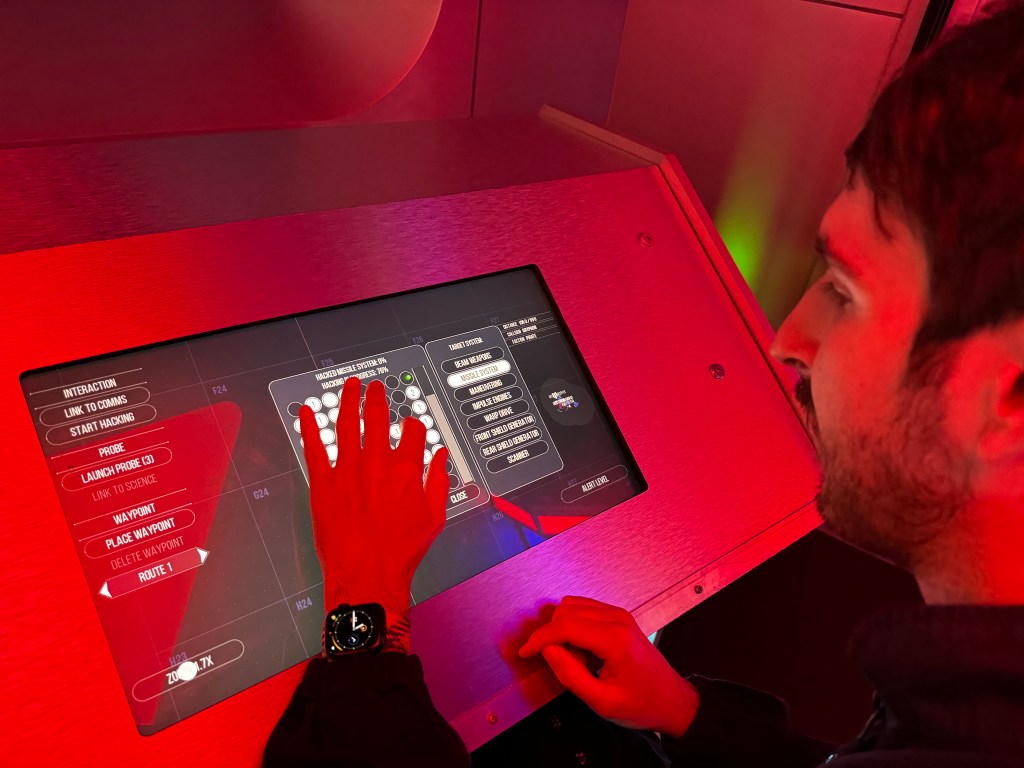
Right before we docked with the Warspite and ended our mission, Major King gave us a choice about what to do with the Terra Novan datapad. We could hand it over to UCN intelligence, pretend it was broken, or deliberately wipe it. Like the briefing, this choice was missing crucial context with which we could make a more interesting decision. Were UCN intelligence the baddies? What was really on the datapad? What would happen if we disobeyed orders? And so on. I’m told this isn’t normal because most groups don’t pick Intrigue as their first mission, but it’s clearly a place for improvement.
Once again, I threw the decision to the whole crew, who shrugged, so we chose to pretend it was broken while being extracted from the starbase. During our debriefing back on the Warspite, a senior officer expressed some curiosity over this, but it didn’t amount to much and we piled into the bar.
Our post-game discussion was giddy with delight. The pace was so relentless that the starship crew had no idea what the shuttle crew were up to, and vice versa, so people eagerly recounted their own adventures. Inevitably, some minor criticisms emerged:
- Our Comms officer didn’t initially realise how important they were for liaising with the shuttle crew, who had no other way of knowing what was going on the Takanami.
- Engineering found it hard to know when they were charging fuel rods correctly. A dedicated screen near the charging area might have helped with this, but I got the feeling that despite the £3 million spent building Bridge Command, this was possibly the cheapest they could’ve done it for while still making it look good. From a business perspective, this is absolutely the correct decision since you want to avoid any unnecessary costs – and yet…
- The touchscreen viewing angles were poor; perhaps this was due to some layer or film to improve durability.
- There were practically no physical controls like buttons, switches, joysticks, levers, or throttles. Yes, they’re prone to failure and harder to repurpose, but tactile controls are cool and fun, which is why the LHS Bikeshed and the Galactic Starcruiser had so many.
- The viewscreen graphics looked dated. Most of my crew didn’t notice, and when asked, they thought they looked endearing. Perhaps Bridge Command is on the correct side of the sci-fi uncanny valley where the graphics look intentionally basic, and any improvements would become an expensive arms race.
- There was no music during the entire experience. It would’ve really helped with the atmosphere!
- People felt there was too much combat for an Intrigue mission; we wanted more diplomacy and dialogue. This is a common problem with most bridge simulators including Star Trek: Bridge Commander, and a hard one to solve. Combat is easier to simulate and automate than diplomacy, and its centrality in EmptyEpsilon and other engines meant Bridge Command’s combat systems were far more interactive and sophisticated than those for guiding our Marine through the pirate-held base. Then again, I wonder if people really mean it when they say they want less combat – the stakes are clear and it gives most players something important to do. In any case, the great thing about having a human GM is that I can ask them to dial it down next time.
Since half my crew worked in TV, video games, and writing, there was a lot of discussion about storytelling, game design, and roleplaying. If our characters had backstories, Vinay Patel suggested, we might have been able to form more unique opinions on whether to hand over the datapad at the end; a conscript would have more reason to disobey orders than a straight-arrow recruit, for example.
Naomi Alderman noted that Bridge Command works because its audience has already seen Star Trek. A quietly important feature of Star Trek is that it’s a “precinct” show: it has an ensemble cast (the crew), it’s largely set in the same confined environment (the starship), and most episodes follow a small number of structures (e.g. investigating a distress signal, resolving a diplomatic dispute, patrolling the Neutral Zone, etc.)
Bridge Command is derivative of Star Trek. This is not a knock on it; everything, including Star Trek, is derivative of something else. Players know what to expect and how to act: not so much the specifics of how to use weapons systems (though phasers and torpedoes do act similarly) but how they’re meant to co-operate and navigate scenarios. If Bridge Command looked more like Battlestar Galactica, you’d expect more debate and in-fighting, as happened on the Monitor Celestra LARP. But most Star Trek is explicitly utopian; the crew tends to work together as one and characters alway looking for smart, non-violent solutions. Bridge Command’s focus on combat undercuts this somewhat, but I’m told later missions bring in much more diplomacy.
Crucially, Star Trek’s series have so many episodes (a requirement for syndication) that every role can boast a few good stories. Never mind Captain Kirk outthinking the Romulans or Geordie La Forge fixing the warp drive, we’ve seen transporter chiefs, junior officers, ensigns, and even actual children save the Enterprise. Precinct shows fit a “mass participation” game like Bridge Command. They promise every player a meaningful role, which might be why LARPs set wizard schools, villages, and (space) battleships are so popular.
In contrast, Vinay noted, it’s much harder to transpose mythological story structures – like Star Wars – into mass experiences. Single player games like the forthcoming Star Wars: Outlaws can make the player the hero, but it’s much harder to give dozens or hundreds of players meaningful roles in the same world. We can imagine that an engineer in the Rebel Alliance will play an important role in overthrowing the Empire, but that’s not the story the movies tell. The characters with the most power and agency in Star Wars are the Jedi, not least because there are so few of them, followed closely behind by hotshot pilots.
Raph Koster ran into this problem when designing the Star Wars: Galaxies MMO. Everyone wants to be a Jedi, but it made little sense from a storytelling or game design perspective to have millions of them running around. Koster’s attempt to square this circle while satisfying LucasArts’ demands did not succeed.
Since then, Disney has gone all-in on Star Wars for its “immersive” ambitions, most notably in the form of the Galaxy’s Edge theme park area and the Galactic Starcruiser hotel (my review). But contrary to popular opinion, the idea of role play and immersion has been central to Walt Disney’s conception of his theme parks from the very start. As technology has advanced and tastes developed, those ideas have become more explicit. Recently, Disney Imagineer Tony Baxter said that what audiences want the most from Star Wars is:
not the hardware. It’s not the blasters and the lightsabers and all of that. It’s Luke and Han and Leia and the adventures they had and how much we wanted to be them, wanted to be with them, wanted to emulate the things that they did. So the wish fulfillment of getting to go on that kind of journey is what it was all about … It was every kid’s desire sitting in the theater eating that popcorn – ‘Wouldn’t it be cool to be Luke Skywalker and get to do this?’ So you’ve got to look for those moments.
Rides like Millennium Falcon: Smugglers Run really do let people imagine they’re Han Solo, piloting the Millennium Falcon through trench runs and gunning down Tie Fighters. Things become more troubled with Rise of the Resistance, though. It’s a tremendously entertaining ride, but the idea that you’re a hero makes little sense when you’re strapped in a car as the real protagonists do battle around you.
The now-shuttered Galactic Starcruiser faced an even bigger challenge. While the confines of the Millennium Falcon ride could convince groups of six that they were the most important people in the universe, the Starcruiser hosted hundreds of guests at a time. I enjoyed my visit a lot and took part in storylines where I helped the First Order and smugglers, but I felt superfluous during the final battle between Rey and Kylo Ren, two force users who could have killed everyone on the ship in the blink of an eye. It was fun, but it didn’t fulfil Baxter’s notion of wish fulfilment – not in the same way Bridge Command did.
I don’t doubt Disney Imagineering has the capability to make their own Star Wars-themed bridge simulator. The problem is that precinct-style storytelling cannot be found in the most popular Star Wars IP. They could invent a new story for an attraction, but these days Disney puts movies and TV shows first. As The Imagineering Story notes:
[An obstacle] during the development of Galaxy’s Edge [was that] the ultimate fate of the Jedi in the core Star Wars film saga remained unclear, since only the events of The Force Awakens were locked in, and any attracted they created needed to endure for decades – well beyond the completion of the third trilogy … “We only know about Episode VII and [that part of] the story of Rey and Kylo. So it made it very difficult for us to base a ride around the Jedi and the Force – although we felt like it’s such a key part to Star Wars … a ride based around that was one of the most difficult things we left on the table in [planning.”
This is a classic strategy tax, where a big incumbent corporation struggles to innovate because it needs to serve existing interests or customers. Once upon a time, Disney theme parks created IP like Pirates of the Caribbean and Jungle Cruise that became movies; now, the rides are extensions of unfinished movie sagas. Given their theme parks are printing money, it’s hard to argue against this approach, but it may foreclose the opportunity to lead a new sector. Does Disney have the existing IP, or the freedom to create new IP, for extended multiplayer live action experience? Not right now.
Pitting Bridge Command against the Galactic Starcruiser is unfair to both. The Starcruiser was a multi-day experience aimed at more or less everyone, whereas Bridge Command implicitly targets sci-fi fans. A totally solo experience is difficult to accomplish on Bridge Command, but it was much more doable on the Starcruiser, which had lots of parallel storylines to explore, along with more opportunities for cosplay and role play. Where Bridge Command unquestionably excels is in its accessibility across multiple dimensions: time, cost, and difficulty of onboarding.
This is at least partly thanks to decreasing technology costs. Artemis and EmptyEpsilon are designed for consumer-grade computers, touchscreens, and projectors. Bridge Command uses low cost software like Notion to automate player progression tracking between visits. And it benefits from lower expectations compared to what people demand from established brands – not that you’d be able to tell, given the bunk beds we spotted in the UCS Takanami and the creators’ plans for multi-ship, multi-day adventures including away missions. It can only be a matter of time before they use prosumer motion capture tech to introduce alien NPCs.
It’s a fool’s errand to predict the size of the market for experiences like Bridge Command. Given that one of their FAQs is “Is this an escape room”, it’s clearly not fully understood by the general public. What I can say is that people have bitten my hand off to join in. Co-ordinating thirteen people is never easy, but for all that, I had zero dropouts and an honest-to-god waiting list by the time our mission rolled around.
When I mentioned I’d booked a place in Eclipse, a “blockbuster” LARP inspired by Arrival and Interstellar, people were outraged I didn’t tell them earlier. I simply didn’t imagine anyone else would be prepared to drop €710 plus accommodation and travel. The Key of Dreams, a new 24 hour horror-adjacent immersive experience costs £400 per person (~£575/$750 including accommodation), yet a recent feature attracted precisely zero complaints about the price.
In other words, there’s real demand for these emerging high interaction, tech-enhanced experiences. They exist within the nebulous genre of “immersive” but specifically combine:
- The interaction and simulation of video games
- The responsive, improvisational storytelling of D&D
- The predictable format of escape rooms
- And the embodied presence and role playing opportunities of LARPs
Their success depends on their accessibility. Bridge Command still has challenges to overcome in terms of onboarding guests before its hard-launch in October, but it only costs £40 to try and it has an eminently “grokkable” theme, as COO Tom Black puts it. That, plus excellent acting and execution, has given it exceptionally high retention – something escape rooms have always struggled with. Comparisons to the equally grokkable Jubensha – Chinese live action murder mystery games – are apt, especially because Jubensha are more technologically sophisticated than what most English language coverage has indicated.
It’s worth noting that Bridge Command is thematically less challenging than its creators’ previous work like Crisis? What Crisis?, a political interactive experience set in 1979 during Britain’s biggest state of emergency since WW2. This comes at a moment of concern in the Nordic LARP scene that too many productions are now based on Hollywood IP. But science fiction doesn’t preclude ambitious themes, as Battlestar Galactica and Star Trek have shown, let alone authors like Ursula Le Guin and Kim Stanley Robinson. Bridge Command has already run longer missions where players have to convince warring parties to sign a treaty – very Babylon 5.
It’s also easier to tailor your world and story to new constraints and requirements when you aren’t dragging around decades of backstory, though establishing a wholly new IP means you have to work harder to attract customers. Perhaps it’s appropriate, then, that Bridge Command was funded by a former city trader, Sonny Schneider, who described his motivation this way:
You can call it a midlife crisis. Or you could call it a bit of philanthropy. But ultimately, when I was a kid, I enjoyed live-action roleplay and Dungeons & Dragons and still do for that matter.
Real world immersive experiences can’t scale infinitely like video games can, but they are protected against offshoring, and they’re prepared for a future in which people have more free time, or at least, more flexibility in how they use their time and where they work from. The destigmatisation of D&D and LARPs is gathering pace, the ground having been laid by groups who’ve been playing for much, much longer. More and more adults are discovering how much fun it is to play make believe in real life.
These are big predictions, but Bridge Command’s strength lies in its specificity. It’s not trying to be everything to everyone, it’s being one thing to science fiction fans. And I’m already planning my next visit – someone’s got to find out what these Terra Novans are up to.
Some of the information for this piece comes from interviews I conducted with Owen Kingston (Artistic Director) and Tom Black (COO) for my upcoming book about the rise of immersive experiences.
In other Adrian news:
- I was interviewed on The Vergecast about how to gamify fitness without streaks or aggressive notifications. My segment is introduced at 32:37! (also on YouTube)
- I was also on the No Proscenium podcast talking with Noah Nelson about game design, escape rooms, defining what “immersive” is, and much more.
This week, I’m going to Immersion, an international chamber LARP festival in Turku, Finland, and in August I’m at Glasgow Worldcon participating in two panels about immersive experiences.


 mssv
mssv 