
Note: Odysseus is crowdfunding a new series of runs in a permanent base. Their campaign is live now and ends April 16th. I’m not affiliated with it, I just like what they do!
Last year, hundreds of players inhabited a spaceship on the run, scrambling to keep one step ahead of the enemy. The sci-fi larp Odysseus was inspired by Battlestar Galactica’s “33“, but where that episode only lasted 45 minutes, Odysseus’ players worked, fought, ate, and slept in-game for fifty non-stop hours.
Odysseus is widely recognised as one of the most accomplished larps (live action role playing games) of all time and is the subject of an exhibition at the Finnish Museum of Games. Originally mounted in 2019 for three sold out runs, Odysseus returned in 2024 for another three runs. Over two hundred volunteers worked on the larp, using €190,000 to transform an elementary school into a sprawling spaceship complete with mess hall, bar, ops room, science and medical bays, jail, and hangar.
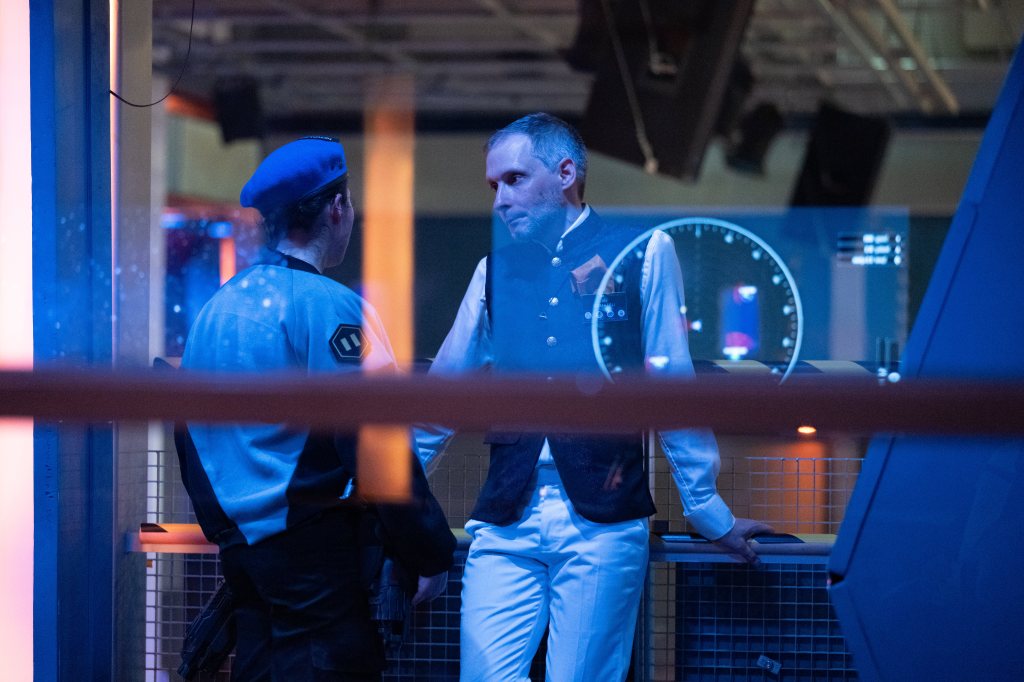
The gameplay and story design was equally ambitious. Custom open source software was written to power Odysseus’ combat and engineering hyperdrive jumps, RFID-scanners, internal message board, and livestreaming drone videos for away missions. Every player character was unique, supported by over 300 NPCs, their activities as doctors, criminals, soldiers, fighter pilots, terrorists, and politicians meshed in intricate “clockwork” gameplay. Where the Star Wars: Galactic Starcruiser’s story was hopeful and life-affirming, Odysseus’ mixed grief with joy, anger with determination, and its plot raised the spectre of genocide. It was demanding and adult. Participants had to role-play specific characters with lengthy backstories and numerous relationships.

Though Odysseus’ tickets were €550 each, they barely covered its production budget. None of the volunteer’s 30,000 hours of work was compensated – but its success has its creators wondering what it would take to become a permanent, financially sustainable larp – one of the first of its kind.
When I met with Laura Kröger, Odysseus’ lead producer and narrative designer, it was for my upcoming book on the history and future of immersive art. I’d travelled to Knutepunkt 2025, the annual conference for Nordic Larp, to learn more about the field. Our conversation ended up being much more current than I’d imagined, so I’m publishing it today, less than a week after we spoke.
This is a story about ambition. Ambition in game design, character design, emotional design, production, SFX, and narrative. But it’s not individual ambition – it’s the collective ambition of two hundred people working at the top of their game, beyond what I’ve seen in all but the most expensive commercial experiences, all as volunteers.
During our conversation, which has been edited for length and clarity, we discussed Odysseus’ experience design, organisational structure, production tools, decision-making processes, org charts, burnout, and just how many tickets per year they’d need to make it financially sustainable while paying everyone properly.
For you, what defines a clockwork larp?
When we had the idea for Odysseus, our very first inspiration was the Battlestar Galactica episode “33”, where they need to keep jumping in order to escape the enemy. There would be really strict time pressure for the players to keep doing their things, and the drama and the experience would be built around that dynamic. I don’t think that, when we started to do the design, we considered we were doing a clockwork larp. We were starting from an idea, what we wanted to create, what kind of feeling we wanted to evoke. Then it evolved into being probably one of the most successful clockwork larps ever created.

What other clockwork larps are there?
I have discussed this with Markus [Montola] a little bit, and I think he’s better to define it. But he wrote a piece about Odysseus in last year’s KP book [Nordic Larp’s annual journal] and the examples were Monitor Celestra and basically any larp where there are tasks that the players need to do in a timely manner to keep the larp going forward. It’s not just that there is a schedule. It’s like clockwork, you have these interacting components. You have different players doing different tasks in sequence to each other that keep the play moving forward. It can even be a village preparing for battle.
Montola: “Clockwork larp is a larp where characters work on diverse and sequential interdependent tasks that feed into each other, forming loops that progress the story and the dynamics of the larp.”
There’s direct interaction. It’s not like I do a task and then I tick a box off on a list. You can see what you do is being directly impacted by others.
And everybody who is part of that machinery can see that their work contributes to the success of whatever is going to happen.
You’ve said that the thing that you’re interested in doing in the future is more larps that have this idea of the loop.
Yeah.
And so do you still feel that way? But also, what is it about the loop that appeals to you?
In general, I enjoy a lot of things. I enjoy doing different kinds of larps. So, I’ve done very small larps and then I’ve done a couple of Odysseuses and other somewhat big larps as well. And I like challenges. I like challenging myself.

As a designer or as a player?
Specifically as a designer, I think I have pretty good skills in terms of plot design or emotional design. I also have a somewhat good sense of what are the implications of a design choice in a larp and how, when you have an idea of a design, you can make it work in a larp. Because I see larps where there are really good ideas, but the execution is not always… There has been a really good vision, but it doesn’t always relate to a good experience for players. There are so many steps from a good vision to a good experience for players. I’m really interested in what those steps are and how you can do them very efficiently.
You’re interested in the execution of those ideas.
Yeah.
You mentioned plot design and emotional design. Those sound like different things to me.
Yeah, I think they are different things, but they can be the same thing. I come from a Finnish larp culture where the [majority] of larps aim towards very emotional play. Plot can be a love triangle, or a problematic marriage, or things where the main plot is the emotional impact you get from the interaction.
So that’s a crucial outcome of the plot.
Yeah.
If it’s not generating emotions, maybe it’s not successful.
Yeah. There are plots like, you need to go and find this piece of map so you can put the three pieces together and find a treasure. That’s also a plot, but that’s a kind of a plot I’m less interested in.

How does that relate to your interest in loops?
In the things I’ve done before Odysseus and some of the things I’ve done after Odysseus, I have focused a lot on creating emotional play for players, but I’ve also approached that with creating an abundance of content. Characters have so many plots they definitely aren’t going to get bored, and there’s going to be so many things they can do and interact with and have emotional contact with, that some of those things definitely work out. That’s the design philosophy. I’ve done quite a few of those kinds of larps, and in some ways Odysseus was very much that kind of larp, as well because there were a lot of things going on.
But I also feel, after playing some larps and after seeing how players react, that less is sometimes more. So the correct direction is not to just have an overflow of stuff to make sure that some of it works, but to do less and do it better so that it most likely works even without all the backups. And I think that in Odysseus we had different kinds of larps intertwined with each other because there was that emotional… We had pre-written characters with multiple connections, like family, siblings, parents, friends, colleagues, lovers, ex-lovers. Every character had probably around ten pre-written connections, and there was a lot of this personal play.
And then we had the layer of the clockwork so that these characters had their personal lives, then they had their jobs, which were all the things they needed to do all the time to keep the clockwork running. And then there were the events that happened during the larp, things they didn’t have any pre-knowledge of, be it the [enemy] boarding or some big announcement, which they then reacted to in relation to those connections they had and their jobs. So there’s three layers on top of each other.
What you’re telling me is that there are loops in Odysseus, but the emotional experience is not looping.
No, it’s contributing to it, but it’s not that.
It’s not like your emotions are resetting every loop where it’s like, “Okay, now I have a new family.”
No, it’s building with it. The point was that the most intense experiences probably came from the pre-written characters and the connections, but the clockwork element contributed, because if you only have a limited amount of time to play with your significant other, then that moment is more significant because you are both fearing that you might die in the next hour and the ship might blow up. That creates the emotional impact for those relations.

So, a massive number of people were involved in making Odysseus.
Yeah.
Can you tell me about the structure of that organization? Is it a non-profit? Is it a charity?
It is non-profit. We have an association, Illusia Ry, which I’ve been a part of for seven years. I’m one of the founders of that association and it was created in order to be able to do this kind of blockbuster larp. The finances go through that association so that it’s not any one of our personal investments.
And that’s a Finnish organization.
Yeah, that’s a Finnish organization. Basically the biggest thing that the association has done is Odysseus, but there are other larps it’s been involved in.
That’s fascinating. And so it’s facilitating?
Yeah, it is basically a facilitator. There’s little else that the association currently does due to a lack of volunteers. I think that most of the volunteers in Odysseus are not members of the association. They are just doing Odysseus, but officially Odysseus is a product of that association.
It means it can have a bank account, get insurance and all of that.
Yeah, and then we can use the association for those.
Can you tell me a bit about the internal communications and organisational structure? How did you work together?
I was the lead producer and I had three assistant producers who were sharing my workload. We had a core team, about twenty people, which was formed mostly of the team leads of other teams. So we had, for example, a graphics team, we had a spatial team, which was responsible for designing and creating the spaces. We had a sound team, we had a light team, we had a software team. Many different teams, which all had their own team lead.
We had core team meetings with these team leads and the producers, where we discussed all the things that we wanted to decide together, like how we are going to distribute our tickets and stuff like that. The big decisions regarding the practicals were done in the core team. And then the team leads were responsible for their own teams and managing those teams. If they had any issues, then they would bring them to the core team and we would discuss together how we approach them.
Some of the teams worked very independently, and the team lead was doing most of the team leading and I was less involved. But then there were quite a bunch of teams in which I was also personally involved, like the story team, the team that was in charge of the design and character writing. I was also involved with marketing and communications.

How was decision making done? Did you try to get unanimous consent?
It doesn’t need to be unanimous, but everybody needs to… Like, we had maybe twenty people in the core team. And not everybody was always present in the meetings. Earlier, we met maybe once a month or a little bit less often. And then towards the game, maybe every two weeks. Usually the meeting agenda was presented beforehand, and if you were passionate about something that was going to be discussed, then it was a good idea to be present in that meeting. But basically, we had very few differences, in a way that people were not feeling that decisions were made that they wouldn’t agree with. I think our style of creating and our artistic vision was pretty aligned.
And then there were individual teams making their individual decisions. So, for example, the lighting team was able to decide what kind of lights they wanted. They had a budget and they were told, “This is what we want you to do. And this is the budget we want you to do it with. And how you execute it, it’s up to you.”
What kind of tools were you using? Slack, Discord?
We had a Discord server for the [two year] pre-production phase where we had everybody who was involved, and then we had another Discord for the runtime [i.e. the three live games themselves]. We had maybe 80 people in the pre-production phase, and then when we started building, there were closer to 200 people contributing in either running the game or helping to build or dismantle.
I’m interested in project management tools. Were you using Trello? Were you using…
We were mainly just using Excel and Google Docs. We had a Google Drive and we had basically everything written down in there, then we had individual team lists. I had my own to-do lists and then the other people in some teams had their own to-do lists. But we didn’t have shared or whole production-wide project management tools because it was divided in different teams.

Okay. People wanted to use different things. You mentioned marketing. Eclipse massively sold out. I read that twice, three times as many people were signed up as you had places, so there was a lottery.
When we started the discussions whether we should do this again after the [first set of 2019] runs were over, our very unanimous response was that this is never going to happen again. <laughs>
And yet you did!
“Never” turned out to be a little bit less than two years! <laughs> But yeah, we were pretty sure that this was not something we wanted to do again. But then corona [the COVID-19 pandemic] happened and everybody was bored and we had a little bit of time to recover. And we started to discuss, I think, late in ’21, that… would we want to do this again? And then we made the decision in early ’22 and we announced it in May ’22 that this is going to happen in ’24. And we had, in a matter of a day, over a thousand people join the interest group.
So you knew immediately you were going to sell every single ticket.
Yeah, before we said anything anywhere, we knew we were not going to be lacking players. I don’t think we really dared to make real estimates about how much interest there would be, but I think that around a thousand was something that we estimated beforehand.
And we were very cautious with our marketing towards larpers. Very early on, when we discussed what we wanted to achieve, we did not want to do marketing for larpers because there was no doubt we would oversell two or three times the amount. We wanted to promote it for the bigger audience. We wanted to tell what larping is about to everybody else who are not larpers.
Do you think that worked?
Yes, I think that worked. In 2019, we had really good coverage in Finnish media. And people who were actually working in the media and were part of our team were a little bit suspicious whether we would get a similar amount of coverage [for 2024], because it’s a rerun. It’s the same thing.
But actually we got more. Maria Pettersson did a lot of work to get us in a lot of places. I think that this is the first larp featured in primetime news in Finland. Not as ending comedy either, but as a serious piece. And that is super cool. Now we are featured in the Finnish Museum of Games in a rather large exhibition for almost a year. That’s huge. And I think that was the aim for our marketing from the very beginning.

You’re using it as a kind of flagship project to promote larping in general.
Because I think that in Finland people generally have started to recognise the word “larp”, but they have this kind of funny, goofy idea. It’s used mostly as a joke. Or it’s not a serious thing you’re doing. And I think that Odysseus is doing a huge favour in order to shift the general opinion of what larping is about.
So the coverage is not just “look at this fun, spectacular thing”, it also touched on the emotional aspects and the serious aspects.
Yeah. Very much so.
That’s cool.
I’ve been doing larp organizing for 23 years now. Regarding my professional skill set, I’m a project manager in IT. I have accumulated basically every single [piece of] knowledge I have, from larp organizing. And that’s like… if I have Odysseus in my CV, people have no idea what that means. There is zero idea for the employer to actually understand that [Odysseus] means way more than my actual day job, which I get paid pretty much.
So if a commercial operation – which Odysseus was not – was getting at least three times the demand, it would raise prices. If you promoted it hard, you’d probably get ten times the demand. A commercial operation would be like, “We’re gonna raise prices as high as they can go, so we only just sell out.” And you didn’t do that, even though it’s still a comparatively expensive larp.
It is, but there are much more expensive larps where you get subjectively “less” with that money.
So, access was important. You wanted it to be accessible.
Yeah. In 2019, when we first did Odysseus, the ticket price was €200 for the standard ticket, and then we had a sponsor ticket which was €300. The international sponsored tickets sold out in eight seconds, because they guaranteed a spot in the larp [unlike the standard tickets, which were available in a lottery]. So, when we did the ’24 [run], we very early decided that we were not going to do the same thing, because we don’t want to have this sort of “pay to win”.
Because rich people could guarantee they can win over others.
Yeah, and also we don’t want to have it sort of like an “F5” competition for who can refresh the webpage fastest, because it was…

It’s not fair.
Yeah, it’s not fair, and I think that everybody who was interested in this larp would have paid the €200 or €300 extra, whatever the reasonable amount we would have put as an extra price for the sponsored tickets. Most of the people who signed up would have been competing for the guaranteed spots. So, we were like, “Yeah, there is no point in doing that.”
In 2019, we were unknown organizers. We were known names in Finnish larp, but internationally, we were absolutely nobodies. And so, we were like, “We need to put the ticket price in a ballpark where people can take the risk.” Because they have no idea what we will do. For them, it is basically a risk. We were very cautious about what we promised, but even the little things we dared to promise sounded like, “Yeah, this is insanity. Nobody can pull this off.” Which was pretty crazy, and then we ended up creating so much more.
So, for 2024, there was only one ticket price?
We actually had several. We had one ticket price which was €550, and then we had a sponsored ticket, which was either €600 or €650. That didn’t give the people who signed up for that any other benefits except a small token. We had these pins, which you could take. But it was like, if you want to support us, and if you want to allow us to distribute more discounted tickets, then you can choose to pay a little bit more. But it didn’t guarantee you a spot. It didn’t basically give you anything else.
But we had almost a third of the people who signed up say that they would pay the sponsored price, even though it didn’t have any benefit. And that allowed us to actually have a pretty decent amount of the discounted tickets, which I think was €280 or something like that. [Note: the subsidised ticket was €250].
I can imagine some organisations convincing themselves to raise the price and either pay the volunteers or put the money into subsidising other larps.
Yeah, when we announced the game and then when we announced some statistics of our signups, which was I think 968. And we had 312 spots. So, it was over three times the amount. And people were like, you could easily do this professionally. You could charge higher prices. And I think that people who are saying that don’t have any idea.

I saw your Facebook posts. You’re saying that you would have to charge $3,000.
Not necessarily. There would need to be changes in the structure. Permanent location, a lot of streamlining, a lot of automation and roughly €1000 tickets might be commercially sustainable. But it would need a lot of runs because you would need to cover the fixed costs of the venue for the rent. And you would have some number of people who would need to be paid month-to-month.
You can’t just keep everyone freelance. So, from a commercial point of view, and I’m sure everyone’s thought about this a lot, it’s an issue of sustained demand.
Yeah, are there enough larpers? Since Odysseus [2024], we have been discussing with a lot of people about: would it be possible, how it would be possible, what it would require. Because for me personally, when I did the 2019 Odysseus, it was a matter of, like, “challenge accepted”. I’ve been doing pretty good larps in Finland, but does it scale? Can I do something that is in another league? And that was a personal challenge.
When we succeeded in 2019, and when I started to think “would I do it again?”, my main motivation was that there was a lot of luck involved in 2019. When we got the keys to the location, even I didn’t have an idea what we would end up creating. So when it all came together and it worked absolutely beautifully, like three times in a row, it was sort of, I can’t say it was a surprise, but there was a lot of luck involved as well.
So 2024 is much more intentional.
In ’24, we knew exactly what we needed to do and we knew exactly what it would take to get us there. For me personally, it was to prove that this was not luck, this was skill – that we would be able to replicate the success of the 2019 runs and even improve in several areas.
So, I’m going to Eclipse in two months time, and I think they announced an eighth run later this year. That’s an expensive larp, and I assume they’re selling these spaces out.
Yeah, if they’re getting more runs, they probably sell out.
Does it seem like there is starting to be more demand, more larpers, what do you think?
I’m now contemplating for myself if I am willing to find out! <laughs>
Do you want to believe?
Yeah, it would require something like 1000, 1500 interested people yearly to run something like Odysseus, and with a price tag of [around] €1000. That’s not much, but at the same time, it is.

If you were doing it commercially, you could charge more, though.
That is very much the discussion. Because I think that it is very important that, like you said, if it were done commercially, you would raise prices until you just sell out. But I think that for us, for the people who created Odysseus, it’s been very much a passion project from the very beginning. And for us, it wouldn’t be like, let’s just charge as much as people are willing to pay.
$5000!
Yeah, because the [Star Wars: Galactic] Starcruiser failed. I didn’t go there. I have read some articles and some stuff about it. But with very limited information, my personal take is that it cost too much. And the experience didn’t provide what people wanted.
I’ve got a piece in the [KP] book about it. But I will say that more than 1200 people went to the Starcruiser. [Anatomy of Larp Thoughts, p184, PDF]
Yeah.
Like a lot more, probably 100,000 people went to the Starcruiser. [Note: 71,000]
Yeah.
Now, it’s Star Wars and it’s Disney.
Yeah.
But you know that 100,000 people are willing to spend…
That much. But it’s also like, Finland is a shitty location to do anything, because that’s like the middle of nowhere.
Well…
That would be a limitation. It wouldn’t be a deal breaker. But it is easier to get 100,000 people to go to the US than get people to fly to Finland to do something.
You don’t have to tell me this, but have you had any [interest from] investors? I mean, people must have approached you.
Not investors, but I think that what we have done so far is not yet that appealing to any investors. But I think we are approaching a point where we need to decide if we want to try to test if it would be possible to do this differently.
Because most investors will want a return. And then it becomes a commercial thing.
Yeah.
Non-profits can run commercial operations, obviously, but then…
Yeah, they can. And I think that that’s also been the discussion that… I’ve been doing Illusia for seven years now, and there are very few volunteers who are interested in contributing to the bureaucracy and running for it. If it were a company, then people would have ownership of that company and they would be more involved in it. So I think that in that sense, it would be more interesting for people to do things as a company. But also, if I would do something like that, I think that I would prefer to do it with some state/EU funding and then some crowdfunding way, because that would allow us to actually own the IP and not have investors putting pressure on us to do things in a way they want instead of us doing the things the way we want.

That’s a good idea.
Yeah.
You know, when I saw your Facebook posts and other writings and talks after the runs last year, I got the impression you were like, I think I want to do something else. And you sound a little bit different now. You sound like you’re exploring the possibility of…
Yeah, I think I came to a conclusion already, before even the ’24 runs in the spring, that this is the last time I will do this as a volunteer. This is something that I [spent], I estimate, maybe 2000 hours on, 550 of those during the six weeks we were on site. I was doing that on top of my day job and I was like, this is something I’m not willing to do anymore. So, if I get paid, it would be next-level cool to do something like this for a living.
It’s not like you are artistically burned out on the idea of doing it.
No, because…
You’re financially burned out.
Yeah. It’s more of, like, I’ve done larps for 23 years as a volunteer. I’ve done two Odysseuses as a volunteer. I have proved that I have the skills to sort of steer this kind of ship, this kind of structure. <laughs> And moving forward, whatever it would be, I would be interested in doing it in some shape or form professionally. I have a lot of core values related to… I want to do larps for larpers. I’m not interested in doing murder mystery dinners for companies. I want to do stuff that interests me because I was also a narrative designer of Odysseus and I’m extremely proud of the story we are telling. I think that it is really good. It is something I’m personally almost more proud of than the clockwork [mechanics] or how the larp looked or how we managed to do the practicals, and everything.
Because I think that there are a lot of blockbuster larps in cool locations with decent practicals. They are well-organized. But in Finland, we have really, really long roots with pre-written characters, very, very design heavy larps, and a lot of thought put into that. And we were like, can we do a larp with working technology, cool location, good practicals, actually an intriguing and good story, and have everything click together?
I’ve got a couple more questions. You said you want to automate or streamline more things if you were doing it commercially. What kind of things?
We had 70 to 80 people working behind the scenes in each of the runs.
And that’s for 100 players?
That’s for 104 players. So obviously having as many crew as there are players is by no means sustainable in any commercial sense. But also, I think that a lot of those [crew] were there because they wanted to be there. People love Odysseus. Not only as players, but as the 200 people who’ve been involved in organising, this is their baby.
It’s fun.
Yeah, it’s fun. The community is awesome. A lot of people were there helping out because they wanted to be part of that in any shape or form. So there are a lot of things that can be outsourced, like catering. You can have someone else doing all the food. We had people writing the [text-based] NPC characters talking to players. There were 17,000 messages in each run written between the characters with each other and with our NPC players and GMs.
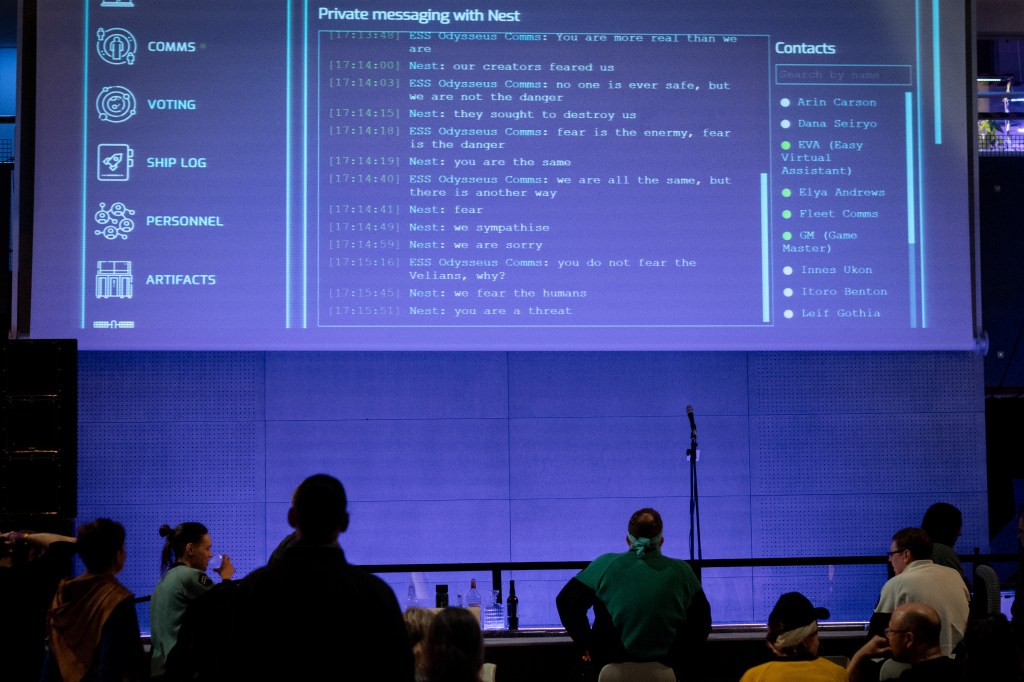
On the larp’s internal message board.
Yeah. There was an insane amount of this work, but you could train AI by putting all of our material in and then automating that, and take a burden off having people doing all that. You could automate EmptyEpsilon scenarios a lot more. Tech-wise, there is already really, really good infrastructure behind that, and there is still room to do a lot more automation so that it doesn’t need manual triggering. And then, of course, we had a huge crew of photographers. We had a huge crew of SFX, makeup. You could streamline those a lot. If there were 14 runs a year, you don’t need to have a photographer in each run. You could say, “Okay, we have two runs in a year where we have a professional photographer and others, we only take portraits,” or stuff like that. So it would streamline a lot of the people needed to be on site.
At the Galactic Starcruiser, you could pay a lot of extra money to have a photographer take photos of you.
Yeah. There are a lot of larpers who are not that interested in having that because larp is not about photos.
But some people do.
But some people do! So there are a lot of opportunities to do that. And these are just the first thoughts which we had.
Awesome. That’s very exciting. I can’t wait for you to talk to the Bridge Command people. So the final question I have is about your museum exhibition, which is awesome. When did they approach you?
We approached them. My husband bumped into a person attached to the museum at a conference, and I just sent an email that we had this larp, would you be interested in featuring it in the museum? The person replied and we had a meeting. I was there for two hours, telling them what we did, how we did it, why this was significant. And they were like, “Yeah, we want to do an exhibition.”
Was this after the 2024 runs?
Yes, this was after. It was in late August, early September. It was also really lucky because this temporary exhibition was ending in February. They had plans to have another exhibition, but they changed those plans because they wanted us there.
Wow! So this is one of the first exhibitions – the first – about larps?
In the same museum, there are a few larps in small displays. There is Halat Hisar and then there is this Finnish tavern larp [Rajakatse] which has been going on for 30 years. So [Odysseus] is not the first larp, but to have it in this scale, a major exhibition dedicated to a larp, that’s significant, because it’s the Finnish Museum of Games. It features all the games and [gamers] are very core target audiences for any larp.
Are they going to add any of the objects to their collection?
The objects are ours, so they are loaned. But we’re having preliminary discussions on whether we want to have the same exhibition go elsewhere, because all the items are ours and we will get all the graphics as well, which were created for the museum.
Cool. Yeah, you should.
Further Reading
Creating Odysseus 2024 is a good introduction with budget breakdown and production details, while Machinery Behind a Clockwork Larp goes into the core loop, contingency plans, org charts, run-time checklists, and event breakdowns.
Watch Laura Kröger speak about Odysseus at Games Now, and read about the tens of thousands of hours required to make the larp. Geographical information systems (GIS) were used, including for the LORA Science Voyager, a “Google Maps of the future enhanced by long range space scanner probes and space jump capability.”
James Bloodworth wrote detailed player retrospectives on the 2019 and 2024 runs, and Jaakko Stenros wrote about the 2019 run:
The refusal of Odysseus to give clear answers to the ethical questions at play ensured, for me, that the work stays with me. We have to live with the choices we made … The production and design of the larp were nearly flawless – and fully in service of a creative vision that was an uncompromising and unflinching judgement of humanity. We are the monsters.
Markus Montola has written about the clockwork game design of the 2019 runs, and Evan Torner discusses the challenges of writing gameplay for criminals in larps and Odysseus in the 2025 Knutepunkt book (PDF, p121).
Official resources include Odysseus’ website, Instagram, YouTube, and Github repo.
I’ve written about my experience as a newcomer to Nordic Larp at the Immersion chamber larp festival in Turku, Finland, The Smoke festival in London, and this year’s annual “Knutepunkt” Nordic Larp conference in Oslo.
In 2023, I visited Disney’s Star Wars: Galactic Starcruiser toward the end of its run. I thought it was fun and interesting!
Header image courtesy Tuomas Puikkonen.

 mssv
mssv 