Web
Free
William Rous
5 hours long
In an age of non-descriptive game titles, Type Help may win the championship belt. Far easier to cite its inspirations – Return of the Obra Dinn, Her Story, Unheard and The Roottrees are Dead – all members of the burgeoning genre of deduction games, where players piece together a tragic mystery from audio or video or static tableaux.
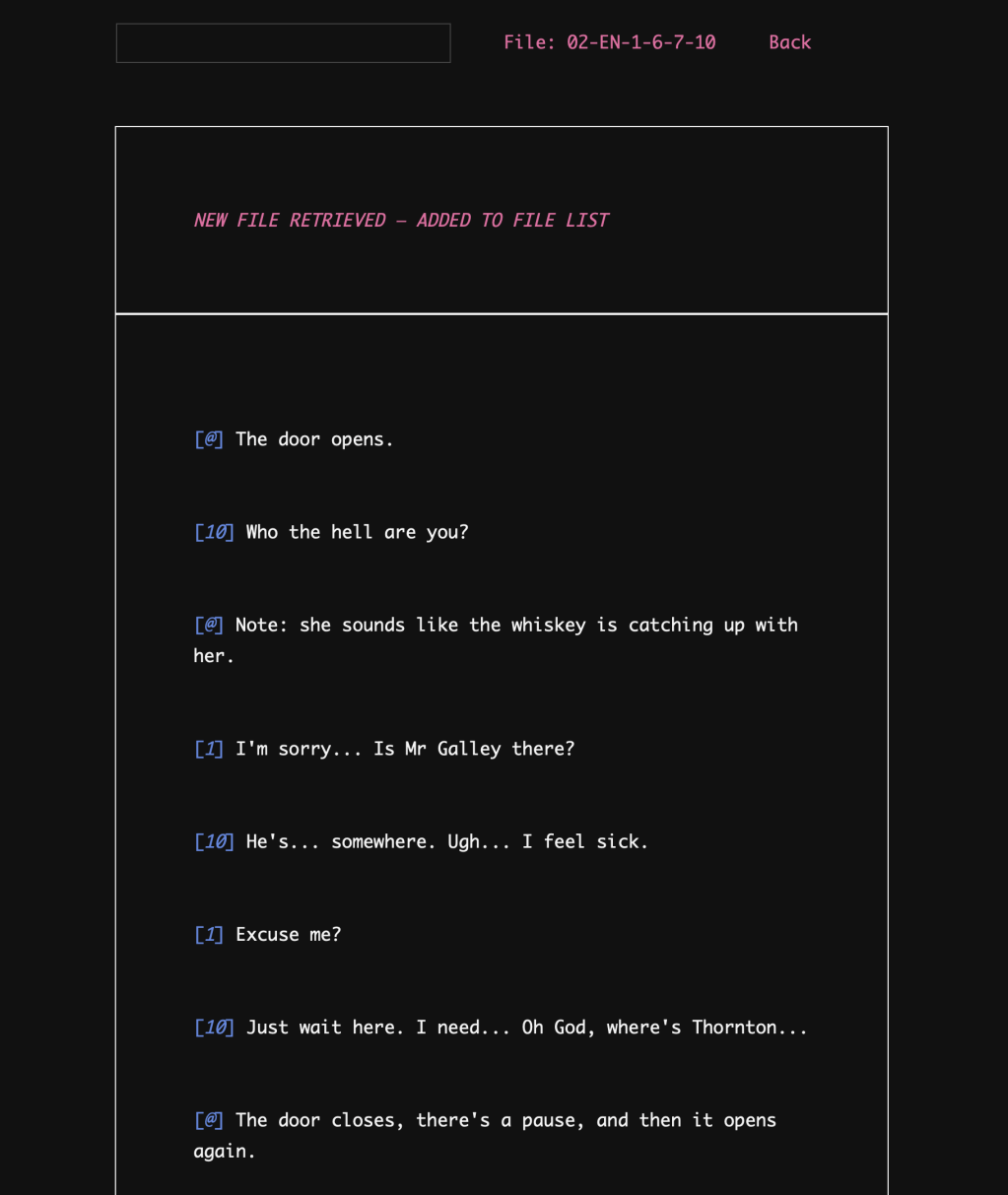
The only time you type “help” is at the beginning of the game, where it’s explained you’ve come into possession of a computer containing the investigatory records of a long-ago mystery. The Galley House was discovered with a number of dead bodies and no clear culprit; all you have are transcripts of audio from its inhabitants, divided by room and by time period.
Transcripts have filenames like 02-EN-1-6-7-10, which can be decoded as:
02: The second time period of the mystery. There are 26 in total, and they can be as short as a few minutes or as long as several hours.
EN: Entrance, i.e. the room the transcript is from. There are lots of rooms.
1-6-7-10: The people present in the room during this time period, in this case, the persons designated 1, 6, 7, and 10. An early task is assigning names to numbers.
Because there’s no list of filenames, your primary goal is to find as many as you can in order to learn the full story. This is as straightforward as making deductions and guesses based on what people say and do, and then typing in the resulting filename. For instance, if persons 7 and 10 said they were going to leave the room in transcript 02-EN-1-6-7-10, one might guess at the existence of a file named 03-EN-1-6 for the same room in the following time period. Then again, if other people joined them, that filename wouldn’t exist. There’s no punishment for guessing incorrectly, and indeed you can spam as many guesses as you like, though this gets tiring quickly.
![Screenshot of the game:
I5] Don't worry about it - you're welcome to stay here as long as you need. Let me introduce you - this is Victoria, Helen, Tony, Eddie and Damian. We're having a small gathering here this evening.
[9] Did you have anything planned, Martha? Because we shouldn't really start until my daughter arrives...
[6] I don't think she'll be coming any time soon.
[9 Excuse me?
[8] Does anyone know where Annie is?
[4] She said she didn't want to come. I don't see why we all need to be here anyway!
[7 I'm sorry...
Who are you?
[1] Actually, Martha, I might need to stay the night while the weather improves - if you wouldn't mind.
[4]
At least I was invited here...
[5] I suppose we could accommodate one more. I'll show you to the spare bed in the Study, Mr Hobbes. And you'd best come with us too, Damian - we could do with a strong man to help set things up!](https://mssv.net/wp-content/uploads/2025/03/living.png?w=780)
The Galley House’s inhabitants are always splitting up into little groups to plot and confront each other owing to an endless supply of familial strife and intrigue, exacerbated by the disturbing fact that, one by one, they’re falling dead. It quickly becomes apparent the deaths are being caused by supernatural means, and so as they investigate the deaths, so do you (though as the game frequently reminds you, “there are no ghosts in Galley House!”) This makes pronouncements of “Let’s go to the study” or “I saw X and Y in the kitchen just now” less contrived than you’d imagine.
The sheer number of rooms and time periods makes Type Help practically impossible to solve without a spreadsheet or a notebook. It’s probably a little too easy to solve this way, even if the inhabitants frequently misremember and lie, but fortunately the appeal of the game doesn’t lie solely in rote deduction. There are a few moments when you finally realise what might be going on and say to yourself, “well, if that’s the case then if I try this it should work,” and you’re rewarded with a whole extra meta-textual piece of the puzzle.

But for the most part, you’re filling in spreadsheet cells. This places the game firmly in what Marie Laure-Ryan would call an “epistemic narrative”, which she says originates in the nineteenth century:
The epistemic narrative [is] driven by the desire to know. Its standard representative is the mystery story. The trademark of the epistemic plot is the superposition of two stories, one constituted by the events that took place in the past, and the other by the investigation that leads to their discovery.
… The intellectual appeal of the mystery story lies in challenging the reader to find the solution before it is given out by the narrative; in order to do so, the reader needs to sort out the clues from the accidental facts and to submit these clues to the logical operations of deduction and induction. This mental activity would not be possible if the print medium did not give the reader the opportunity to parse the story at her own pace.
Deduction games innovate on print medium by verifying players’ incremental guesses. Apart from the interactivity this offers, this also unlocks longer and more complex mysteries, especially when games do the bookkeeping for you. So maybe we should call this genre “epistemic games” rather than Obra-likes or deduction games or information games!
Whatever we call them, Type Help distinguishes itself from its counterparts in its deeply gothic nature. The magic in the Golden Idol games is ultimately rational and scientific, having been developed by an ancient high tech civilisation, reminiscent of New Romance stories by Jules Verne and H. G. Wells that become popular around the turn of the twentieth century. This was the time of modernity, according to Max Weber. In modern life,
…. there are no mysterious incalculable forces that come into play, but rather that one can, in principle, master all things by calculation. This means that the world is disenchanted.
You can master the Golden Idol by calculation – its instructions are on the back, if you can decipher them. The horrors of the Galley House, on the other hand, can be documented but they cannot be fully understood. Type Help is closer to Lovecraftian tales of confounding, effable forces and movies like It Follows where chaos infects the clockwork of calculation. Their victims are confused, panicky. They try to figure out what’s happening to them, but they can’t. Their world has been re-enchanted.
Type Help is a new low-water mark for the technical complexity of deduction games – and I mean that as a compliment. It runs entirely in the browser and is probably just a bunch of text files with Javascript on top (edit: v buckenham tells me it’s Twine/Sugarcube). It feels like what hypertext games ought to be.
Its simplicity points to an even better comparison, though: experimental fiction. Type Help most reminded me of George Perec’s Life: A User’s Manual. The novel contains 99 chapters about the inhabitants of a Parisian apartment building, all told at exactly the same snapshot in time, just before 8pm. The building is ten storeys tall and spans ten rooms across, which is where you get the 99 from (one basement room is skipped).
Befitting oulipo, a kind of writing with self-imposed rules like not using the letter “e”, the order of the chapters is determined by a knight’s tour of the building’s cross-section:

Life: A User’s Manual’s linearity allows Perec to tell a story with a meaningful conclusion. Type Help gives players more leeway in their exploration, but just as there’s only one way out for the inhabitants for the Galley House, there’s only one way for players to complete their spreadsheets: down, down, down.
 mssv
mssv 