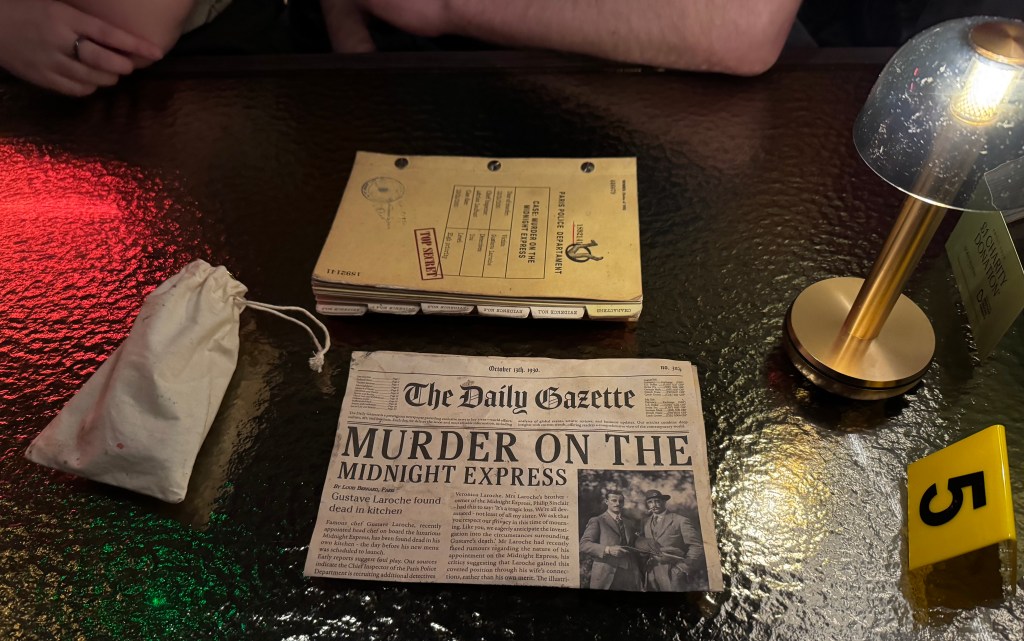
Last week, I visited Somewhere by Nico’s Murder on the Midnight Express “immersive cocktail experience”. I’m writing a book about the history and rise of immersive art, so it was research. Also, they were offering a steep discount during January.
I’d been curious about Somewhere by Nico for some time. The bar is part of the popular Six by Nico restaurant chain, which made its name by offering themed six-course tasting menus; the current one is about 80s nostalgia. Six by Nico has perfected the art of “mass luxury” hospitality (or what Venkatesh Rao would call premium mediocre, “food that Instagrams better than it tastes”) by rotating themes every six weeks, encouraging repeat custom. With Somewhere by Nico, it’s applying the same formula to cocktails.

But Murder on the Midnight Express is not just a theme, it’s a full-blown interactive experience. On arriving, our table already had a newspaper, chunky booklet, and a bag holding a magnifying glass, blue light torch, and red acetate filter.
The story, in short, was that the chef on the Midnight Express had been murdered. There were four suspects – his wife, the train’s owner (also the chef’s brother-in-law), a waitress, and his doctor. As each cocktail was delivered, we’d receive an extra physical clue, like a calling card or a discarded wallet, and we’d turn to the next page in the booklet to “visit” a new location in the train.
To our great surprise and delight, servers performed in character, of the “we found the chef in the kitchen, there was a bullet in his back, sorry if a bit of blood got into your cocktail,” variety. Dinner theatre is hardly new, but it was interesting to see it done with such a focused story for individual groups all going at different paces.
The servers were the absolute high point of the experience. The cocktails were aggressively OK. I can’t complain about the value: £30 for five cocktails (normally £45) is a better deal than you’ll get anywhere in Edinburgh, though of course most people would normally a) not buy five cocktails and b) get to choose which ones they got; a couple of cocktail “courses” had two choices, but that was it. It’s a smart idea though, and a good way for everyone to save money.

The problem was the story and the puzzles. I already suspected the photos were AI-generated owing to their uncanny sheen, and Six by Nico has previous form in using AI for a marketing video. But as we turned the pages, I began to suspect the entire experience had been written by AI, as if someone typed “write me a Murder on the Orient Express murder mystery that can take place over five cocktails…” into ChatGPT.
Obviously I can’t prove this. What I can say is that the “mystery” wasn’t anything of the sort. Here’s the story:
You go into the kitchen and discover a napkin inviting the chef to a private compartment. The compartment belongs to the waitress; they were having an affair. The waitress was drugged, obviously by medicine from the doctor, whom the booklet has already told you has debts. The train owner has the calling card of another chef whom he presumably wants to hire. The final cocktail is accompanied by the bullet found from the chef’s body. The server tells us it’s from a particular kind of gun that only the owner uses.
So who killed the chef? You choose by unfolding one of four suspect pages at the end of the booklet. We chose the chef’s wife: she had the strongest motive. Wrong! It was her brother, the train owner. Why? The bullet. Some mystery!
As for the puzzles – well, there were barely any. One required us to use the red filter on a calling card to see hidden text there. Another involved matching a fingerprint, which was so easy it didn’t require the magnifying glass, let alone any actual study. We desperately wanted something more to do, like assembling a torn note or solving an anagram, but it wasn’t to be.

This was all the more disappointing because pretty much every other aspect of the experience was average-to-good. Most drinks came with a cute sweet or snack, like a cigar made from parmesan cheese. The booklet was pleasingly solid and looked convincingly beaten up. The servers seemed to be genuinely into their performances. But the things AI could do – the story and puzzles – were dreadful.
Again, this might not be down to AI. It might just be a lazy writer catering to drunk patrons. But I think it’s AI. And the tricky thing is that AI means we can no longer rely on the usual markers to tell whether something will be good or not: illustrations, grammar, absence of typos, etc. These things used to be reasonable proxies for overall quality. Now it takes much longer to tell whether an experience will be a disappointment.
You could pay a writer £500 to do a much better job – but why pay £500 when you can pay nothing for a bad job that people won’t notice until it’s too late?


 mssv
mssv 