4-5 January 2025
London, UK
Omen Star
£90 (some £40 subsidised tickets also available)
Last week I visited The Smoke, a two-day international chamber larp festival in London, organised and run by Omen Star. It’s very similar to the Immersion festival in Turku, Finland I wrote about last year.
I wasn’t planning to do a full writeup of The Smoke because I am trying very hard to focus on the book I’m writing, but after I brain dumped my thoughts on Facebook, I decided to tidy them up for here out of guilt. Why Facebook? Sadly, it is the primary social media forum for the discussion and discovery of Nordic/chamber larps, so if I want larpers to read it, it has to go there.
I did four larps in total across two days. Each day was split into morning and evening sessions, running from 11am to 2pm, then 4pm to 8pm. I believe none of the larp runners were paid to be there, and it felt very non-commercial all round. Here’s a copy of the programme with full details on all 40 larps presented at the festival.
The Canals of Mars
Designed by Sue Lee, Alli Mawhinney, Steve Hatherley, and Tym Norris, presented by Sue Lee and Mike Snowden.
This was a lighthearted steampunk affair where players pooled money to build “Great Works” and elect a leader. I had fun, the pace was fast, and the gameplay gave a clear direction and sense of achievement since you needed to assemble a team and money to do any building. The theme felt a little muddled – not quite pointed enough to make a real political statement, but not so absurd to be dismissed entirely. A couple of scheduling tweaks might help, like changing the election to a two stage run-off system, forcing the final candidates to distinguish themselves clearer.
Emperor’s Retreat
Designed by Jason Morningstar, presented by Sarah Cook.
The Emperor is dying and various factions are plotting to succeed him. At first, the factions seemed clear cut in terms of allegiances, but the motivations of faction members cut against them in pleasingly unpredictable ways. For the second time in a larp-like event, I ended up as a journalist, partly because the other choices I had seemed too flat or too hard to play. If you’re used to interviewing people, playing a journalist is easy, but you tend to be given the least amount of actual information, leaving you completely in the dark to what’s really going on other than what people tell (i.e. lie) to you. You end up having a lot of conversations but it’s all very reactive. I would love to see a setup where journalists gained secret information through primary research or from non-key figures/NPCs.
Still, I was trusted enough to be asked to broker a truce between two sub-factions, which was a thrillingly high wire affair since I had to basically threaten a player by exposing their willingness to sacrifice lives in the name of ideology – something which they ended up backing down from. In the end, events overtook all of this so it didn’t really matter – but that was kind of the point of the game anyway. Much to consider!
12-Handed Monopoly
Designed and presented by Leo Doulton.
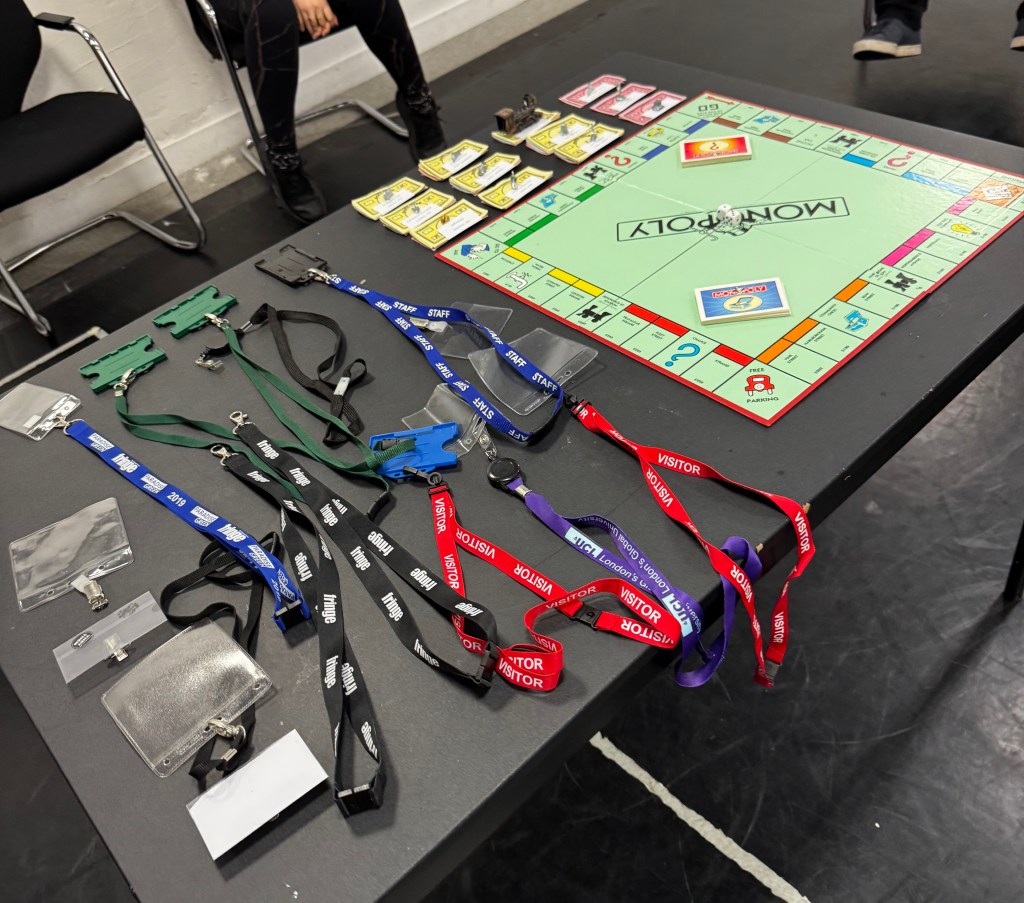
Essentially “normal” Monopoly but almost every player had special abilities, like putting policemen on the board, stealing cash, giving loans, being a revolutionary and tearing down houses, etc. The intro workshop took almost 90 minutes due to all the rules.
During the game itself, Monopoly’s tedious turn-based nature was amplified by the fact we had 13 players (yes) who were doing deals and role playing on the side, so most players only got to roll a few times during the two hours. Not a huge issue if players could do interesting things outside of their turns, but many people couldn’t (or didn’t realise they could); also, some abilities required a certain amount of progression.
That said! I laughed the hardest during this larp than in any other during the weekend. A player next to me played as a nail technician with precisely zero (0) special abilities and spent the entire time complaining about the corruption and unfairness of the system without breaking character once. As for myself, I led the military industrial complex and, after a hint from the larp runner, borrowed £2000 from the banker at 10% to bribe the State in order to declare war, thereby increasing all taxes and the defence budget. No sooner had I done this, I’d landed in jail due to a Chance card and survived an assassination.
Most of my issues were pointed out during the debrief, and the larp runner was attentively taking notes through the game, too. Simply having more paper cash (or a faster form of bookkeeping) probably would have sped the game up by 20%; maybe you could have a countdown per turn, etc. Anything else, like simultaneous turns, multiple boards, etc., would result in something really complicated and not much like Monopoly at all – which is still maybe worth making, but then you’d need to call it something else.
The Board
Designed and presented by James Bore, Sarah Lascelles, and Andy Coley.
Seven players made up the board of Redwood Manor, a family hotel/resort. The founder was retiring and the company would be undergoing a succession (yes, the Succession soundtrack was used for the intro/outro).
The whole thing was played pretty straight, demonstrating the larp runners’ background in corporate simulations and role playing, perhaps to the point of being a bit too believable/conventional. Then again, maybe that was only a problem for me because I’ve literally sat on a board for two decades; others might have found it more escapist. I kept expecting more dramatic things to happen (deaths, takeovers, disasters, etc.), but the company more or less did fine.
Once again, The Board showed how larp is a co-created art form. I recognised a player from a previous larp and knew we were in for a good time, since he was an excellent role player. Even better, he was Head of Marketing and invented a brilliant side plot about the hotel accepting digital payments from “Zublox” youths which was just on the right side of believable. It was genuinely inspirational for me and I’ll be thinking how to improve my own role playing as a result (I drew a fake Financial Times article, for one).

General Thoughts
The Smoke was my second chamber larp festival after Immersion in Turku last year. Naturally, it would be foolish to draw any conclusions about British vs. Nordic chamber larping cultures from this, especially since there was an overlap between creators – but being foolish has never stopped me!
My main note is that British chamber larps seem to be more of “talking shops” than fully embodied. There was a lot more deliberate movement and touching and hugging in the Nordic larps, more time spent on that in the workshops. Maybe this is just a result of the space available in Theatre Deli (The Smoke’s venue); maybe it’s about traditional British reserve; maybe it’ll come in time. Maybe it’s just a coincidence!
Speaking of workshops, there was a lot of emphasis on the “two foot rule” when it came to player safety, in that if you felt uncomfortable, you could just leave. I don’t remember that being discussed anywhere near as much in Turku. Maybe it was just taken for granted there? Or maybe it reflects a kind of individualist attitude to self-protection.
The larps I played spent less time on player interiority versus Turku; less time for players to sit and think on their own, far more time doing stuff and talking. A shame! Also less time on debriefs and decompression.
Finally, it was interesting to observe how British chamber larp is more of a subculture than a (more) widespread artform as it is in the Nordics. More in-jokes; people sticking to groups, that sort of thing. This is inevitable with smaller communities and not a criticism! But the informality can be exclusionary, too. One larp runner breezily assumed everyone playing knew what “lines and veils” were. As far as I’m aware, those terms are more of a tabletop RPG thing than a Nordic larp thing, and so it was a weird piece of knowledge to assume – especially since there were people who said they were completely new to larping at the event.
However, on the whole, everything was handled very neatly and respectfully. It was a really well-organised event in a fantastic central London location, with a truly amazing variety of larps. I loved seeing players with such a variety of ages and backgrounds. I’m hoping I can do more to support the scene across the UK and particularly in Edinburgh and Scotland in the coming months and years.
While in London I visited the Tate Modern’s Electric Dreams exhibition, on art and technology before the internet. There was a lot of good stuff relevant to my research such as works by participatory/installation art collectives like E.A.T. and GRAV, and more modern stuff from people playing around with video games and computer graphics. These latter works were, in fact, made after the internet and even after the web, so I don’t really understand the cutoff point, but whatever.

The exhibition as a whole was overwhelming, and not in a good way. The problem with putting self-admitted “immersive environments” in a white cube setting, especially one this crammed, is that visitors have little time to adapt to and process what they’re seeing. One moment you’re stumbling through a corridor printed with an optical illusion, the next you’re in a room with brilliant stripy projections and balloons flying around. Perhaps there is no coherent way to show the breadth of artworks covered by Electric Dreams, in which case a more focused topic would’ve been better.
This is what MAXXI in Rome did for its Ambiente exhibition, showcasing just 19 environmental artworks by women artists from 1956-76. In all fairness, MAXXI has way more space, but they chose to use that space comparatively sparsely, giving each artwork room to breathe and be considered on its own. Less is more!


 mssv
mssv 