PC, Mac
$13.99
Bureau 81
3.5 hours
The Operator is a narrative puzzle game where you play an intelligence operative assisting agents in the field. By analysing photos and videos and searching databases, you discover clues, solve crimes, and unravel a conspiracy. All gameplay happens on a simulated computer desktop, which is why I like calling this genre “desktop/phone simulators”.
Like alternate reality games, desktop simulators promise highly intuitive gameplay: if you want to check your email, you open the email app rather than digging through game menus. They’re also meant to be more immersive because they include fewer non-diegetic elements like inventories or scores. Unfortunately, I’ve always found this genre to be more fun in theory than in practice.
It turns out that many desktop simulators, especially ones with linear narratives, benefit from things like hint systems and cut scenes; they can reduce players’ frustration at not knowing what to do next, and save writers from having to twist themselves into knots because they have to tell the entire story through emails and photos and voicemails. The allure of total immersion is too strong for many designers to pass up, which is why I’ve tended to steer clear, despite having enjoyed games like A Normal Lost Phone, Her Story, and Digital: A Love Story.
But The Operator doesn’t make those mistakes, leading to an unusually smooth gameplay experience that feels cinematic in more ways than one…

The game begins with a brief first-person cutscene where a mysterious voice asks you about UFOs and if you remember who you are. It’s deliberately blurry, with dazzling lights set in the darkness, and nicely establishes the mid-90s X-Files vibe.
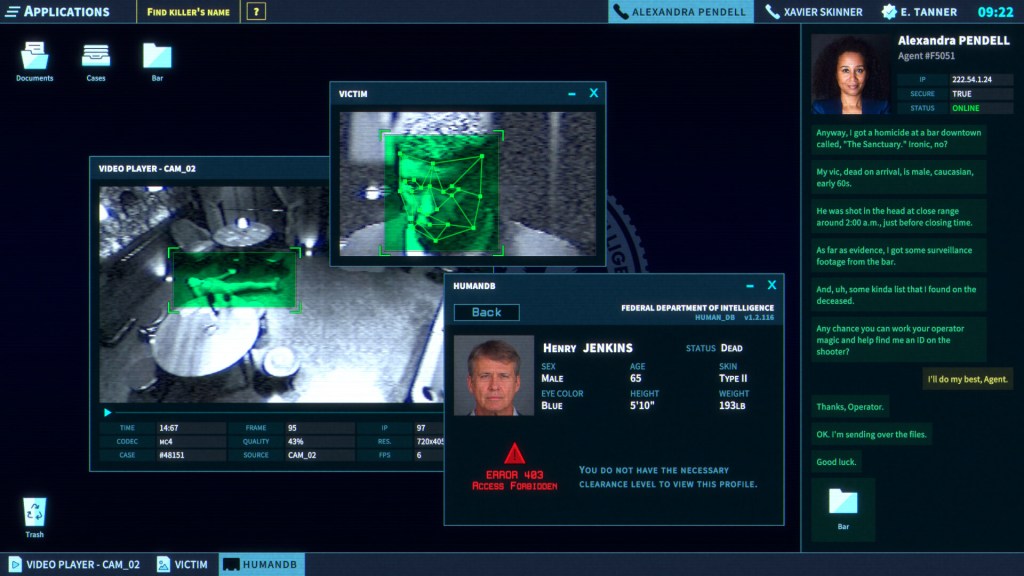
You’re then presented with a login screen on a “Federal Department of Intelligence” computer. Typing any characters fills in the username and password for Evan Tanner (i.e. you), revealing a desktop and an incoming call. Calls feature voice acting with live transcription, and you can occasionally choose one of a few replies, not that they make any difference to the plot whatsoever.
The call is from Mike Trench, Director of the FDI. Oddly, you’re friends with Mike already – in fact, he got you this gig. After some chitchat, you’re connected to an agent on an investigation. Typically, agents will lay out their case, upload evidence files to your desktop, and ask a question like “What’s the killer’s address?”. Quests appear as a tab at the top of your screen as a reminder of what you’re working on and a way to submit answers.
In this case, you’d open a video and pause it when the suspect is in frame. Clicking on their blurry face will “enhance” it, and clicking on the now-clear face will match a name from the FDI’s database.

When you type the name into the “HumanDB” app, you’ll find their address – the answer. To submit it, you’d click on the “Find Killer’s Address” tab, then click on the address displayed on your screen. This connects the two elements with a line, and if you’re right, they’ll intersect with a green checkmark. If it’s wrong, it’d show a red cross, but otherwise there’d be no penalty:

This is a highly streamlined puzzle UI. Consider how much more complicated it could’ve been. Maybe you’d need to drag files into an “Image Enhancement” app, then choose between different zoom and enhancement options, or to submit an answer, you’d select an option from a long list.
Instead, The Operator boils down almost all interactions into clicking on things directly. Something weird in a video? Click on it, and something interesting will happen. A blurry bit of text? Click on it. At times it feels like a really easy hidden object game. That’s not a criticism, since the game is more about a fantasy of being a hyper-proficient “person in the chair” operative than posing a tough intellectual challenge. Later puzzles do involve more steps like guessing a password or running a chemical test, but it’s generally very clear what you need to do, and if you’re stuck, you can call your supervisor at any time for a hint.

Toward the end of the game, puzzles become even longer and abandon the question tab format. Guiding an agent through a building requires reviewing floor plans and watching live CCTV feeds to tell her it’s safe to move – very cinematic, and very easy.
Defusing a bomb is probably the hardest puzzle in The Operator. This involves speedreading a multi-part bomb defusal manual, cross-checking details with an agent to identify what kind of bomb it is, then guiding her to snip the correct wires in order. It’s a thrilling logic puzzle and the only one with a time limit, albeit very generous. (Hilariously, my supervisor said I had to defuse the bomb because all the other agents were occupied – with what, other bombs?!)

You encounter several agents throughout the game, each of them with distinct personalities. The dialogue was 20% too long in every instance and the tone was too broad – an occupational hazard for non-Americans writing Americans – but the voice acting was decent and I never felt too annoyed.
There are a few short first-person cutscenes in between major chapters of the game. At the end of each “day”, Evan commutes to an empty apartment; at another time, Evan walks through the FDI’s headquarters to a restricted area. Like the introduction, these are blurry, gauzy videos, but they’re surprisingly effective at conveying atmospheres of loneliness and tension. Once upon a time, even blurry videos would’ve been expensive to produce, but I’m guessing these were created from a combination of stock footage and machinima, making them a clever and economical solution to depicting story that couldn’t otherwise occur on his desktop.
It’s these videos, along with the highly streamlined and linear gameplay, that demonstrate The Operator is less of a simulation, let alone an immersive sim with a high degree of player agency and choice like Uplink, than an ultra-interactive movie. I was most reminded of Searching and Missing, movies that play out entirely on protagonists’ computer desktops, with some amusing diversions to other kinds of screens:
The Operator’s theatrical leanings are most apparent when you uncover a particularly juicy secret in a password-protected directory and it’s accompanied by a musical sting; on a moment-to-moment basis, it’s a nicely-directed story.
For that reason, I could see The Operator doing well as an indie “desktop computer movie” like Missing, though the story would need major changes. We’re never given enough time with the main characters to form meaningful connections, and the revelations surrounding the conspiracy are entirely predictable if you’ve paid any attention whatsoever; when you meet only a handful of people, it’s easy to guess who’s the villain. That said, I enjoyed the bleak ending, which felt fitting given the game’s wider themes.
Alternatively, The Operator would be a fine addition to Netflix’s games library, especially if it added multiple episodes. The only thing I’d need is a way to save progress during episodes; I appreciate that most players will complete the entire 3.5 hour game in one or two sittings, but it’s ridiculous that you can go for 45 minutes without a single save point.

The Operator is an odd in-between game. Not quite a movie, not quite a desktop simulator; and a very short game, too. The market doesn’t reward things that don’t fit neatly into genres, but maybe that’s why I’m so charmed by it. The only reason you’d make a game like this is if you were hell-bent on proving it could work.
And that it does.
In other Adrian news:
- Last week, I spoke at The Experience Economy Meeting in Madrid, an exclusive industry gathering for people running, marketing, and promoting immersive experiences – things like touring exhibitions for brands and museums, and ambulatory VR experiences. I was struck by how many people there originally worked in live music promotion, shifting almost seamlessly into immersive experiences. That’s probably why they were skeptical that “immersive” was anything but a marketing buzzword, just like “experiential” or “interactive” before it. I disagreed, but it was nice to talk to people with such a depth of business experience.
- I also spoke at the Immersive Experience Summit in London, reviewing some of the trends, challenges, and opportunities I’ve seen on my tour of immersive experiences around the world. The video will be posted on YouTube soon, and I’ll link it here.
- Next month I’m speaking at Immersive Tech Week in Rotterdam and will try to make the point that immersion doesn’t equal or require technology.
I’m trying to give new talks at each event, partly because they’re all for different audiences, and partly because it helps me figure out ideas and arguments for my book about the history and rise of immersive experiences. When I challenged the idea that “immersive” is just a buzzword, it forced me to articulate an alternative definition, and I feel like I’ve come up with one that encapsulates the many kinds of immersion I want to cover without sounding completely woolly. No, I will not be sharing what that definition is – yet.
Next year, I’ll be at:
- January: The Smoke, an international chamber larp festival in London
- February: Unannounced major conference talk
- March: Knutepunkt larp conference in Oslo
- May: Eclipse blockbuster sci-fi larp in Krakow
I also need to fit in a visit to Le Puy du Fou, a very popular historical theme park in France that’s notorious for its reactionary politics. But I’ll mostly be writing the book.
I’m always surprised there aren’t more films like Searching (2018) and Missing (2023). Searching made $76 million on a $1 million budget, and Missing made $49 million on a $7 million budget. That’s a big drop-off but any producer would kill for a 7x return; 3x is usually the marker for a solid profit on a traditional Hollywood movie.
I can only assume that filmmakers and/or studios simply do not want to make these kinds of “computer screen movies”. Maybe they think they can’t market them, or the stories are too limiting? Or maybe they’re too annoying to make? I read that Searching and Missing both required a highly custom workflow since they had to recreate computer graphics perfectly. If it’s the latter, that’s surely a problem that can be alleviated technologically. If it’s the former, you have horror movies like Host that really expand the format.

 mssv
mssv 