I caught a couple of fascinating shows while in London for the Immersive Experience Network summit (I’ll post my slides soon). These aren’t as exhaustive as usual, but I want to get these thoughts down while they’re fresh.
The Manikins
London, UK
£110-125
Deadweight Theatre
1.5 hours
The Manikins is an immersive theatre show for one, where you seek help with your nightmares in the office of Dr. Ligotti. It’s difficult to write anything about the show without spoiling it, so just skip this piece if you have any intention of seeing it. That said, The Manikins is coming to the end of its current extended run and is pretty much sold out, so you’re probably fine.
On arrival, the creator and lead performer Jack Aldisert asked if there was anything I’d like to know in advance. Nothing came to mind, so he noted that if I wanted the show to end for any reason, I could say “I want to stop,” at any moment. This was sufficiently important that he asked me to repeat it out loud. He also explained that there’d be a short intermission where he’d come out of character to see how I was feeling.
The show took place in a small room made even smaller by a thick curtain dividing it in half. I sat down on one side and instructed to walk through the curtain to the other side when the music stopped. Someone slid an envelope through the bottom of the curtain; it contained a single page formatted like a script. Almost all of the lines were squiggles except for an exchange in which a nurse got a patient’s name wrong.
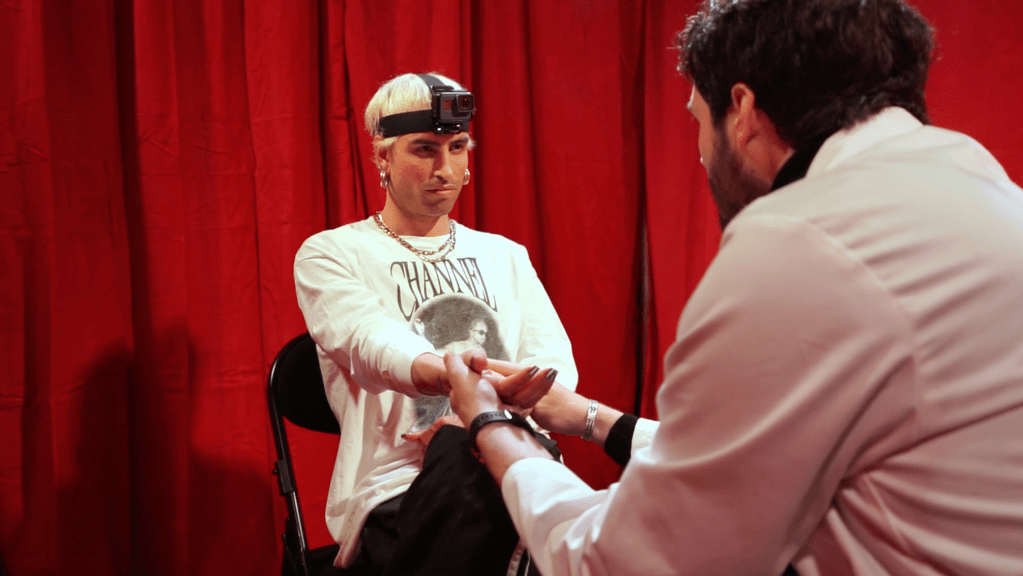
When I walked through, a nurse greeted me with the wrong name, just as the script indicated. I knew I wasn’t meant to be roleplaying as anyone but myself, but it still felt odd wanting to perform as a good patient. She took down various personal details, a perfectly familiar scenario made gradually more eerie by:
- The script
- The nurse’s questions about a clock I couldn’t see
- Her gradually increasing distress that I couldn’t recall my nightmares in detail
Before guiding me through the curtain once more, she urged me not to tell Dr. Ligotti I couldn’t remember my nightmares, The doctor (played by Jack, now wearing a lab coat) asked me about my nightmares. After some back and forth about the non-existent clock and the nature of knowing whether we’re dreaming or not (inability to read writing, clocks, etc.), I agreed to his experimental treatment, which required putting on a sleep mask and wireless headphones.
A voice counted backwards from ten and began telling a story – a nightmare – in second person. “I” was in a room with a clock behaving oddly and a door that vanished, then I found myself on a stage facing an audience of half-human, half-manikins. I had a feeling of terrible fear, where a giant hand was reaching for my shoulder from behind me, holding a piece of paper telling me what to say. It ended, and someone took the headphones and mask from me. As audio storytelling, it was atmospheric and chilling.
This is where my memory gets hazy, because The Manikins’ scenes loop and repeat in a deliberately confusing manner. I met the nurse and the doctor several times, with more script pages slid under the floor. As conversations repeated, they both came to realise they were actors in a play. The intermission, where Jack appeared and asked me how it was going, only made matters weirder; when the show resumed and I went through the curtain, Dr. Ligotti asked me where I’d just come from. I dissembled for a bit, then admitted I’d just met him in a different guise.
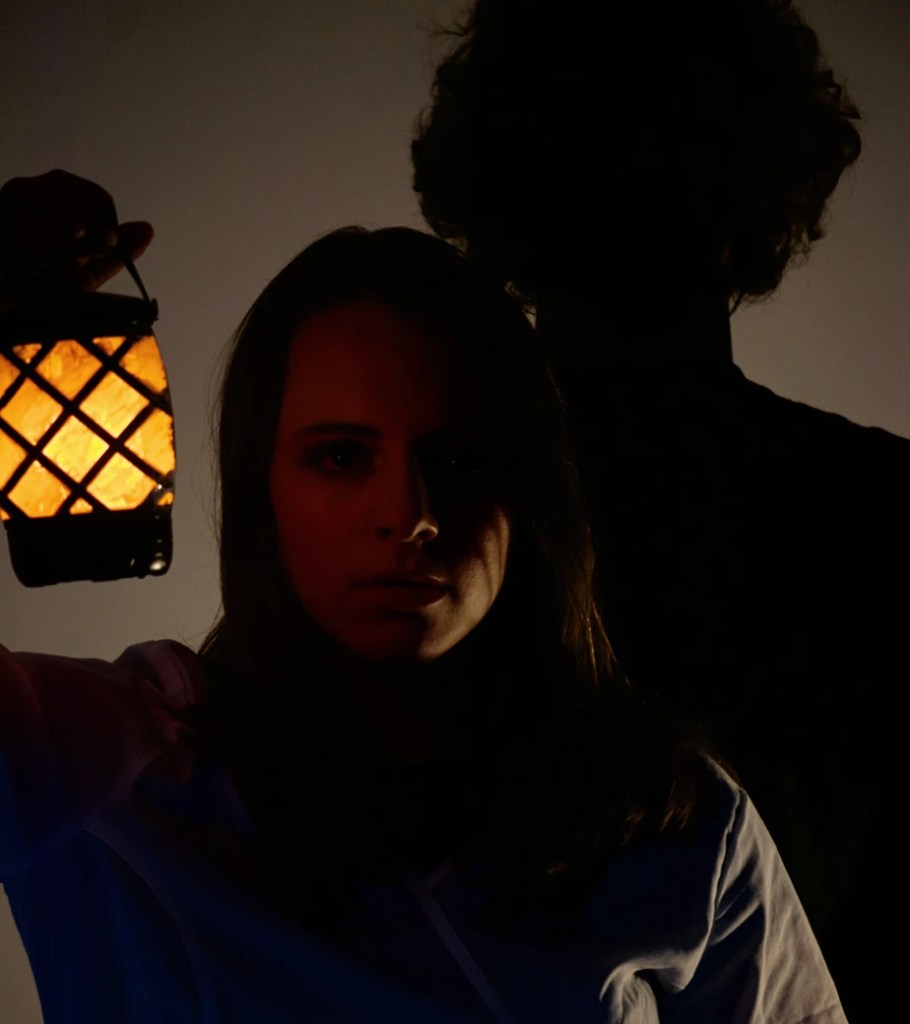
Later, the nurse asked me to wear the lab coat. As the doctor, I met “Jack”, a patient trying to write a play but plagued by nightmares of manikins. I did the experimental therapy again at some point, emerging to a darkened room where “Jack” and the nurse acted out a scene featuring my precise words from earlier in the show, then asked me – the director/writer – for feedback. Finally, I walked through the curtain a final time to see the nurse, who said in apparent terror that only I could stop everything, and that if I did, I should never start it again. “You know how to do that, don’t you?”
I said “I want to stop,” the lights came up and the two actors emerged. They asked me if I wanted to continue the show or end it. The thought of putting the nurse through it again appalled me, so I chose to end it. The tech person came out in front of us, and we all took a bow. Jack saw me out of the building, and passed me a final envelope through the door: of course, it was a script page with our conversation.
The Manikins is metafictional in a Borgesian/Calvino sense – it’s a story aware that it’s fiction. Like The Stanley Parable and alternate reality games, it breaks the fourth wall by enlisting the audience as performers. What’s unusual about The Manikins is that it’s real time, fully embodied, and deeply intimate. Unlike an ARG, you can’t step away from the story by stepping away from your screen; even highly intense larps tend to give you a break if you want one. And unusually, by the end of The Manikins, the audience isn’t merely a performer, but the writer/director.
Fitting all these self-referential layers into a short production evidently required jettisoning practically everything other than the absolute basics, hence there is no story or world as such other than “the existential horror of realising you exist in a show”. One might exit the show wondering whether the entire world is merely a show or a dream (or a nightmare); apparently one early audience member required reassurance on that matter.
Despite these metafictional musings, I was troubled by The Manikins’ deliberate manipulation of role playing and theatrical conventions, specifically safe words and out-of-character moments. Now, I am pretty sure “I want to stop,” was not presented as a safe word as such, and I can’t deny that it worked in the sense that when I said it, the show stopped. Similarly, the intermission really did feel like an intermission and I’m sure that if I said I felt uncomfortable about certain aspects of the show, they would’ve taken that into account. Nevertheless, the incorporation of the existence of the intermission and the people involved in it into the fiction, if not the words exchanged inside it, feels like it violates an unspoken rule about how storytelling in theatre “works”.
I’m wary of shows playing around with safe words and out-of-character scenes because these are extremely important tools that enable people to participate in more challenging experiences. If audiences start suspecting they won’t work in the way they expect or they work in more ways than anticipated, they might lose their power as metatechniques.
Yet I don’t want to say no-one should ever play with them. The conceit of The Manikins has a better justification for its manipulation of conventions than Ontroerend Goed’s Internal, which seduced audience members into revealing personal secrets in private, only to share them with everyone. In this show, the business with the intermission left me more disconcerted than betrayed.
There are two ways to think about The Manikins’ legacy. Literally everyone I’ve spoken to about it, including its creator, has noted its lack of financial sustainability. When audience members are paying, at best, £90 per hour, you can’t cover all the costs of a cast and crew of three plus overheads. So by that regard, The Manikins will have no legacy because no-one else will want to make a similarly labour-intensive show that loses money. But this reminds me of the old joke about economists:
Two economists are walking down the street. One of them says “Look, there’s a twenty-dollar bill on the sidewalk!” The other economist says “No there’s not. If there was, someone would have picked it up already.”
The Manikins exists! It is clearly not going to “scale up” to the size of a Broadway hit, but it is apparently creatively fulfilling enough, and not financially ruinous enough, to have completed over 400 performances. Perhaps because I’m larp-pilled, the financial question isn’t a showstopper for me; maybe Jack Aldisert will start making TV shows for Netflix and do The Manikins on weekends for the next decade. Maybe a group of Nordic larpers will perform it for each other every year. Or maybe the government will start funding the arts again; that’s how one-on-one performers like Adrian Howells made their work in the 90s and 2000s. I’m as interested in money as the next person, but it isn’t the only way to understand the show’s legacy.
So what’s the other way? At first, I thought of Orson Welles’ War of the Worlds, which lives in infamy for fooling, or at least scaring, millions of radio listeners, but didn’t directly lead to anything else because audiences aren’t easily tricked twice in a row. Then I thought it wasn’t the right comparison because The Manikins isn’t about trying to pull one over the audience. And then I thought it was the right comparison because the best fourth-wall breaking shows like War of the Worlds and Ghostwatch were usually preceded with disclaimers that they were fiction, and that part of their achievement is immersing (yes) audiences in seemingly absurd stories.
Our obsession with predicting the future through quantification has ruined arts criticism. Fans pit their favourite movies and games against each other, declaring victory based on sales and box office returns. The promise of profit is only one, admittedly powerful, motivation out of many. When I think about The Manikins outside of its legacy, I wonder how it is that we treat fictional characters like real people; why the simulation hypothesis has become so powerful; and our competing desires for control and predictability and risk and uncertainty in our entertainment; and our fear of being unwittingly controlled by others. That’s more than enough to care about for now.
Bridge Command
London, UK
£40-60 per person
Parabolic Theatre
1 hour 45 minutes
Earlier this year I wrote about my visit to Bridge Command. I usually don’t return to immersive experiences because it’s often a case of diminishing returns, and if I do, I prefer to write about newer things – but this time I’m making an exception.
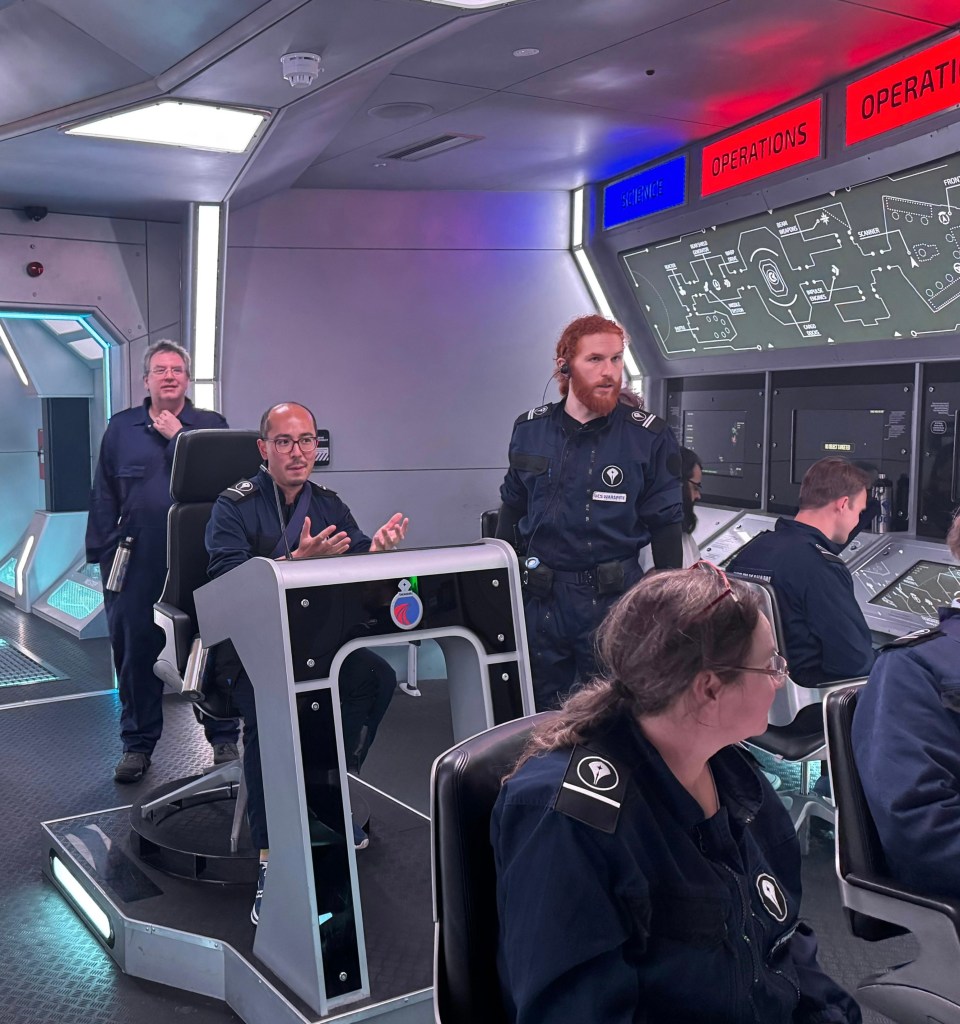
I was apprehensive about our second mission. Out of our fourteen-strong crew, ten would be returning, and I worried that absent the novelty of walking onto a starship for the first time, they might find it less thrilling. At first, my fears seemed unfounded: the teleporter and the bar were still fun.
Our mission briefing began with a new scene-setting video from the UCN President, which started strong but got muddier as it unveiled more and more worldbuilding. If the UCN was so desperate for the magical unobtainium (“gravium”) in this sector of space, why wasn’t it a bigger deal in our missions? How had the abandoned colonies in this sector grown so rapidly in a single generation? These are not the kinds of questions players should have before they start their “Exploration” mission to investigate a strange space anomaly.
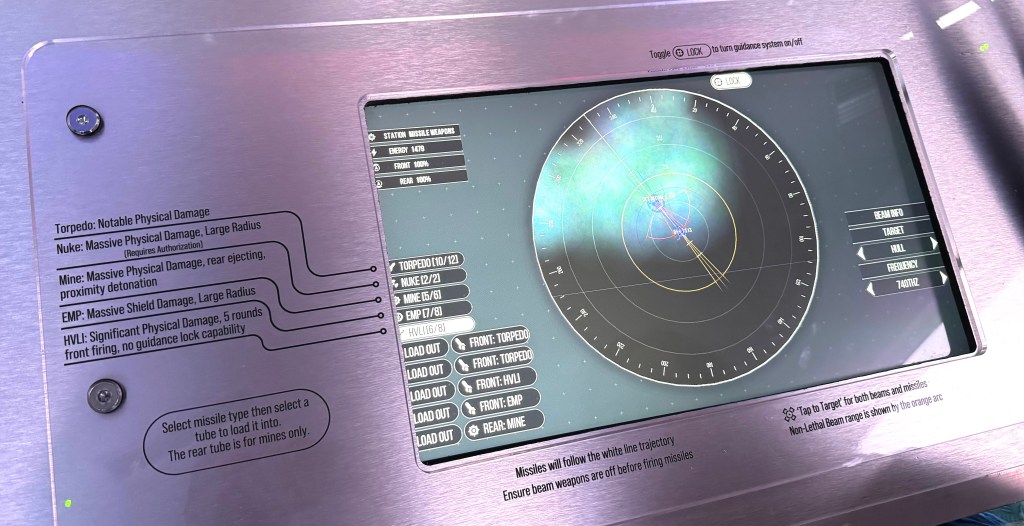
Walking on to UCS Takanami again was a strange experience. There were countless little changes, from informational decals on every computer consoles to a proper on-ship toilet. I was a little disappointed that despite most of the crew being repeat visitors, we went through the entire onboarding and training exercise again. Still, it was a bit zippier and people were more relaxed, so there was more joking around.
With the formalities concluded, I announced, “All hands, prepare for warp!” (a line supplied by our Helm) and we proceeded to the anomaly – until we were halted by a warp jammer. A message warned us not to approach, which we ignored. Four hostile ships promptly attacked and we barely survived until a mysterious message appeared on our viewscreen, saying our capabilities had been tested. We debated whether to blow up the warp jammer but were interrupted by the arrival of an AI-controlled Ark Ship called Paige. Paige had infiltrated our computer systems such that both attack and escape were impossible.
It was around this moment that I reached a personal nadir. Nothing on the ship was working, it was completely unclear what was going on, and as Captain, I wasn’t sure what to do. An incoming hail deepened the mystery: it was from a young woman, Miranda, who claimed to be the last surviving passenger of the Ark Ship. If we let her on board, she could help us since Paige wouldn’t want to harm her. This was dubious logic at best, but it didn’t feel like we had much choice and as Comms noted, it was the most promising avenue to continue the story.
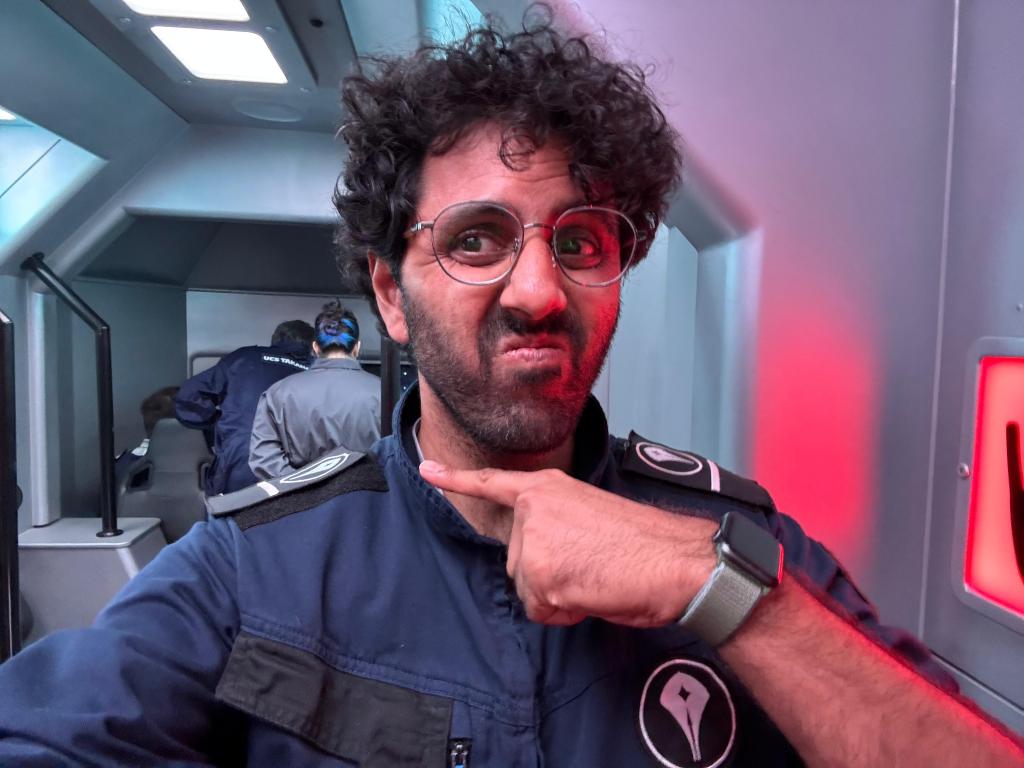
I asked my first officer to keep a close eye on her, but when she arrived on the bridge, it all clicked into place. Miranda explained that Paige saw her as their child, so in order to escape, we’d have to reassure Paige we weren’t a threat to their family; at the same time, we could “defuse” Paige by locating and destroy three fragments of the ship that were causing it to go haywire. Now I knew what kind of Star Trek episode we were in: The Ultimate Computer (Kirk talks a maniacal AI into self-destructing) with a dash of Darmok (Picard uses allegories to communicate with aliens)!
We bundled Miranda into our shuttle where she guided them toward Paige’s fragments. On the starship, our Comms officer and I mollified Paige by pretending Miranda was still on board but asleep, explaining the flexible nature of family by means of Paige’s favourite story, The Princess Bride. Meanwhile, our systems were still going haywire, so our Engineering and Operations teams were sprinting around the ship putting out fires and making sure we had enough power to keep running away from the Ark Ship.
There were at least two other routes to concluding this mission that I could see. The first was obvious: blow up Paige, perhaps using a missing nuclear drone mentioned in our briefing. The second was hidden in an error message we found on a hacked computer; it indicated Paige could be wiped if we inputted a special system code (shades of Wrath of Khan’s prefix codes). Both of these were contrary to my preferred utopian vision of Star Trek (as opposed to DS9), but I kept the prefix code option in mind in case things went sideways.
In the end, the shuttle crew destroyed the fragments and we kept Paige at bay through sheer conversational prowess. Miranda expressed a desire to see the universe with us, but in a slightly off-key note, had to return to Paige to keep them happy – I thought we’d fixed that?!
The sweetest thing happened during our debrief. While I was recounting our adventures, an officer burst in and demanded to see our Comms player. “This is for what you pulled during the mission!” she said, ripping off Comms’ epaulettes – and replacing them with a freshly promoted set. Our Comms officer had done some fantastically imaginative and demanding role playing throughout our game, and it was lovely to see that recognised and rewarded.
Once again, everyone was delighted and demanded I organise a followup – perhaps with two ships, since people wanted to bring their friends, too. Various plans were suggested for extended and overnight missions, perhaps involving a stay at a nearby Premier Inn hotel.
Bridge Command has been open since March but only hard-launched two days ago, accompanied by mostly good reviews from The Stage, Time Out, Trek Central, and Everything Theatre. Its improvisational nature means people’s experiences are heavily influenced by luck and initiative, two factors that are much less present in traditional video games, let alone theatre and movies.
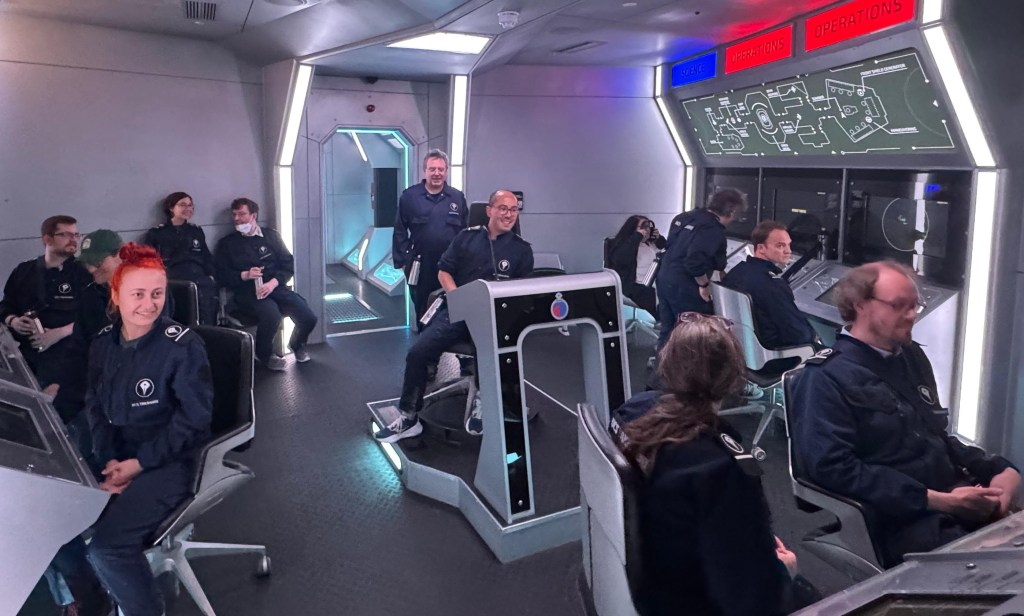
So if anything, I’m even more impressed by my second visit to Bridge Command than my first. The breadth of storytelling and role play it supports is wonderful, from a combat-intensive spy mission to talk therapy with a murderous AI. My momentary confusion is the price you have to pay for that kind of unpredictability, and it’s probably more of a problem for the Captain than for people with more specific roles to play. Like in any good tabletop RPG campaign, sometimes you just have to trust that the people running the game know what they’re doing.


 mssv
mssv 