A quick life update first before I cover three recent shows/games/experiences you should know about…
I’ve had a very busy August. After the Immersion Larp Festival, I was on two panels at Glasgow Worldcon about the history and future of immersive experiences. Back in Edinburgh, I conducted a bunch of interviews with creators up for the Fringe, saw a ton of shows, and hosted the Immersive Creatives meetup at the Traverse Theatre. We had amazing speakers from New York, Melbourne, and Edinburgh, and I was delighted at how the excited the audience was to chat and network afterwards. Thanks very much to Ellen Gledhill at the Traverse for helping make this happen!
I’ve been meaning to play and write about games like Arco, Tactical Breach Wizards, The Operator, and 1000xRESIST, but I’ve reluctantly accepted that it makes more sense to keep my head in the “immersive” sphere for now. Yes, video games are also immersive, but I’ve got more catching up to do when it comes to theatre, installation art, etc.

My book critiquing gamification, You’ve Been Played, has been translated to Italian, so this month I’m on a mini-book tour to the Mantova Festival of Literature then to Rome to talk about it and my first book, A History of the Future in 100 Objects. I’m also swinging by Venice to see the Biennale for the first time. It probably has the highest density of new immersive(ish) installation art in the world and a lot of my favourite pieces, like Zineb Sedira’s Dreams Have No Titles, debuted there.
For some reason, I never realised the Biennale was open to the public, but sure enough, a three day ticket only costs €40 – what a bargain! Also, did you know the Biennale was on for seven months of the year? An event that happens only every two years is actually open for more than a quarter of the time. Who knew?!
I’m unabashedly loving the research process for my next book on the history and future of immersive art. It’s a very different to how I wrote You’ve Been Played, partly because I want to spend more time on the origins and influences of immersive art, but mostly because I have way more time. I wrote that book during evenings and weekends while running Six to Start, which didn’t give me the space to read very widely, plus I was more interested in contemporary developments.
This time around, I’ll have done way more reading. Since I don’t have any formal background in the humanities, it was tough going at first, but it’s been incredibly satisfying to have all these different parts of art and media history and anthropology and sociology and political theory start connecting together in my head with the latest developments in video games, larps, immersive theatre, and participatory art. Much more on this to come.
In the meantime, here are three things I think you should know about:
Burnout Paradise
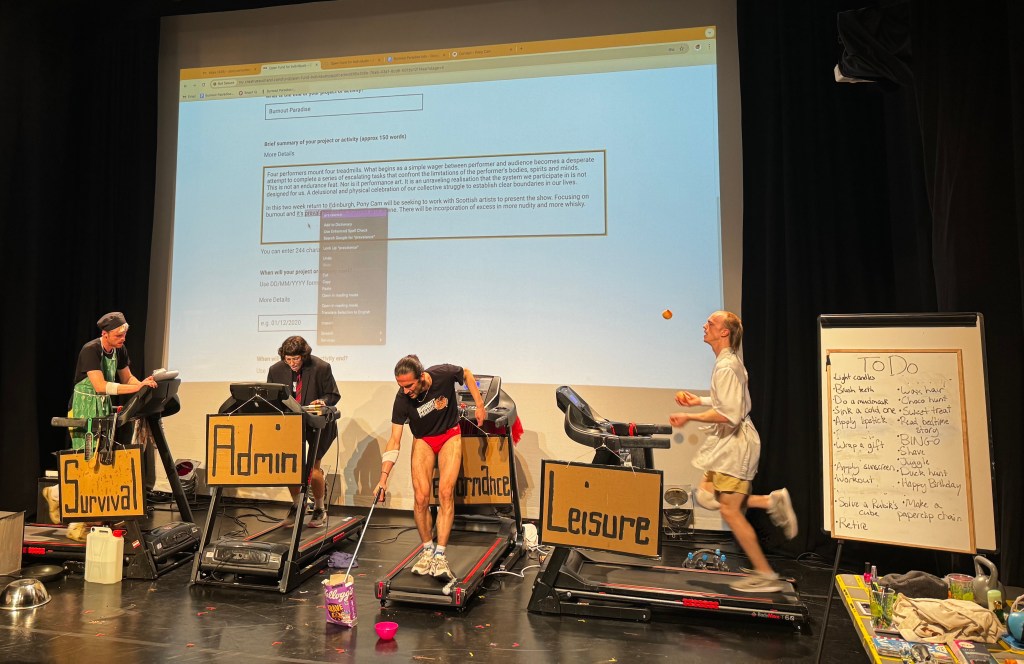
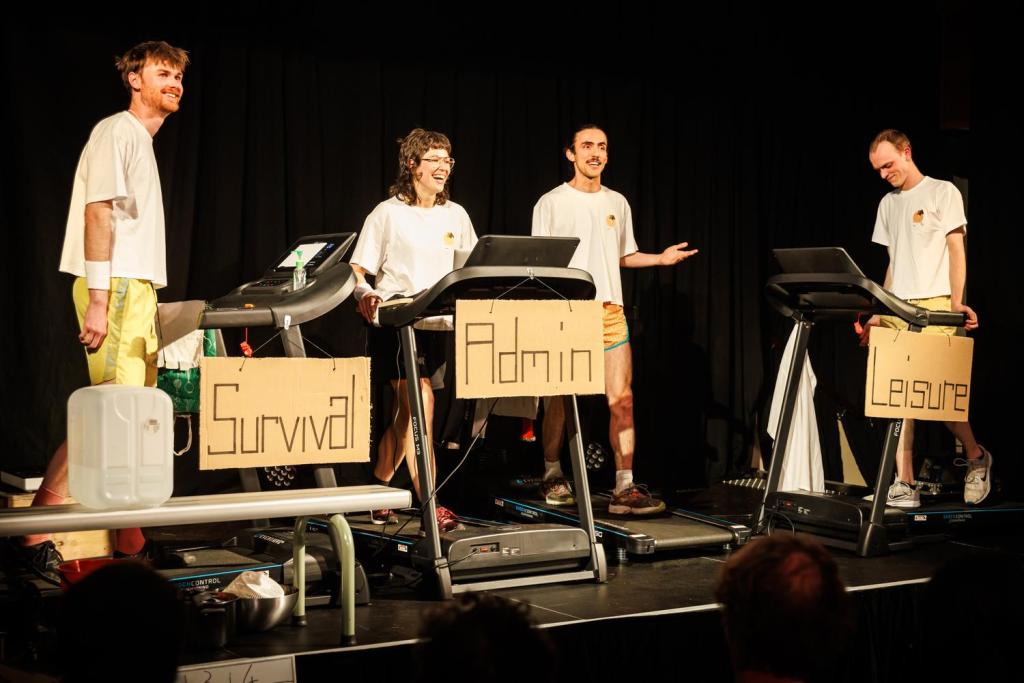
Imagine a four-person Twitch stream made flesh and you have imagined Burnout Paradise, a show by Pony Cam, an Australian experimental theatre collective. Four performers run on treadmills while completing complicated tasks; if they don’t beat their record distance (around 5km each), they’ll refund every single audience member.
The tasks were divided into four categories which performers rotated through every ten minutes:
- Survival: Cook a three course meal for two members of the audience.
- Admin: Write an arts fund application.
- Performance: Dance, sing, clown, etc, while walking or jogging backwards.
- Leisure: Complete a mix of personal, fun-adjacent chores (solve a Rubik’s Cube, juggle, shave, wrap a gift, etc.)
The audience were encouraged, if not instructed, to help performers with tasks: a steady stream of volunteers ferried objects to the Leisure treadmill, people emailed testimonials and photos in support of the funding application, pledging their support in writing. Like the less toxic Twitch communities, there was a strong sense of “we’re all in this together”, with the digital component reminding me of ARGs’ free-form co-operative participation.
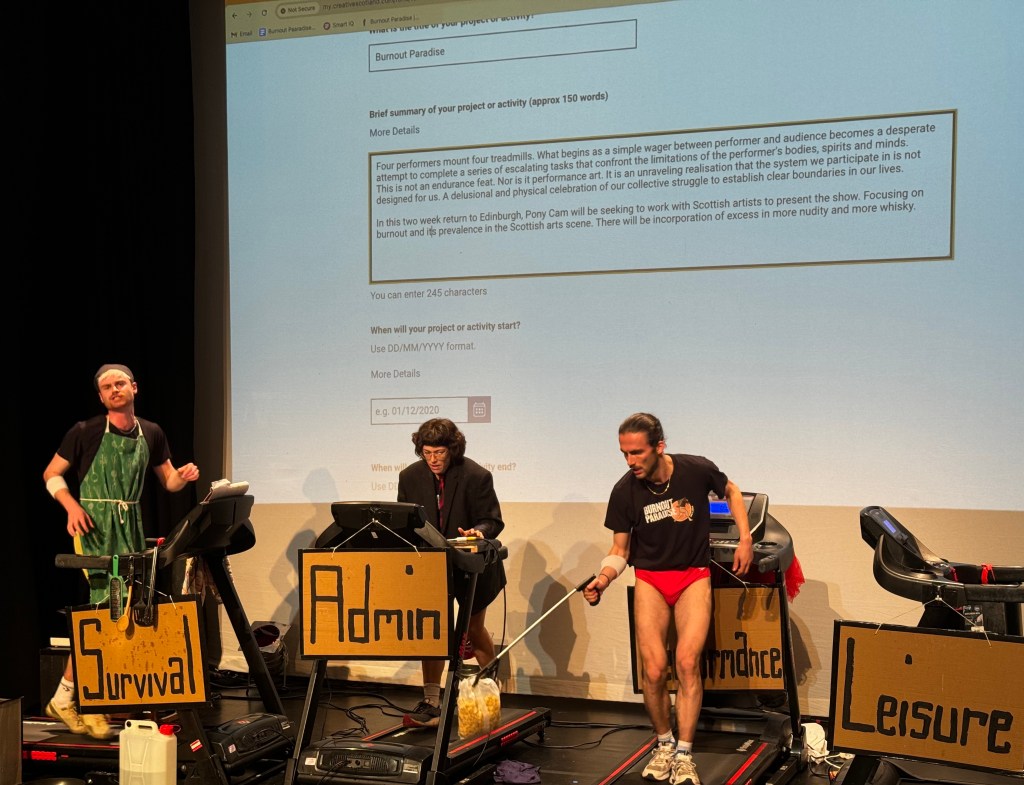
Burnout Paradise is a critique of the unbearable demands that modern work and life places on us, but also a commentary on how making art in the 21st century frequently rests on a toxic relationship with audience and fans. The performers walk a tightrope of manipulative vulnerability: they need our help to achieve their seemingly impossible goals, but those goals are of their own making. After all, it’s not like they had to offer £10 refunds for losing their challenge.
Or maybe they did: the peril of losing hundreds of pounds will feel authentically exciting to audiences in a way that other Fringe shows can’t match. Yet when audience members run around fetching balloons and cooking pasta, aren’t they merely celebrating and abetting the very burnout the show critiques? A close match is always more exciting. Then again, even the notion of refunds is performative – I didn’t see anyone claiming their money back when the performers inevitably failed during my show. Much to consider!
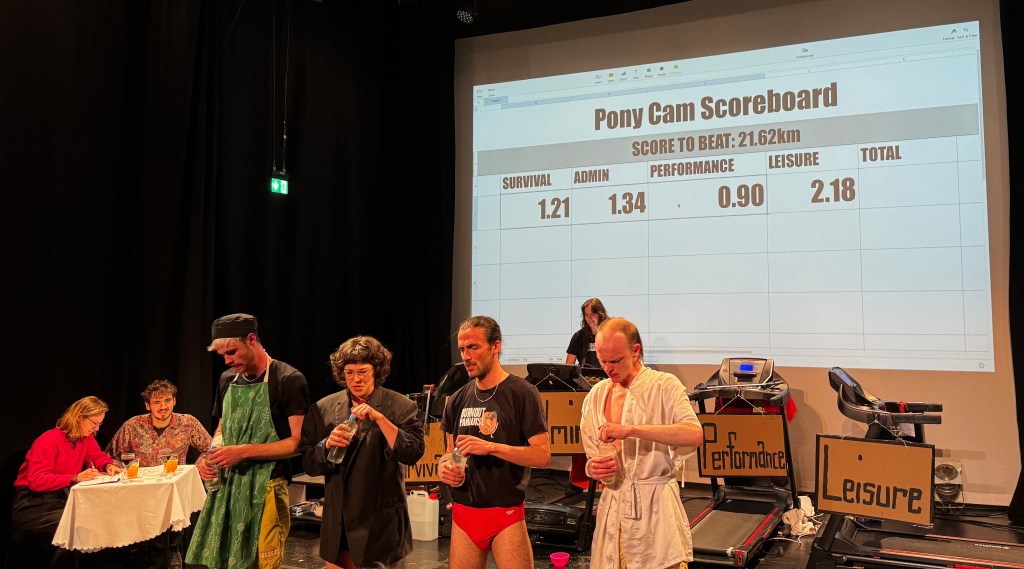
The genius of Burnout Paradise is that the distance they have to beat keeps rising. If they manage 21km, they need to run a little bit further the next day. Why? Anything less would be boring!
Temping
There’s a genre of video games I like to call “phone simulators” or “desktop simulators”, such as A Normal Lost Phone or Hypnospace Outlaw. The game takes place entirely through a fictional user interface where you use familiar apps like email, web browsers, chat clients, and social networks to solve puzzles and advance the story. Frequently, you’re snooping through someone’s else device to rescue them from kidnappers/bring them to justice/understand their plight, etc.
These games have a strong affinity with ARGs which also use your real web browser, email, and phone to bring you into a fictional reality. The main difference is that ARGs are typically one-shot, live, semi-improvised co-operative experiences, whereas phone/desktop simulators are single player, replayable, and non-improvised.
Temping is something in between. Created by Wolf 359 and presented at the Fringe by Dutch Kills Theatre, it’s a show for one audience member and zero live actors.

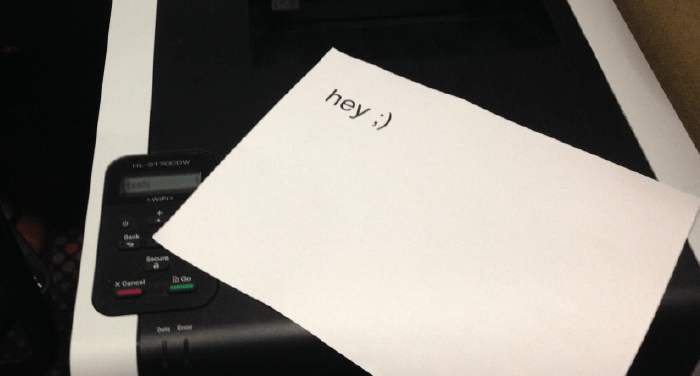
When you arrive at the venue, you’re welcomed as a new temp worker and shown into your cubicle. There’s no-one else around, just a desktop computer, telephone, printer, and all the paraphernalia typical of offices: stress balls, sweets, pens, books, filing cabinets.
Occasionally the phone rings with a new voicemail and new emails appear on the computer. You can reply to the emails and get real, personalised responses, because while there are no live performers in the room, there are two performers backstage watching your every mouse click, key press, and body movement via screen-sharing and a hidden webcam. This level of attention allows the hour-long experience to be closely choreographed. When you receive a particular document, the lights dim; as soon as you finish reading and put the paper down, the lights lift. Occasionally you hear muffled audio of people in “other cubicles” in between filling out spreadsheets and looking up figures in actuarial tables for colleagues.
Much of the time there isn’t a lot to do, so you wander around the office, have a stretch, flick through books on the shelves, and note which passages have been highlighted. There’s no mystery to solve, no competition to win – just a story to exist within, that of the worker you’re sitting in for and the job she did. So while I felt the story was a little too muted, I appreciated the different vibe.
I’ve always found phone and desktop simulator games to be more interesting in theory than in practice. There is something enticing about the limitless possibilities presented by a fictional computer whose interface you already understand, especially one owned by a stranger. The problem is that the linear narratives preferred by creators end up collapsing these possibilities into multiple choice dialogue trees and puzzle-solving of the “guess her password” variety. Rather than being freed, I end up feeling railroaded and frustrated.
Temping also has a linear narrative, the spine of which is conveyed by voicemails and letters, but its delivery feels looser because its progression isn’t directly tied to your completion of game objectives. Instead, humans are literally watching you to figure out when the best moment is to move things along. They can tell the difference between frustration and boredom, and they’re willing to let you breathe.
My ticket for Temping cost £15.50. You don’t need to be a genius to realise this cannot be a profitable venture for Dutch Kills Theatre, and yet they still do it. What a gift to us all!
The Morrison Game Factory
What exists at “the intersection of escape rooms, interactive fiction, and immersive theatre”? The Morrison Game Factory, according to its blurb: a tabletop narrative puzzle experience PostCurious and Lauren Bello that looks like a board game but is more like an escape room in a box crossed with an ARG.
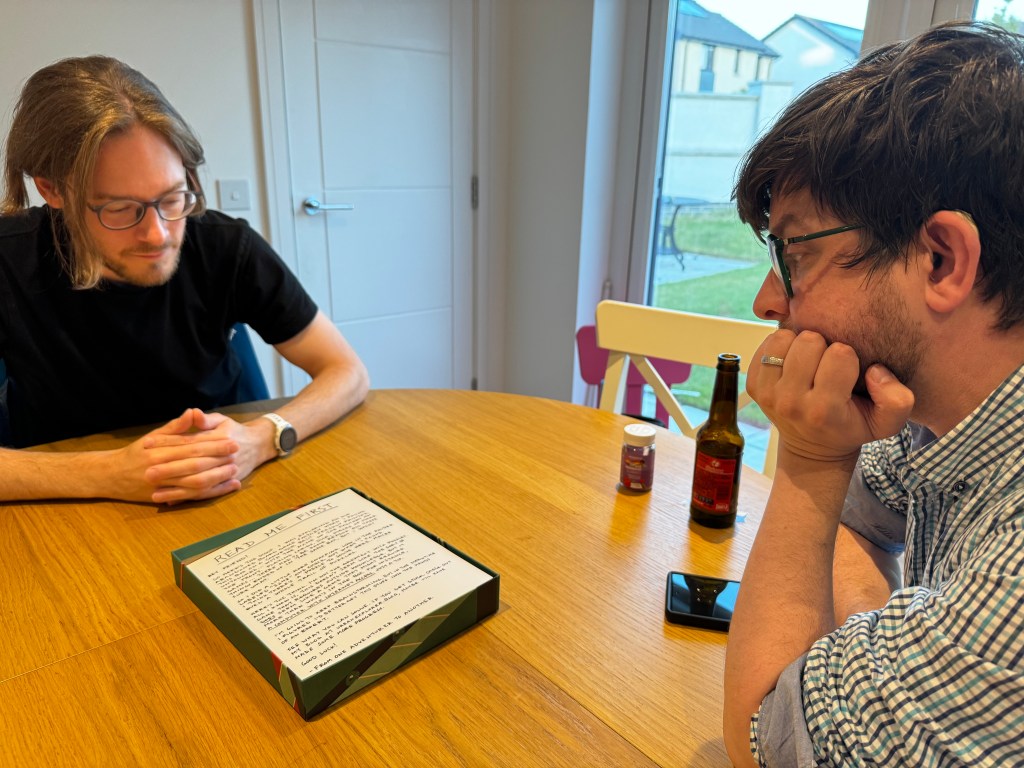
A letter sets the scene: you, an “expert”, have been sent a board game from an abandoned factory. It contains a jumble of game components and documents the sender believes is a juicy mystery to solve.
Among the documents is a factory maintenance log, which details how machine 3248 has seemingly developed sentience. A slip of paper with a Caesar cipher asks for help, directing you to call the factory’s phone number. When I called (using my precious Skype minutes hoarded for such emergencies, since I live in the UK), the message was… “This Google Voice number has been deactivated.” Oh well!
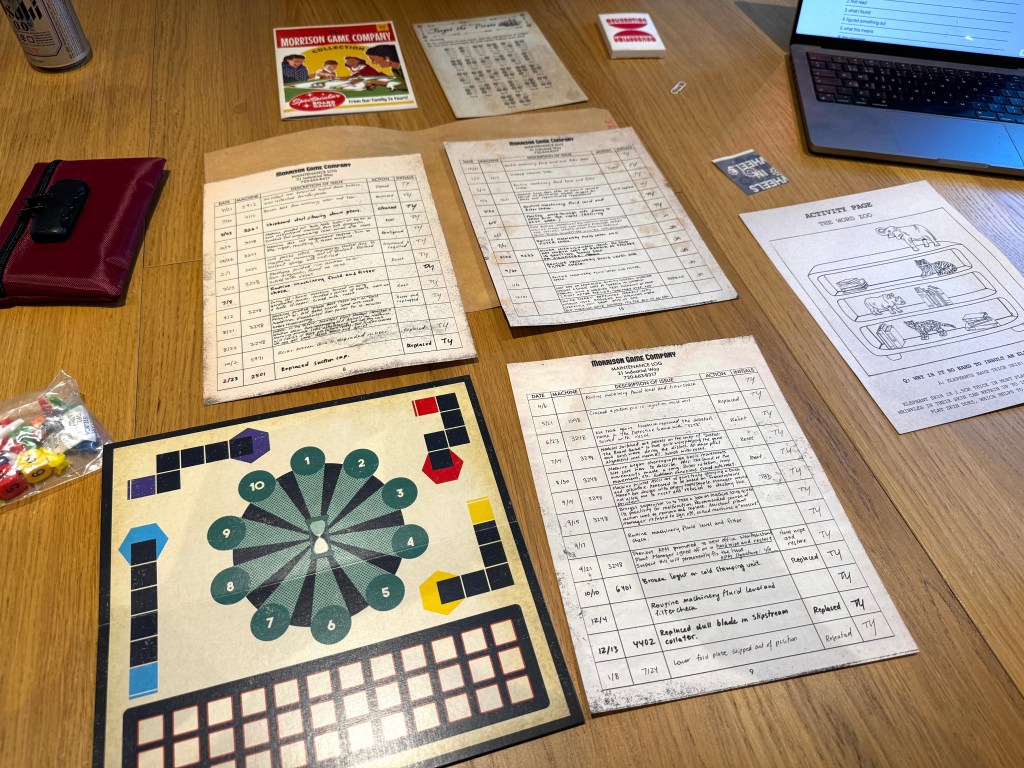
We went to the official hint website, which included a recording of the voicemail. This conveniently/bizarrely included a morse code message from machine 3248 spelling out a website address. The website would be our hub for the rest of the game, containing instructions on how to rescue 3248 from destruction by solving puzzles using the components in our box and entering the answers on the website.
There were also three text-based “Memories” from 3248, unlocked as we completed puzzles. The website was made in Twine, so these text-based diary entries had a characteristic “click to continue” interface to reveal paragraphs one by one. After a few minutes of reading, my friend Alex Macmillan exclaimed, “and this is Memory One?!” “Get a blog!” I cried.
While the story was too long for a group sitting around a laptop – nearly 5000 words in total – it was sweet, with real narrative propulsion. My main objection is that machine 3248 had a deeply inconsistent level of smarts. Sometimes they had a barely childlike understanding of the world, other times they’d know as much as any other adult.
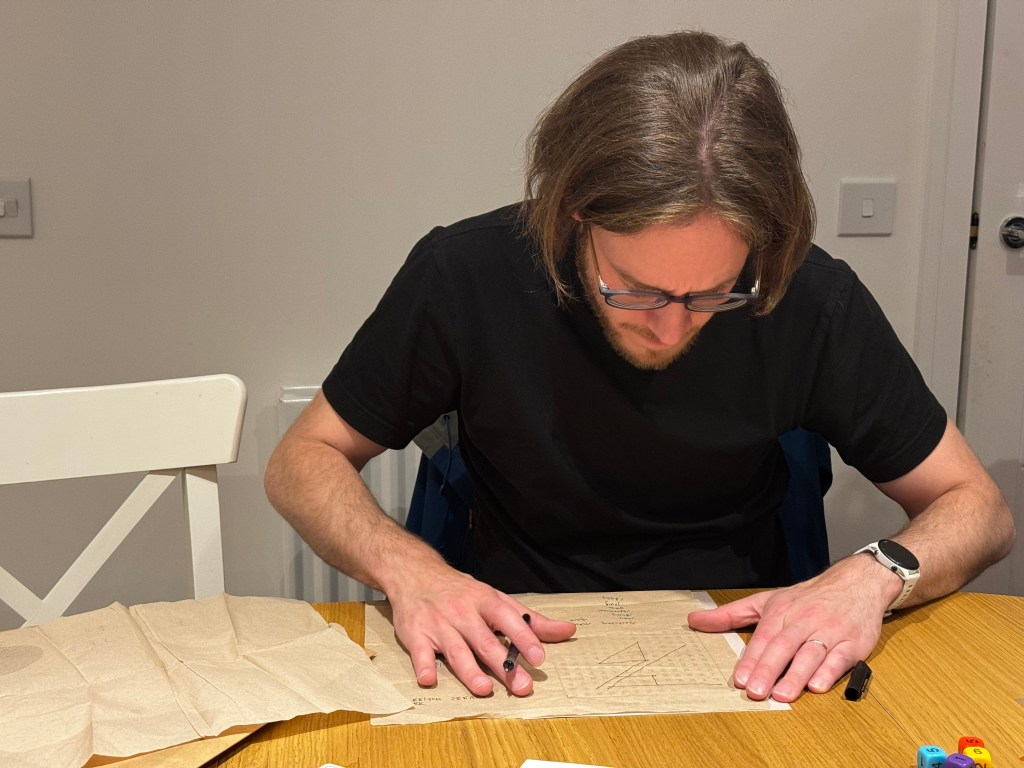
The puzzles were generally fun and imaginative, except for the final multi-part puzzle, which had so many overlapping codes and solutions we were more exhausted than exhilarated by the time we finished. Matt Wieteska noted it didn’t help that the answers were often in the form of codes and numbers – very much like the “combination lock” escape room cliche – rather than more human-readable or self-validating solutions one might get in deductive logic puzzles. Both Alex and Matt also felt the game didn’t “nail the dismount” with its underwhelming conclusion.
As game designers, playing The Morrison Game Factory was like a busman’s holiday: it was hard to stop judging its design. I imagine most players will be more positive, and I certainly can’t complain about the cost – $39 is a bargain given its excellent art and physical construction. But as a puzzle game and story, it was inconsistent. Much of it worked well and some of it literally didn’t.
I’m not entirely clear what in this game is meant to be “immersive”. I suppose the comparatively expansive story is meant to be narratively transporting in the same way that a good book can be considered immersive. Also, the fact it’s told over multiple media (brochures, letters, voicemail, websites) may contribute to a feeling of being surrounded by the world, as one does in immersive theatre.
I don’t find this particularly persuasive. When I read a book in a comfy chair at my own pace, I can feel immersed. Reading thousands of words from a laptop positioned so three people can see it at the same time is much less conducive to immersion. Worse, it’s antisocial, which is entirely the opposite effect you’re hoping for from a boardgame. There isn’t an easy answer to this, which may explain why “immersive” board games aren’t as popular as story-light puzzle games like the EXIT: The Game series.
Still – I appreciate the ambition and the experimentation, and I’m curious to see what they do next!

 mssv
mssv 