London, UK
£31-44
Punchdrunk
45 minutes
Viola’s Room is an immersive experience where visitors navigate through rooms and passages guided by audio narration and lights. The motto, “Follow the light,” is literal — illuminated tunnels and chains of ceiling lights indicate where to go.
Unlike Punchdrunk’s most famous productions like Sleep No More and The Drowned Man, Viola’s Room is entirely linear with no opportunities for audience members to choose their paths or explore freely. There are also no live performers; the story unfolds through narration, music, and the environment.
It’s not quite theatre, not quite installation art, and not quite a real world walking simulator. After decades of Sleep No More-style shows with hundreds of audience members and dozens of performers running around multiple floors for two hours, Viola’s Room is a major departure for Punchdrunk. That’s exciting – and risky.
So does it work? Not quite.

After arriving at Punchdrunk’s Prop Store bar, I was taken to a bare holding room and joined a table of five strangers. There were three other tables, indicating a maximum capacity of 24 people per 15 minute timeslot.
Some info sheets were on the table. A staffer briefed us on the same information again, stressing that we should “just follow the light”, with air quotes. She reminded us that there would be no actors; we should stick together as a group; not walk backwards as we’d bump into the next group; and stay put during any moments that were pitch black.

Next, we went to another bare room where we took off our socks and shoes and used sanitiser spray on our feet. Each of us received a pouch with a smartphone wired to Bowers and Wilkins headphones; we were to put our own phones in the same pouch during the experience. Another staffer used a tablet to activate our devices and play a test sound. In short, the pre-show was high touch but lacking in atmosphere. There was always someone to answer questions or help with headphones, but I felt like I could’ve been anywhere – a far cry from Disney’s elaborately themed queuing areas that set the scene.
We waited until a light above a door turned on, then trooped into an empty room with six chairs set around a hanging lightbulb. An audio narrator began running us through another set of instructions, the substance of which I’d mostly heard twice over by now. (Punchdrunk may be relieved to hear that many of the immersive experience creators I’ve spoken to are also struggling with making onboarding smoother.)
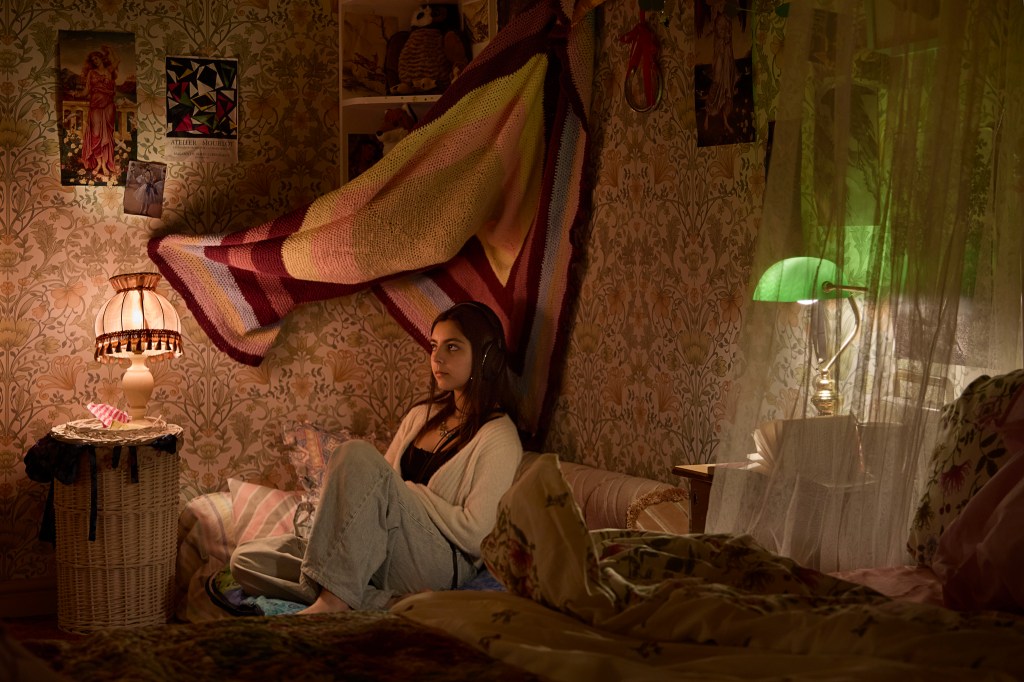
The actual experience began in a corridor leading to a brightly-lit teenage bedroom from the 2000s. We were instructed to lie on small beds while Helena Bonham Carter, in full ASMR mode, narrated a bedtime story. The room dimmed, then lights shone on posters and drawings on the wall in time with the story of Princess Viola: her parents died when she was young, leaving her to be unhappily wed to a prince.

When the narration ended, the only thing lit up in the room was a play tent in the corner. Someone gingerly stuck their head inside and discovered a hole in the wall to crawl through; this was not a surprise since a staffer had warned us to expect crawling.
We emerged into a passage constructed from what appeared to be white drapes hung from scaffolding. I felt a little deflated after the charm of the bedroom. At the end was a papercraft castle whose windows were adorned with lights and shadows, synchronised with Helena’s narration of the princess descending from the tower to the ballroom. The lights dimmed, more lights illuminated in the ceiling, and we headed to another diorama, and another. People began shifting around uneasily, looking for lights to appear so they could do anything other than watch a little show, even if it was artfully done.
On the plus side, the audio transitioned perfectly between “scenes” as we moved. I’m guessing it’s some combination of location-sensing (e.g. wifi and/or Bluetooth positioning) and plain old sleight of hand, given our linear progression was being watched on CCTV by backstage staff. When we entered larger spaces like a chapel, an abandoned dining room, and most memorably, a clearing with a gnarled tree, we’d hear soaring music and expensive needle drops.
There was no binaural or real time spatial audio, but I didn’t mind – that stuff is pretty gimmicky and hard to get right outside of video games and action movies. However, I did get distracted by tracks from Mission Impossible: Dead Reckoning; an odd choice given how recognisable its chord progression is.

There were some good ideas, like when the passages became a maze, the lights leading us in circles, or when we squeezed through tight corridors. But on the whole the set design was slight, lacking in detail and texture compared to previous Punchdrunk shows. There’s nothing wrong with a spare set if it’s intentional, but too much of it felt value-engineered.
And despite Helena Bonham Carter talking almost non-stop, the gothic horror(ish) story also felt thin. This is probably inevitable given it was heavily inspired by Barry Pain’s very short story The Moon-Slave (1901) with touches of The Archers’ film The Red Shoes (1948) and a pinch of 2000s coming of age. I didn’t hate it, but it never quite connected emotionally.
After 45 minutes, we ended in Viola’s bedroom once more. It had changed, but I hadn’t.
(If you’re curious, the r/punchdrunk spoilers thread has some good theories on the meaning of the story, though I don’t think it’s useful to treat it as a puzzle to be solved.)

Let’s start with the positives: I’m glad Punchdrunk is trying something different.
Last month, I went to a preview of Life and Trust, a show by Emursive, the co-producers of Sleep No More in New York. I was hopeful it might depart from the “chase performers around a building” formula, and the first ten minutes were promising, with two actors telling us a story of riches and ruin. My hopes were dashed when we were ushered into an empty hallway with stairs leading up and down. Everyone practically sprinted out to explore; I sighed deeply and prepared myself for two hours of wandering through late 19th and early 20th century sets.
Mounting what is effectively “Sleep No More 2” is a safe bet for an American audience that’s never seen Punchdrunk’s other shows, but what was astonishing to me seventeen years ago in the Masque of the Red Death is now tiring and predictable. Viola’s Room easily cleared that bar.
That said, I’m not sure it makes sense as a new format. Even if the sets and story were richer, I still wouldn’t enjoy trooping around them in a group of six. When you’re at the back, you’re peering over people’s shoulders and hustling to keep up while also trying not to bump into anyone. Being at the front isn’t much better: you get a better view but now you’re responsible for finding the way in the dark for a group of impatient strangers. The best experience would be to book an entire group of six just for yourself, but that’s much more expensive.
Of course, Punchdrunk’s bigger shows have far larger crowds, but the difference is that you can always choose to go somewhere else if confronted by a scrum. Viola’s Room’s linearity means you’re dependent on your fellow group members to figure out where to go next; it’s nothing more than a brief blip of frustration as you wait for them to notice a light to their side, and yet it’s there. This may seem like the pettiest and most antisocial of gripes, but I’m reminded of an observation in Worlds Unbound: The Art of teamLab, which claims teamLab’s immersive art exhibitions are enhanced by crowds because their digital art is designed to bloom in response to human activity – and so we loop back to Punchdrunk’s trademark masks, which, if nothing else, alleviates the nuisance of other people.
The overwhelming popularity of their ”mask shows” explains the lengths Punchdrunk have gone to tell the public that, no, there are no actors in this one, and yes, it’s completely linear. In other words, no-one can visit Viola’s Room and claim to be misled. Still, knowing that something will be missing doesn’t make the loss any less felt. “Following the light” is an elegant way to control audience movement, a kind of proto-AR, but it reinforced the on-rails nature of the experience. Not just on-rails, but on the clock, like a dark ride where you have no agency, not even to spend an extra thirty seconds in a room.
Logistically, Viola’s Room is designed like a dark ride. Every 2-3 minutes, a group of six is funnelled on a linear journey through queueing, loading, and “ride” areas. Some areas that groups spend more time in, like the first bedroom, appear to be duplicated (the first corridor has two doors). All of this makes sense from a business perspective – unlike a massive, actor-heavy show, Viola’s Room is much easier to build and staff up and operate in, say, disused malls around the world.
In fact, it’s not even the first production of its kind that Punchdrunk has done. It Felt Like a Kiss (2009) also saw groups embark on a linear journey through actor-less rooms accompanied by audio. As in Viola’s Room, groups would “revisit” rooms that had unsettlingly changed. That production, however, only lasted for a few weeks during the Manchester International Festival, whereas Viola’s Room is more permanent.
In its current configuration, Viola’s Room can admit 96 people per hour, an order of magnitude lower than the 2000-3000 per hour of Disney’s Pirates of the Caribbean and Remy’s Ratatouille Adventure. The comparison is not as ridiculous as it seems; Laura E. Hall tells me Disneyland’s Haunted Mansion (1969) was originally conceived, in part, as a walk-through attraction. Apparently its low capacity was one reason why the walk-through component was abandoned.
Could Viola’s Room be reconfigured as an actual dark ride? Earlier this year, I visited Cosquer Méditerranée, which hosts an exceptionally long 35 minute dark ride through a highly detailed reconstruction of the Cosquer Caves, complete with palaeolithic art. Most reconstructions are walk-through experiences but Cosquer’s trackless vehicles made the visit surprisingly intimate and powerful, with a capacity of over 300 visitors per hour (my estimate).
Sitting in a vehicle would eliminate every tactile sensation in Viola’s Room, making it a non-starter – but it would improve many other aspects of the experience and business. My point is not that Punchdrunk should buy a fleet of trackless dark ride vehicles, but to highlight the challenges of what they’re attempting in creating a continuous, linear, actor-less immersive experience.
I paid £37 for my ticket, which felt fair. However, I’m not running out into the streets telling everyone to see it, like I did with Masque of the Red Death and The Drowned Man. Attractions like Viola’s Room live and die based on word of mouth, and judging by social media, Reddit, and most importantly, the wide availability of tickets, I don’t think the excitement is there.
At the high end, it’s competing with The Nest in LA (my review), a more expensive but more powerful experience. At the low end, it’s up against $20 video games like What Remains of Edith Finch that feel richer and more interactive. And in London, it has a near-identical price to Bridge Command, a delightful starship bridge simulator with live actors.
Viola’s Room is a welcome departure for Punchdrunk – but it’s got a long way to go yet.

 mssv
mssv 