Las Vegas
$104-264
50 minutes
The Sphere is a music and entertainment venue with a 15,000m² “16K” screen, apparently the highest resolution in the world (more stats). Since opening last year it’s hosted bands like U2 and Phish, but it also shows an original Darren Aronofsky film called Postcard from Earth, which I caught last month.
When the hype around something reaches the heights of the Sphere (111m) it takes a lot to wow me. For much of Postcard from Earth, I was impressed but not awestruck – but there was one moment when I felt genuinely transported, to the point where I could barely believe my eyes.
It wasn’t when the audience was flying through the Grand Canyon or blasting through space. No, it was when we were inside.

On the way to the Sphere, my Uber driver asked why I was in town. “I’m researching a book,” I said. He proceeded to rattle off a list of every immersive experience he could think of, starting with Cirque du Soleil and ending with Dining in the Dark, something he admitted could probably be found in cities other than Las Vegas.
“But you’ll love the Sphere!” he said.
“It’s a big screen,” I agreed.
“Not just a big screen,” he countered.
“A really big screen,” I said.
I arrived in a traffic jam and lined up in the baking 40C sun for a few minutes before entering into blissful air conditioning. Postcard from Earth is available via a ticket for The Sphere Experience, which prepends an entirely superfluous 45 minutes in which you’re encouraged to talk to unconvincing AI robots and buy expensive food and drinks.
The very best “director’s seats” in the very centre of the seating can only be bought with a $264 VIP package. Despite having come to Las Vegas in part for the Sphere, I couldn’t quite swallow paying an extra $70 for a T-shirt and a beer, so my ticket put me just across the aisle from the elite.

To acclimatise the audience, the first few minutes of Postcard from Earth only lights up a small cinema-size section of the screen. As if in compensation, my seat started rumbling when a spaceship hurtled toward the surface of a barren planet, the first of several 4DX-style practical effects offered by the Sphere.
The two humans inside the slick CG spaceship are in hibernation. “It’s time to wake up, you need to go slow and steady,” says the narrator in a thinly-veiled address to the audience themselves. It’s at this point when the entire screen is activated: we see Earth against a dark background, growing from the cinema frame to the entire dome, then we smash cut to a view of real-world mountains. Cue delighted gasps and laughter.


Everything is calculated to mitigate motion sickness: we see the horizon line where it “should” be, the camera is in level flight, and wind blows towards us. A few nature scenes later and we start changing elevation, but only gently. We’re treated to more 4DX effects like scents, and classical music swells to intensify the spectacle.

The nature photography was a little boring so I turned my attention to technical issues. It was very hard, though not impossible, to see individual pixels or compression artefacts. What I was most impressed by was the lack of distortion at the extremities of the screen. Smaller screens tend to struggle with very wide angle views, but the giraffe necks extending upwards and monkeys scampering through tree canopies looked perfect.
The immersive illusion was aided by crisp surround sound aided by 3D audio beamforming, along with the requisite 4DX haptic thumping as elephants walked and horses galloped by. Still, I felt more transported and exhilarated by older rides like Disney’s Soarin’ or watching Avatar in 3D, both of which literally added more depth to the experience.

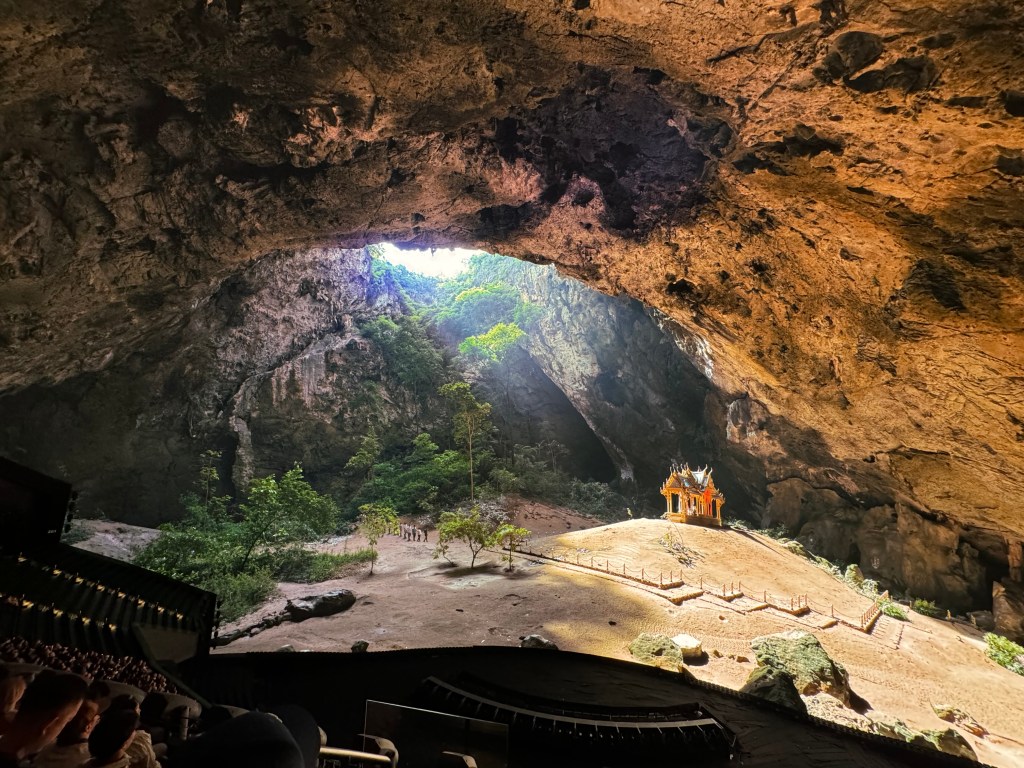
The one exception arrived when the film cut to the interior of a cave. Up until this point, every shot had been outdoors or underwater. They looked good but didn’t really showcase the Sphere’s strengths as a wraparound display, since it’s easier to fool depth perception with a clear blue sky versus a detailed interior. But gazing up at the walls and ceiling of the cave, I genuinely felt like I was there.
Frankly, if someone told me they’d had this experience at the Sphere, I’d have dismissed them as insufficiently discerning, no matter the size or resolution of the screen. And yet here we are: I was convinced.

Oliver Grau’s Virtual Art discusses how the epic Battle of Sedan panorama, painted in 1883, used the latest optical and physiological science by Hermann von Helmholtz to create the most convincing illusion possible. Supposedly the distance from the viewer to the painting – 12m – was partly based on Helmholtz’s observations that human stereopsis can only perceive object depth up to roughly that distance. Naturally, science has moved on since then, but the point is that there are limits to human vision.

I wasn’t able to find any hard figures for the Sphere, but my guess is that most viewers are 20m from the screen – quite a distance. Add in monocular cues of depth perception like motion parallax and lighting, and you get a startling level of presence, especially if viewers can’t move.

The two other interior shots I remember are a slow dolly shot down the aisle of a cathedral, and in an absolute flex, a theatre whose proscenium the Sphere literally engulfs. From a purely visual perspective, it wasn’t like VR, it was better than VR because the field of view was almost total and I didn’t have to wear anything on my head.
I’d happily spend hours longer in the Sphere, but only if I got to see more interiors. Interestingly, this is a historical inversion from 19th century panoramas, whose most popular subjects were overwhelmingly landscapes and battles.

Postcard from Earth is not a good film. It soon switches from languorous nature shots to frantic sped-up montages and collages, as if the enormity of the screen were not enough to sustain the audience’s attention – or perhaps they just ran out of money. Worse, the story is garbage, a weird fable about humanity’s spread across the universe via terraformation. Nevertheless, everyone clapped.
I can’t be the first person to note the absurdity of debuting a film about humanity destroying the Earth in Las Vegas, of all places. Worse, when I visited, the Sphere’s pedestrian bridge to the Venetian Resort was closed, so visitors were instructed to drive there. I had to walk outside for 15 minutes in 40C heat (104F) to reach my next immersive venue, the Grand Canal Shoppes:

Las Vegas’ combination of climate disaster and themed/immersive indoor environments feels distressingly prophetic. The other immersive experiences I had there were individually impressive – Meow Wolf’s Omega Mart, Particle Ink: House of Shattered Prisms, even ARTE’s Las Vegas teamLab ripoff – but the effect of being shuttled from one dark structure to another in airtight taxi pods left me queasy.
I’m still struck by how the Sphere, for me, is best at rendering interiors. The very first panorama in the world, the one that coined the term, was painted a mere fifteen minutes walk from where I write, at Edinburgh’s Calton Hill in 1787. Over the next century, panoramas spawned all manner of visual experiments and entertainments, and Walter Benjamin would later describe the genre of panoramic literature, characterised by detailed examinations of every strata of urban life:
Contemporary with the panoramas is a panoramic literature … They consist of individual sketches, whose anecdotal form corresponds to the panoramas’ plastically arranged foreground, and whose informational base corresponds to their painted background. This literature is also socially panoramic. For the last time, the worker appears, isolated from his class,, as part of the setting in an idyll.
Announcing an upheaval in the relation of art to technology, panoramas are at the same time an expression of a new attitude toward life. The city dweller, whose political supremacy over the provinces is attested many times in the course of the century, attempts to bring the countryside into town. In panoramas, the city opens out, becoming landscape – as it will do later, in subtler fashion,, for the flaneurs.
Panoramic art looked at landscapes with an expansive, acquisitive eye. Our century’s immersive experiences often feel like an inversion: inward rather than outward, closed rather than open, controlled rather than chaotic, individualist rather than communal. Of course, many immersive experiences are open and unpredictable and social – more so than traditional cinema and theatre and art galleries, at least – but the question is what they replace as a whole.
Given panoramas’ use as propaganda for war and colonialism, I don’t want to valorise the past or the present. It’s not hard to imagine incredible uses for the Sphere’s technology. But like the places it best simulates, the Sphere’s ultimate service may be as a refuge from the heat of the world.

 mssv
mssv 