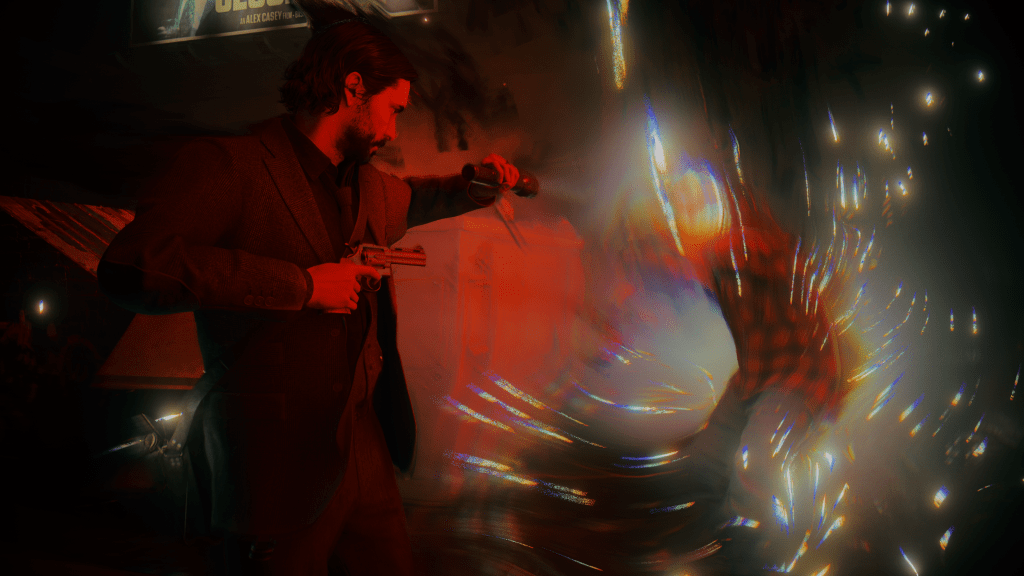
This is my first post for my Have You Played games newsletter that’s appearing directly on my blog! Everyone who subscribed to my old Substack should have received this via email but let me know if you’ve had any problems.
Playstation, Xbox, PC
$47.99-$59.99
Remedy Entertainment
18 hours long
Alan Wake 2 is a survival horror action game where you solve a metafictional mystery in which novelist Alan Wake is trapped in an alternate dimension. You play as two characters: Alan and FBI agent Saga Anderson. Both roam large environments collecting clues to organise in 3D mind palaces while battling shadowy enemies.
I did not finish this game! I only got five hours in, barely a third of the way through, so feel free to dismiss this as the bitter ramblings of someone with skill issue. But if you’re curious why I abandoned a game I genuinely hoped to enjoy, this is for you.
Before I started, a friend advised me to:
- Read a story recap for the first game and expansions
- Play on the easiest “Story” mode
- Ignore all sidequests
So you could say I was playing under the best possible circumstances. And the start was strong!
We begin with a cutscene of Alan talking about horror stories. Metafiction! This is not a cutscene but a video featuring actors. The camera pulls up from the surface of a glassy lake, and a naked man scrambles out.
I control the man as he stumbles toward the shore into gloom. A deer leaps out, then the entire screen flashes to a video of someone who looks like Alan screaming – a double jump scare, the first of many. A shadowy ghost appears and Alan screams a bit more. A cutscene reveals the shadows as masked cultists who drag me onto a table and kill me. They’re interrupted by a woman and run off, but I’m still dead. The camera pulls up to a wide view of the lake, and massive titles appear: “ALAN WAKE II”. Very stylish.
Also stylish: an Atlanta-ish aerial tracking shot of a car winding through a forest. Agent Saga has an unconvincing phone call with her daughter Logan; it occurs to me that, like so many things that are bad in this game, maybe it’s bad on purpose. Alan Wake is meant to be a hacky writer, right? This does not strike me as a good excuse.

Saga and her partner, Agent Alex Casey, arrive at Cauldron Lake to investigate the most recent of a series of ritualistic murders, which the player was just a victim of. A high-level checklist of objectives appears, which includes checking out a map of the area, a pleasingly skeuomorphic poster with an exceptional level of detail. We meet a cop with an overdone accent, and the game’s minimalist UI superimposes dialogue options next to his face, with important questions are displayed in larger text. This looks cool but isn’t always easy to read.
The crime scene is at the end of a winding path. Classic detective gameplay ensues: I walk around and press buttons on highlighted things (wounds, footprints, etc.) to collect clues. These clues are instantly captured by Saga as “mind polaroids” (my term) to be arranged on the murder board in her “Mind Place” (their term).

As in countless detective shows and movies, Alan Wake 2’s murder board is where you organise evidence to better understand a case. Specifically, you assign Clues to the correct Question, unlocking new Questions and Deductions.
This is not optional. If you don’t put the Clues in the right place, you can’t progress, even if you already know the answer. This may be why you can’t assign Clues to the wrong Question and why some Clues have a sticker that says “For Later” if the board, for whatever reason, doesn’t have the relevant Question on it yet.
As a result, the murder board ends up feeling both ahead of and behind your own knowledge. When you start a new investigation, Questions are splayed comically far away from each other, almost as if the board already knows how much space it’ll need for sub-Questions and Clues. At other times, the game will insist you deduce where a suspect is by assigning Clues to the right Question, despite multiple people already having told you the answer in dialogue.

The best way to describe the murder board is “intrusive”. Chatting with witnesses? New Clues materialise at the bottom of the screen. Collect an object? New Clue. Notice lots of footprints? Saga will remark, “multiple people were here… multiple killers?” and a new Deduction will unlock. All these Clues will need to be arranged on the board before you can continue.
And for what? Murder boards aren’t a coherent system, they’re just a visual style we’ve seen from TV. Driving a car is a coherent system that games can simulate to varying levels of approximation. So is shooting a pistol. But how do murder boards work in real life? You use red string to link related things together – and then what? Nothing! They’re a way of organising information and formulating hypotheses, not verifying deductions.
Other than “it looks cool”, I can think of two reasons why the murder board is such a big part of this game:
- It gives players something to do and makes them feel like a real detective.
- It’s narrative signposting to confirm players know what’s going on.
The first doesn’t trust that the rest of the game is sufficiently engaging. The second doesn’t trust that players will understand the story, so the designers make players take a test.
It’s tragic. Alan Wake 2 is deliberately modelled on TV. It has genuinely engaging and well-directed cutscenes. The dialogue may belabour the plot, but that only reinforces players’ knowledge. What a waste!

As much as I disliked Saga’s murder board, I was charmed by her Mind Place, which looks like a cosy office cabin. There’s pamphlets for upgrading your weapons, a TV to rewatch videos you’ve seen in the game, a wall with maps you’ve collected, and more. It’s Magic Cap’s hyper-skeuomorphic interface but in 3D.
Games usually don’t do this because it takes time to load new 3D worlds. Now that consoles have fast SSDs, those 3D assets can be summoned instantly, which is how Spider-Man 2 lets you zip across Manhattan and flip between realities without a loading screen in sight. It’s a neat idea and I hope more games explore it.
Back in the real world, Casey says he’s letting Saga take the lead in the investigation. “You aren’t going to retire, are you?” she replies. “We all know what happens when detectives say they’re going to retire.” So much of Alan Wake 2 is like this, a precocious kid showing off their reading assignment on horror movies.
Since the game won’t let me move on from the crime scene, I look for more clues and stumble across a box with a combination lock. The box has a note saying I should wash my hands, get a chicken out of the fridge, and have a nap. Inside the nearby trailer, symbols are painted next to the sink, fridge, and bed. Sure, that makes sense! (but maybe that’s the point!!!).
I collect flashlight batteries and ammo, but no clues. I resort to the game’s checklist, which suggests I talk to someone. It turns out that I just needed to speak to the police officer to move things along, and I hadn’t noticed a new dialogue option was available because it only appears when you get close to them. This is where ultra-minimalist UI becomes a hindrance.
After Casey and the police officer tell me the victim is former FBI agent Robert Nightingale, it seems redundant to pin polaroids on the murder board for the question, “The victim?” and have Saga deduce it’s Robert Nightingale – and yet that is what I do. What a delight!
A cutscene explains how Saga can “Profile” subjects and discover new Clues by using her “intuition”. When I profile Nightingale, a video of him flickers on the screen. Saga learns he was killed in a ritual murder, and that he emerged from the lake. This is annoying since it is quite obvious from the crime scene evidence that it was a ritual. To celebrate, I waste time in the Mind Place arranging Clues.
Tracing Nightingale’s footprints back to the lake, I come across a typewritten manuscript page describing Saga’s very actions at that moment, written by Alan Wake. Spooky! The more manuscript fragments I find, the more I can upgrade my gun skills.

We visit the town of Bright Falls via another driving cutscene to perform an autopsy on Nightingale’s body. It’s a marvellously detailed town that really shows off what a million dollars of 4K HDR art looks like. There isn’t much to do, however, except to wander to the diner and talk to witnesses who saw Nightingale just before he died. I profile them, but this time it’s more like reading their minds, which is absurd (but maybe that’s the point!!!).
On the way to the morgue, I pass a TV in the police station showing a video advert which I know to be in Twin Peaks style even though I have not seen Twin Peaks. Everything in Bright Falls is Twin Peaks – the witnesses in the diner were eating cherry pie, for example.
My grumbling pauses as Saga performs an autopsy on Nightingale in a well-directed cutscene. “Interesting angles,” I murmur. Apparently a cult is performing rituals to create monsters. I find a manuscript page in the body. When the Sheriff recognises it and shows me a box with more pages, he vanishes and Nightingale’s corpse wakes up and throws me across the room. I stay in the light where he can’t approach, then run over to my pistol and shoot him, whereupon he escapes.
“END OF CHAPTER”. “Very stylish and meta,” I murmur. A song plays, its lyrics about falling down a rabbit hole, staying in the light, tearing every page apart, and other plot points from the past hour. I frown.
When the song ends, I have to look for Clues about where Nightingale is, even though he’s obviously gone back to the only other place we’ve seen so far: Cauldron Lake. I muck about in the Mind Place some more until the game silently decides to let me tell Casey, “Let’s go to Cauldron Lake.” It’s dreadful.
I collect painkillers, first aids, ammo, and batteries, and head to the lake to track down Nightingale. Countless jump scares ensue, of the traditional diegetic kind and the “smash cuts to Alan’s screaming face” kind. I decide to enable a setting that tones down smash cuts’ volume and brightness, making them about 20% less annoying.
As the forest by the lake darkens, the shadow enemies multiply. I have to use a special Flashlight Boost (a bright pulse of light that drains the battery) to render them corporeal, then shoot in the head. In between combat, I profile Nightingale again. This feels unwise since the game previously explained that going to the Mind Place does not pause the game (but maybe that’s the point!!!).
The chapter ends with an unpleasant fight with Nightingale that goes on forever. He has no health bar; instead I have to Flashlight Boost and shotgun him over and over again. It is easily the worst combat I played in a long while. Skill issue? Maybe! But I have played and enjoyed Elden Ring.
Alan Wake crawls out of the lake, then another song plays. I workshop alternative overly-literal lyrics – “I just killed a monster, yo I’ve got much to ponder” – then I feel bad and wish more games tried weird things.

The next chapter sees you playing as Alan Wake. In an extended video cutscene, a disoriented Alan appears on a late night talk show featuring David Harewood as the host. It’s very fun and Harewood is glorious as he swims in the river of ham, though he says a variation of, “Are we all in your story, Alan?” about a hundred times.
After I try to escape from the studio, I’m introduced to Alan’s version of Saga’s Mind Place: his Writer’s Room (OK, I laughed). Here, he can rewrite his dream reality by moving character and plot cards on a plot board. I place the actor for Alex Casey into the show, which does the trick. Later plot board “puzzles” involve the same level of complexity, i.e. putting one card on top of another card.

A special lamp from the TV studio basement lets me jump between different realities by capturing and transferring bright lights within the world. It’s another impressive SSD-powered trick though in practice, “different reality” means “the corridor is now unblocked” and all you’re doing is turning one light off and another one on. Lamp-based puzzles are mostly about navigation, and unfortunately I found the world Alan emerges to – a darker version of New York – deeply confusing to walk around.
I have never gotten lost in video games more than in Alan Wake 2 and the developer’s previous game, Control. Their UI minimalism is a problem – no minimap, compass, or on-screen waypoints – though there is a map, and it even shows your direction.

So why is it so hard to get around? Partly, its 2D maps are next to useless at depicting staircases, tunnels, and bridges, but it’s more that the game’s dimly-lit corridors are impossible to tell from one another. Many spaces seem pointless, filled with endless metafictional posters and graffiti, padding for the sake of “realism” that only results in endless backtracking.
Say it with me again: but maybe that’s the point!!! You can scare players by literally disorienting them. But as demonstrated by The Exit 8, a compact horror game about liminal and repetitive spaces, you don’t need to make players bored and frustrated in the process. Eventually, I consult a walkthrough, which saves a lot of time.

It’s in Alan’s dream New York that I start dreading this game. It has the same shadows I previously battled as Saga, but where she only encountered them occasionally, Alan is up against an infestation.
Shadows don’t come out of nowhere. You can see them from a decent distance and they usually don’t creep up behind you. The issue is that it’s impossible to know whether they’re hostile or not until they’re right on top of you. If they are hostile, they’ll fling you about, making it hard to aim your Flashlight Boost at them. But since you have limited batteries, you can’t afford to attack every shadows you see – you just have to wait until they dash for you. Apparently if you turn off your flashlight, shadows won’t notice you. The first time I tried this, they immediately attacked, perhaps because my special lamp was “carrying” light.
The combination of surprise and close-quarters shooting made combat uniquely unpleasant for me. I’m sure some like it and others tolerate it, but I rarely play combat-heavy games that don’t let me experiment with other tactics like ranged weapons or opportunities for cheesing.
So I gave up. Not even the prospect of fancy set pieces and more David Harewood was enough.

So much of my unhappiness with Alan Wake 2 is connected to genre expectations, both of its story and its gameplay. While the game is correctly described as survival horror on Wikipedia, the official website and Playstation listing lead with its story. I’m not saying they’re misleading – Alan Wake 2 is a story-led game – but when I play a story-led game and choose “Story” difficulty, I’m expecting something that will be fairly easy to play, because that’s what I’ve experienced in countless other games, whether that’s God of War or Spider-Man or Grand Theft Auto.
GK Chesterton supposedly wrote, “Most [book] reviews say, in effect, ‘this is a very fine plum pudding but there is no taste of salmon’.” So, am I the one who’s at fault for expecting something the designers didn’t intend to make? No, it’s the designers who are wrong. In Larp Design: Creating Role-play Experiences, Evan Torner writes about how genre sets players’ expectations:
Period historical dramas promise social relations that resemble representations of the time period that players are accustomed to consuming. Players will expect the revelation of secrets and plotlines akin to the novels and dramas set in the period with which they are familiar. If you include a cyborg alien among the possible characters, the larp’s genre dissolves. Of course designers can and do experiment with this horizon of expectations regarding genre, but only thanks to their players’ generosity and patience. Players naturally want to play the larp well, and random cyborg aliens might very well upend their efforts.
I welcome designers experimenting with genre; one of my best friends is metafiction. But Alan Wake 2’s broken murder boards, one-note combat, useless maps, and endless jump scares tested my patience to the breaking point. So many people have told me they only made it to the end of the game by gritting their teeth through these things.
Why did I start Alan Wake 2 in the first place? The same reason my arty writer friends probably did – I wanted to play a smart, grown-up, big budget game inspired by The X-Files, Twin Peaks, and Stephen King.
On the face of it, I got what I wanted: mature themes, solid acting, excellent production quality, and a refreshingly different vibe to the average fantasy or superhero game. But it came with so many things I didn’t want, and in the end, the story wasn’t there, either.

Even after five hours and plenty of cutscenes, I couldn’t tell you what Alan Wake 2 is about. It’s so self-referential, there’s a void at its heart. Maybe the story gets better by the end, but I’m too old for that shit. Contrast this with Late Night with the Devil, a modestly budgeted horror movie presented as a banned episode of a 70s late night talk show. It’s not the greatest movie I’ve seen, but it is undoubtedly about something.
It’s telling that Alan Wake 2’s problems are exactly the same as Control’s. Clearly the designers were more interested in making a game the way they wanted to than listening to criticism. I can’t begrudge them that. Artistic independence is a unique pleasure, especially if someone else is willing to take the financial hit.
Still, so many things in Alan Wake 2’s design betray a lack of confidence, or at least, a misunderstanding of the genre. I cannot fathom why there are so many jump scares in this game; we all know Alan is going insane and it’s scary, nothing would be lost without them. And of course, there’s the murder board, a mechanic that deserves to be put to permanent rest.
Since big games with photorealistic graphics are so expensive to make, Alan Wake 2 has precisely zero competition. Investors think there’s more profit to be had in other kinds of games, and they probably aren’t wrong. So this is the only game in town, and if you’re more generous and patient than me (not hard), you too can overcome its flaws.
And if you aren’t? You’ll have to get your weirdo horror kicks from indie games. We don’t expect blockbuster movies to be as interesting as indie movies, and the same is true of games. MyHouse.WAD, World of Horror, Devotion, and The Exit 8’s near-photorealism shows what’s possible. We’re getting there.


 mssv
mssv 