
Xbox, PlayStation, PC
$24.99 (free on Xbox Game Pass)
6 hours long
In Jusant, you climb a massive stone tower one handhold at a time. With a trigger button assigned to each hand grip and a stamina gauge steadily ticking down, movement is tense and deliberate. Traditional ropes and pitons are joined by novel mechanics, some of which work well (rock creatures that you hold on to as they move) and some which don’t (fireflies that float you through the air).
It’s beautiful. With the exception of some oppressive caves, every vista is sculpted for maximum awe, thanks in part to the game’s sci-fi/fantasy setting. The designers’ imagination only goes so far though, with the story and iconography following the same arid environmental and technological collapse fable we’ve seen in so many other recent games.
But let’s start with the climbing. In most action adventure games like Uncharted or Assassin’s Creed, you press a “climb” button and point in the direction you want to go. This prioritises speed, with the game automatically moving your character’s hands and feet, but lacks depth and challenge.

In Jusant, your hands can only move to specific handholds on a cliff face or ceiling like a protruding rock or a ladder rung. You must always have one hand gripping a handhold, performed by holding down the left or right trigger, otherwise you’ll fall. This means that when you’re climbing, you’re constantly alternating between holding one or both triggers (no legs required in Jusant). Let go of one trigger and that hand can stretch towards another nearby handhold by pointing your left stick; hold the trigger again and it’ll grip onto it. Swap arms on a hold and you can get a better reach.
You have to pay close attention to your character’s body. It’s hard to tell whether you can make it to a handhold or your jump will end in disaster – there are no icons or colours indicating the chance of success, you just have to try it and see what happens.
This makes climbing into an intensely physical process. During long climbs, your trigger fingers will get a little sore, echoing the sighs and gasps from your character as their stamina slowly drains (or quickly, after jumps). You can recharge stamina by pausing to shake your arms out, but the gauge’s maximum capacity also shrinks during climbs and is only fully refreshed on the ground or at certain rest points. By the end of difficult climbs, your stamina is so limited you can only move short distances between pauses and it’s a mental and physical relief to stop tensing. But for the most part there is little time pressure or even action other than perhaps timing a jump-and-hold well.
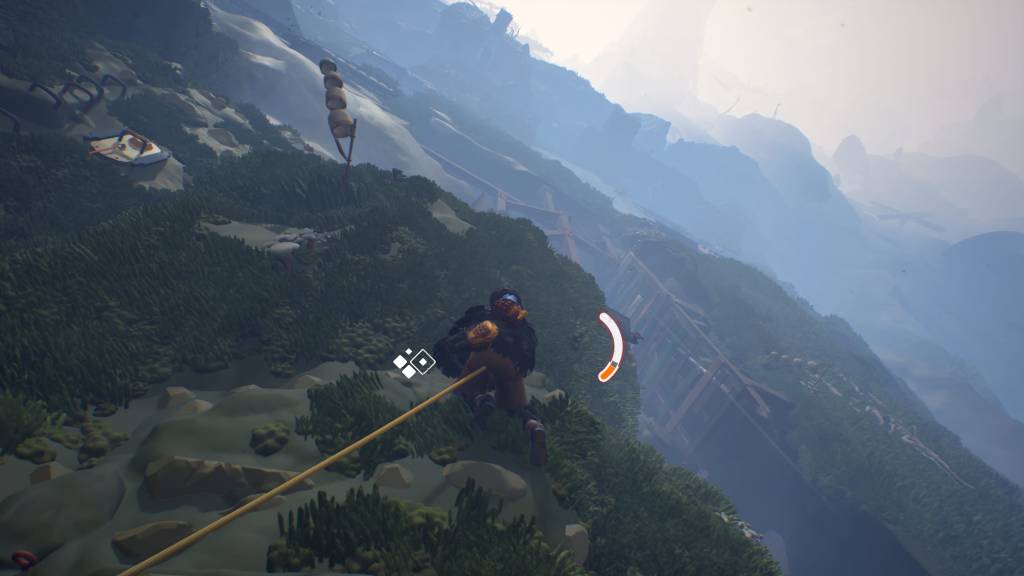
Every climb takes place on a specific route and begins by attaching your rope to a socket conveniently located nearby. This struck me as rather contrived until I realised the former inhabitants of the tower built all the routes you follow; in other words, it’s worldbuilding, not laziness. During climbs, you can place up to three pitons. These act as ingenious physics-based save points because if you fall, you’ll only drop as far as your last piton. Since you don’t have any health to lose and there are no surprises where handholds break or ladders shatter, it’s a very fair and forgiving game overall.
Pitons are also used as solutions to climbing problems. When you find yourself in a spot where you can’t climb or jump to the next part of the route, you hammer in a piton, rappel down, and swing sideways to a handhold. This kind of thing is the platonic ideal of physics-based puzzling, even if Jusant’s control of swinging in free space doesn’t always work.
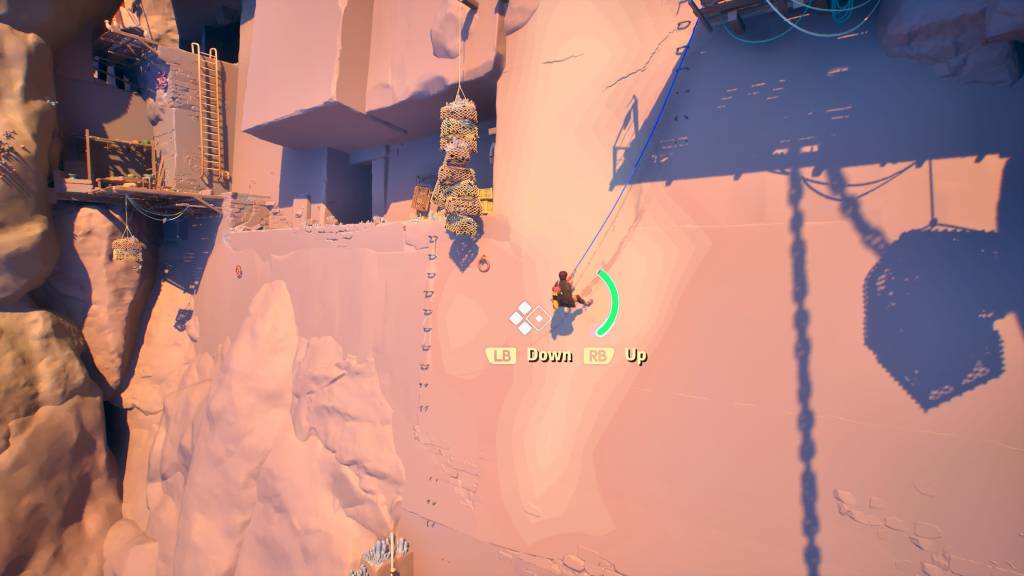
Your rope only extends so far, presumably to make players be a little careful in how they place pitons. Cleverly, it changes from blue to red as it runs out, though that never happened except on one infuriating occasion which I will recount in due course. On completing a climb, you rapidly wind your rope back into your bag and regain any pitons you placed.
While the game is essentially linear – there are no story-based decisions to make – there are occasional side rooms and ledges to visit that prevent you from feeling railroaded. Most climbing routes feature shortcuts or alternate routes, some of which are faster but riskier.
Pleasingly, there’s barely any recognition of which path you take – no timers, flags, scores, and certainly no achievements. Even more remarkably, Jusant has no progression mechanics whatsoever. Your rope doesn’t get any longer as the game proceeds, you don’t get any more pitons, and your stamina doesn’t improve. What changes is the nature and difficulty of the climbs, and your own skill.

(Jusant doesn’t have difficulty settings, but there are accessibility options for unlimited stamina, jump assistance, alternate rappel mode, and more.)
So: not only does climbing in Jusant fundamentally make sense, but it’s fun. It’s a feat worthy of praise when so many games continue to rely on shooting or hitting as their main way to interact with the world.
That said, there are rough edges. The game stumbled early on when it failed to tell me how to do a double jump until I’d failed twenty times. A more serious problem came during a tricky climb where I placed all three pitons such that I ran out of rope a mere metre away from my destination. The game “helpfully” told me I should figure out a way of freeing up more rope by detaching a piton. I didn’t relish backtracking, especially with my stamina gauge as low as it could get, so I restarted at the last checkpoint (there’s no save system), assuming this would be where I began my climb.

Reader: it was not. I had to repeat multiple climbs, murderous thoughts drifting through my mind about how I was being punished for doing the things (placing pitons) I’d been taught to do earlier. Not long afterwards, I was on another long climb, completely piton-free what with the trauma still fresh, when the game suggested I place a secondary piton in case I fall. I learned it from you, Jusant!!!
Like a lot of games with novel but simple mechanics that might otherwise be perceived as being “too easy” or “too boring” by people who have nothing else to do than play games all the time, Jusant adds increasingly weird and contrived challenges every chapter. Early on, you encounter huge vines studded with handholds that lengthen when activated by your mysterious animal companion. Another plant creates handholds over a wide area that wilt and die after a few seconds in the sun, introducing time pressure to climb across them and place a piton. In keeping with the game’s generally forgiving nature, plants can be activated unlimited times.
One variation I enjoyed were moving rock handholds borne on the backs of little cliff-dwellers, groups of which would trundle across otherwise-impassable routes in intersecting and diverging streams. If you hold onto one rock creature for too long, it eventually slows down and stops (tang ping exists everywhere) so you need to keep swapping between them. Fun and cute!
Higher up the tower, wind becomes a way to make your jumps go further. Since it keeps changing direction, you have to time your jumps right. If you’re caught out in the wind, your stamina drops fast, encouraging you to hide behind shelters like moving waterwheels. Again, it works because everyone knows what wind is.
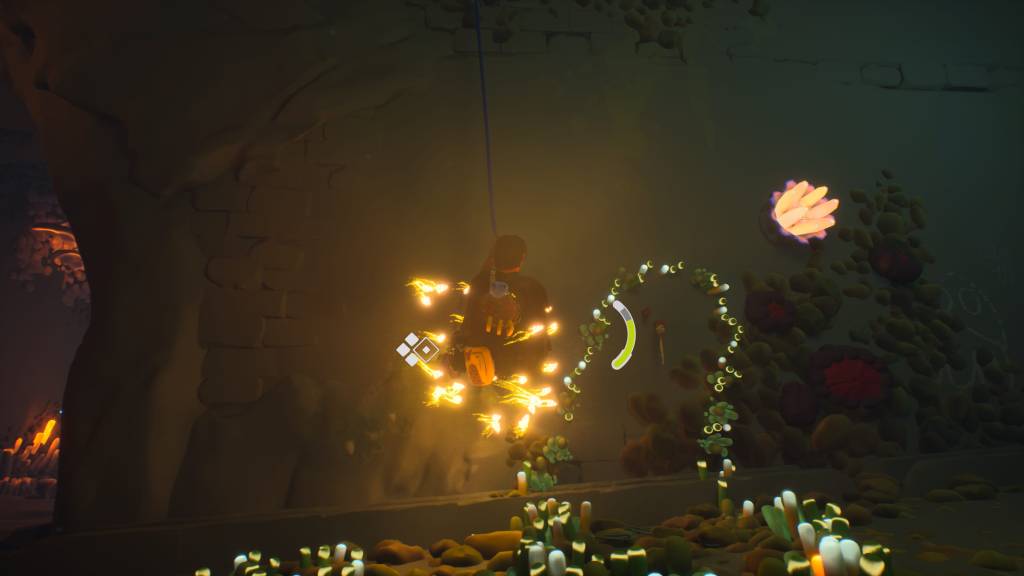
Less good: firefly “sparks” in caverns that surround and loft you between highly specific locations on cliffs. Send this one back to the drawing board, lads.
The caverns highlight another of Jusant’s weaknesses, in that its complex geometry and layered environments can make it hard to know where you’re meant to go next. The game’s lack of traditional user interface elements also meant I wasted a lot of time trying to climb around impassable barriers. It turns out that if you eschew maps and objective markers and glowing breadcrumb trails in favour of immersion, your environmental design needs to be absolutely bulletproof. Your companion creature can tell you the direction of interesting things, but since these are usually behind lots of walls, it’s next to useless.
All that said, I’m not sure I’d have preferred a map showing a list of places for me to visit. It was refreshing to wander along, occasionally pausing to read letters and place a stone on altars, no doubt missing a few, but safe in the knowledge the game would ensure I saw the really important stuff.

I was very excited for the thirty minutes during which I thought Jusant had zero dialogue or writing. The game starts with a wordless cutscene where your character trudges through a dried-up seabed littered with rusting ships, eventually reaching an impossibly broad and tall pillar of rock. Nestled inside their bag is a small blue creature whom you have undoubtedly already guessed will be the key to restoring environmental balance to this desiccated world.
The tower is deserted, with only a few harmless animals around. Signs of the inhabitants are everywhere, though; not just ladders and shacks but entire villages and ziplines and cavern complexes. As you ascend, the technology and buildings and crafts become more complex and sophisticated – there are even burger joints in later chapters – communities built and abandoned as the sea levels rose and fell.
You’re given fleeting glimpses of their past lives by listening to conch shells. Pick one up in a workshop on a cliff face and you’ll hear the chiselling of wall carvings, the laughter of children jumping from a diving board into water. There’s no animation, just sound more evocative than any cutscene could be – and much cheaper, to boot.
That’s why it was so disappointing when I came across my first letter:

No actual human writes like this. This is exposition 101, as clunky as it gets, and worse, completely unnecessary. You don’t need a letter to realise the tower’s inhabitants loved their home or to figure out they left because of a drought. If you must have words in a game like this, keep them to a minimum, like the shop sign that said something like “closed until the sun starts moving.” That’s neat!
Of course, you are here to sort everything out. At the end of each chapter, you place a blue conch shell into a sculpture. When you blow in it – and your companion hums along – ancient technology activates, with plants magically sprouting forth from the bare stone, glowing blue symbols telling the story of what happened.

I sighed when I saw this, and not in a good way. I am tired of the Atlantean trope, where an ancient civilisation possessed incredible technology that was their downfall but could be our saviour. Deployed in countless games, typically with vaguely Arabic or Mesoamerican art, it’s meant as a cautionary tale of hubris and greed, but to me it comes across as simultaneously reactionary and blasé; hey, we might destroy the world, but at least someone in the future might fix it – using our amazing technology!
It is OK to care about environmental collapse, and it is understandable that artists will put that into their art, but doing this well is not easy and can end up compromising both the art and the message. The story works far better when it moves closer towards Journey’s magical realism and you reach the pinnacle to find a huge blue sphere floating above. Yes, it’s made of water, and your blue companion helps make it rain. It’s nice!
Jusant’s narrative missteps weren’t enough to dent my enjoyment, though. Even if its story is literally overwritten, it’s still a beautiful, meditative marvel.


 mssv
mssv 